How the LinkedIn Algorithm Works in 2026 (+ Growth Tactics)
Learn how the LinkedIn algorithm works in 2026 and discover proven tactics to boost reach, engagement, authority and thought leadership in your niche.

LinkedIn’s algorithm has changed again.
You may have felt it firsthand.
The type of posts that traditionally used to perform aren’t quite taking off. On the flip side, content that you thought would do little reaches a wider audience.
And you are not alone.
Founders and creators on LinkedIn who want to gain more followers and generate qualified leads need to understand what changed.
This article explains the nuances of the current LinkedIn algorithm and provides you with actionable tips you can implement today to grow on the platform.
Key Takeaways
- The algorithm rewards originality and niche consistency. LinkedIn actively suppresses baiting phrases, engagement-farming and generic content.
- Pick 3–4 topics and stay in that lane. Consistent, on-niche posting signals expertise; jumping between random topics confuses the algorithm about what you’re known for.
- Write for saves. Evergreen, in-depth content, like frameworks, breakdowns, contrarian takes backed by data, fall in this category.
- Engagement authenticity cuts both ways. Your comments on others’ posts should be 2–3 thoughtful sentences that add something new; AI-flavored or mass-commenter engagement on your own posts can actually hurt you.
- Skip the outdated playbook. Hashtags, polls, emojis and “link in first comment” don’t work anymore.
- Post from your personal profile, keep it aligned with your bio and put links wherever they naturally fit.
How Does the LinkedIn Algorithm Work in 2026
LinkedIn’s algorithm changed recently in how it scores and ranks content. The platform analyzes your profile-to-post alignment, past account activity, content quality and nature of engagement to determine whether your message gets a wider reach.
LinkedIn’s algorithm does that in three steps:
Step 1: Spam Quality Check
The first step filters out spammy, generic content that adds little value to your LinkedIn feed. If it is repetitive content that many have already shared, it can be classified as spam.
These content pieces rarely engage LinkedIn users because they are already aware of the underlying takeaway and have likely seen a variation of it already.
It has recently become a bigger problem due to general-purpose AI writing tools. LinkedIn’s Chief Product Officer Hari Srinivasan said that the professional network’s algorithm is being trained to detect such content with the help of users.
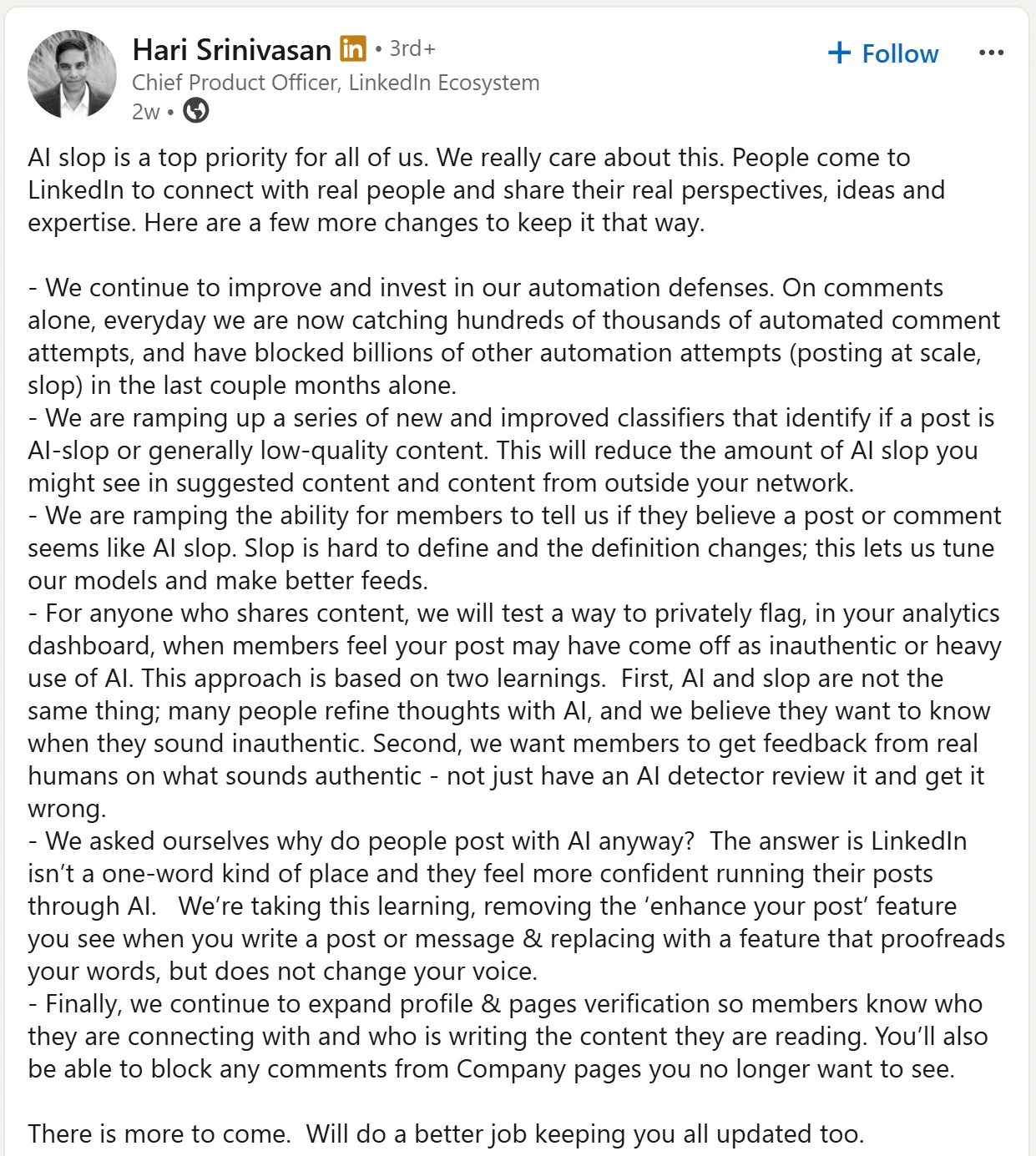
Hence, to improve the overall platform experience, the LinkedIn algorithm suppresses these types of posts.
Fundamentally, you need to be aware of two things:
- Engagement baiting lines and phrases: Sentences like “Comment ‘YES’ if you agree” and rhetorical questions like “Have you experienced it yourself?” fall in this category. These are elements that are designed to attract attention without offering proportionate value in return. This is also why you should be wary of using emojis.
- Originality: Is it unique to you and your brand? While your topic and certain core concepts may match others, the key takeaway or insight should stay unique to you. A quick thought test here is to ask, “Will the post make sense if someone else posts it?”
Step 2: Engagement Scoring
The second phase looks at the volume and quality of engagement your content gets. This includes likes, comments, saves and shares. If the engagement activity is unique and contextual, the post’s reach will increase.
The quality of engagement depends on how relevant a comment is to a post and whether the perspective shared is relevant to the person who shared it.
Let’s say you are an HR professional and you commented on a post that talks about team-building activities; your response will be considered relevant and valuable.
However, if you respond with a generic comment like “Great insight!” to a LinkedIn carousel from a digital marketing expert, it may be interpreted as spammy.
The converse is also true, i.e., comments from other LinkedIn users on your posts. If you attract AI-generated replies masked as thoughtful comments, it can signal to the algorithm that your content is generic.
Typically, this scoring happens in the first hour after your post goes live, often known as the “golden hour.” The following things are evaluated:
- How quickly and meaningfully your post receives early engagement.
- Dwell time, which is the amount of time people spend reading your post or watching your video.
- The quality of engagement, where LinkedIn considers meaningful comments more than generic ones like “Great post!.”
- Whether your audience sample consists of people who typically engage with your content.
This prevents the chances of spammy engagement tactics where some LinkedIn users add multiple comments across posts to simply increase their visibility.
Step 3: Relevance Ranking
In this stage, the LinkedIn algorithm analyzes whether your content is topically relevant to your niche and whether it offers long-term value.
If the content ranks high on the relevance scale, the platform serves it to your second- and third-degree connections, which gets you more impressions. Additionally, evergreen content gets distributed for longer due to its continued usefulness.
To ensure content relevance and longevity, stay consistent and on-niche, rather than bouncing between random topics. Talking about different things doesn’t send a reliable or recurring signal to the algorithm to let it know what your expertise is.
For long-term, educational content, you can repost them from time to time to get more engagement, which increases its visibility further.
4 LinkedIn Algorithm Ranking Signals You Control
The three steps that score and rank your LinkedIn content depend on four ranking signals that you can control through your platform activity. The signals are primarily related to content, profile and other things you can do on the professional network.
1. Content Quality and Long-Term Value
In-depth, actionable content that covers evergreen topics will be prioritized by the LinkedIn algorithm. Such posts and carousels will engage the right audience over time and attract authentic comments.
Content that falls into this category includes frameworks, breakdowns, playbooks and data-backed contrarian takes. You can make them a part of your LinkedIn content strategy by focusing on a specific problem of your target audience.
2. Topic Consistency and Profile Alignment
Consistently talking about a few core topics positions your account as a trustworthy resource within your niche. Moreover, your profile, which includes your introduction, skills, past experience with details of what you did and alma mater, should align with the content.
Random posting, on the other hand, may lead to viral posts once in a while, but will certainly fall short when building a long-term brand.
You can send the right signals to the LinkedIn algorithm by picking 3–4 topics you want to build/attract an audience for/to in the next few months. Then, optimize your profile and create long-form content regularly.
3. Engagement Authenticity (Both Directions)
Your comments and comments under your posts should add something to the community conversation.
If your comments read as AI-generated and repeat what others have already said, LinkedIn may label your account as promotional.
You can control this ranking signal through meaningful engagement. Write long (about 2–3 sentences) contextual comments for each post that present new information and insights.
Similarly, if you attract a lot of mass commenters, your content may not reach the target audience. You can fix this by creating unique content that gets likes, comments, saves and shares on LinkedIn from your immediate and extended network.
4. LinkedIn Post Type and Format
There are several types and formats that fare well on LinkedIn: Text-only posts, carousels, multi-image posts and short-form video content (depending on the topic and context).
These native posts earn saves and likes and typically are long-form. Additionally, most of the business professionals on the platform are used to consuming content in the above formats.
Also Read: Content Distribution Strategy: A 2026 Guide That Works
Tips to Master the LinkedIn Algorithm Today
When creating content for your LinkedIn account or engaging with others, keep the following best practices in mind to send positive ranking signals to the LinkedIn algorithm:
1. Forget Hashtags, Polls and Emojis
Hashtags, polls and emojis don’t have the effect they once used to have.
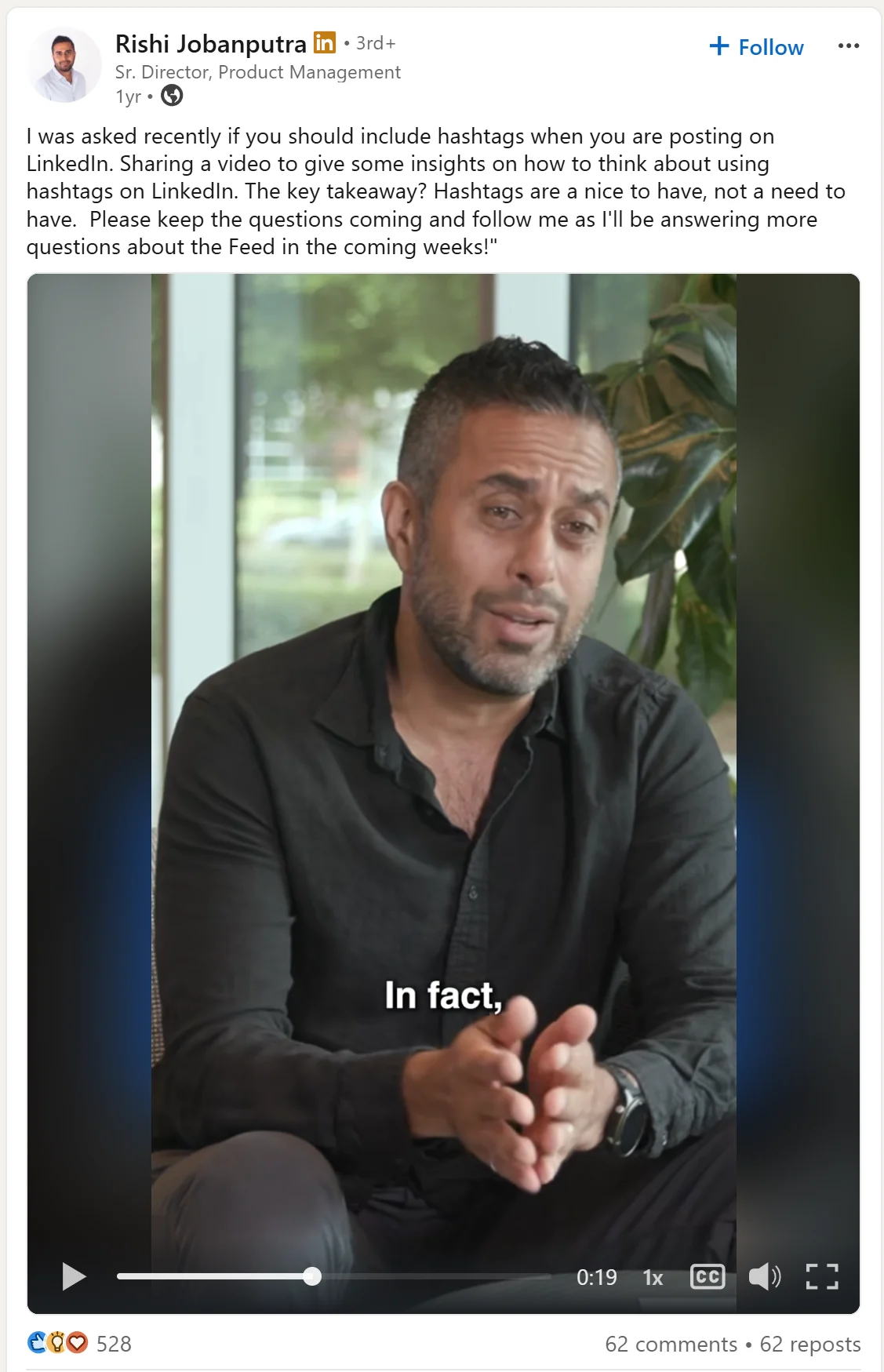
Relevant hashtags used to categorize LinkedIn content and allowed users to explore topics. Now, the LinkedIn algorithm determines the topic automatically through AI and serves content based on your interests and past activity, rendering them ineffective.
Rishi Jobanputra, LinkedIn’s Head of Product (Feed), clarified it in a video post.
Polls should also be ignored because they rarely bring you authentic data that you can cite strongly in your blog posts or reports.
Emojis are only powerful in 1:1 or private group conversations. In a professional environment, such as a LinkedIn timeline, they add little to your key takeaways and insights. Moreover, too many of them can be distracting.
2. Prioritize Images Over Videos
While short-form videos are one of the most preferred formats across the internet, they may fall short against images.
LinkedIn users often scroll through their timelines at work or during lunch break. This means they consume all kinds of text-based and visual content in a professional environment. Consequently, they may mute the audio and just read the subtitles.
In such a scenario, an image (like an infographic) will work way better. First, all of the information is present on a single screen (or a few screens if it’s a carousel). Second, your audience would rather read plain text or an infographic if they are reading the subtitles.
3. Create Evergreen Content and Repurpose It
Write posts and design carousels that stay relevant over a long time. It increases the ROI of your creative effort and the chances of your audience saving it. When a LinkedIn post gets saved, it signals the algorithm that it is of high value.
Some examples include how-to guides, example breakdowns, industry insights analyses, internal data points and survey report explanations. Each of these buckets of content should contain takeaways your audience can implement immediately.
Such content should be reposted and repurposed to present the same concept, takeaway or advice in another context. Comprehensive coverage of a topic will make you a trustworthy resource in your niche.
4. Maintain AIDA or PAS Style for Flow
The AIDA and PAS structure focus on a specific problem of your audience or on an industry trend. It puts your readers in the center and makes the content about them rather than your brand.
You can implement them by:
- AIDA: Mention a specific claim or an uncommon opinion that grabs their attention. Then explain why it matters to them before providing an actionable takeaway. The actionable takeaway will make your content stand out and generate leads because you are saying, “here’s what you should do about this thing that matters to you/your business.”
- PAS: It is a straightforward structure that acknowledges your reader’s problem and validates their emotion around it, making them feel valued. Then, your solution, which can be an actionable takeaway or your offering, will be more welcome.
Note that the purpose of the above content structures is not to pitch something to your readers from the first go or simply grab the attention of random users for impressions or comments. This can backfire because not all engagement will be picked up positively by the platform’s ranking system.
It is to provide useful information in a scannable and relatable format.
5. Add External Links At the Appropriate Place
Add a link at the start, middle or end of your LinkedIn post if you have to. If a link fits well at a certain part of the post, paste it there.
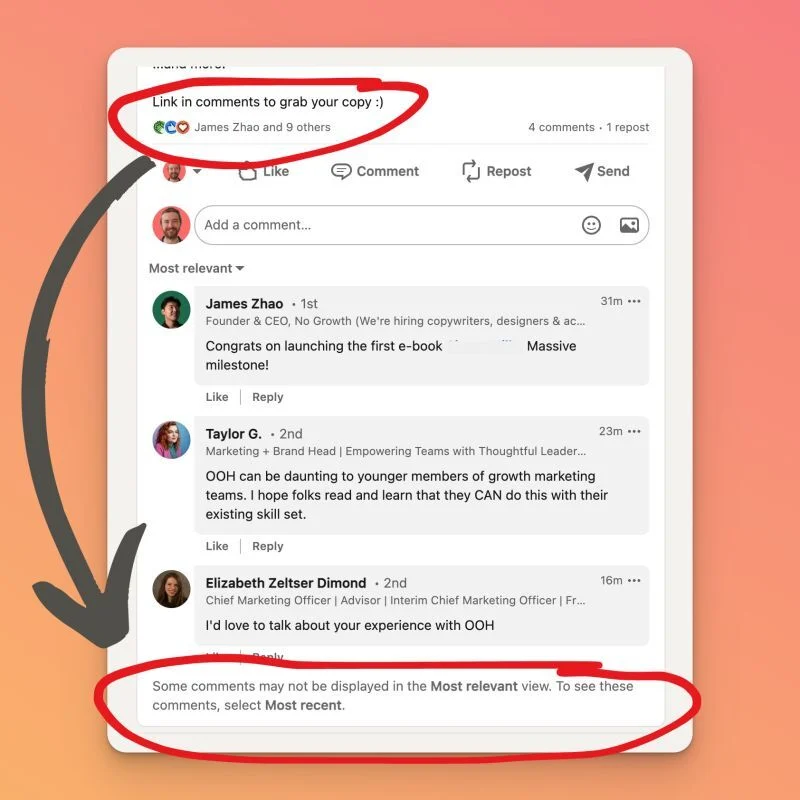
There is a myth that you should add the outbound link in the first comment and pin it, but that doesn’t work because LinkedIn shows relevant comments to users, which can make it difficult for your readers to get to the link:
6. Use Your Personal Account
People want to interact with people. When you share content from your personal profile rather than your company’s page, your brand appears more human and approachable.
Your audience will be more comfortable commenting on your posts and responding to your comments on theirs.
On a creative side, posting on LinkedIn from your personal account allows you to include an emotional touch, which allows you to be more flexible with your LinkedIn strategy. You can share personal stories, for example, that your readers can relate to, improving engagement quality.
7. Keep Your LinkedIn Profile Updated
Your job role, current organization, headline, summary, past experience, responsibilities, educational background and profile picture should be up to date.
The latest information, when it aligns with your content, boosts your content’s visibility in your industry and niche. Moreover, anyone landing on your profile after viewing one of your posts will instantly understand why your content should be trusted, making this a vital part of your social media strategy.
8. Avoid Inorganic Engagement
Inorganic engagement refers to forced comments and repost captions that are irrelevant or add little value for the reader.
You may get tempted to comment and share others’ content more in a bid to increase your profile’s visibility. However, if your engagement isn’t authentic or organic, your message will fail to spark meaningful conversations, affecting your account’s topical credibility in the long run.
Furthermore, you may also encourage your team members and connections within your own network to add comments and hit repost to increase reach.
While it may work, its long-term efficacy depends on the quality of the comments and the captions they write when sharing your message with their network.
9. Tell Your Audience Exactly What to Do
Whether it is to read an article, sign up for a product, book a demo or send you a DM, spell it out clearly in your post. If you are asking an open-ended question, make sure it’s unambiguous to maximize engagement.
When you present your reader with too many options, they will get confused and feel disengaged. A clear CTA prevents the attention drop-off by mentioning a problem or a fact, explaining its significance, presenting the solution and sharing what the reader needs to do to solve it.
The CTA depends on the broader goal behind your social media marketing efforts. It could range from raising brand awareness to LinkedIn lead generation. A good rule of thumb is to stick to one goal per post rather than trying to tick every box.
Two Big Challenges When Mastering the LinkedIn Algorithm
Founders, marketers, experts and CEOs looking to build their personal brand on LinkedIn struggle with two things: creating quality content to post regularly and identifying what works.
Creating in-depth, relevant content that offers new insights can be time-consuming. Small teams or busy professionals may not be able to dedicate multiple hours every week to write high-quality posts.
Similarly, tracking performance metrics, such as impressions and engagement, for each post to gain valuable insights into user behavior can be tedious. Then, this information has to be analyzed further to understand why some posts perform better than others.
How Distribution.ai Facilitates LinkedIn Growth
Distribution.ai helps you master the LinkedIn algorithm by tackling the two key challenges we mentioned above: content and analytics.
The AI-powered content repurposing and distribution solution converts your existing long-form content, like YouTube videos and blog posts, into multiple engaging LinkedIn posts in under a minute. It will generate a steady stream of content for your professional network, enabling you to post consistently.
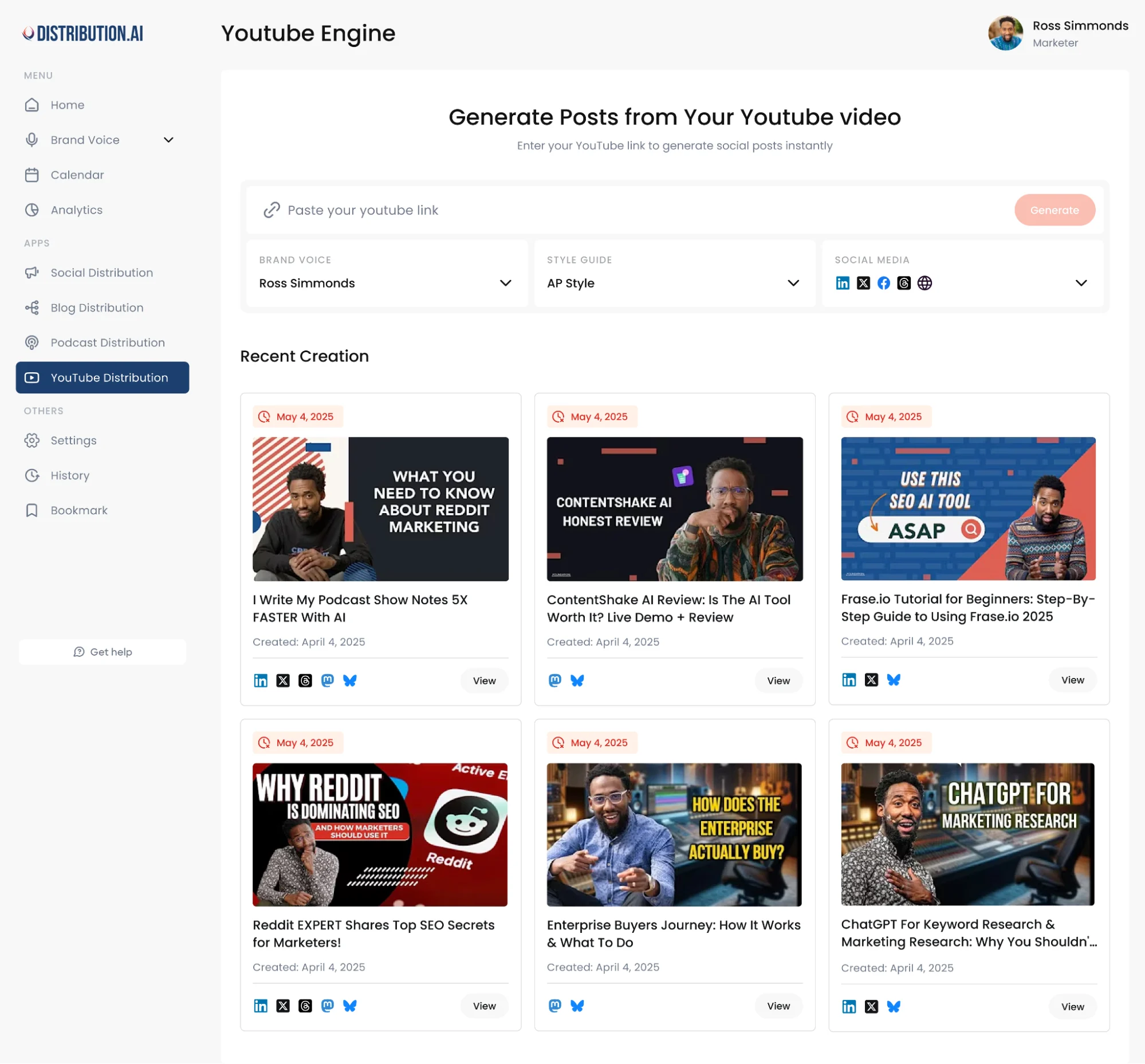
Then, you can use its built-in scheduler to queue them to go live at optimal times, which will maximize reach and engagement.
Finally, the unified dashboard surfaces how each post performed based on metrics such as impressions, engagement rate, click-through rate and likes. You can quickly learn which topics, framing styles, tones and formats resonate better with your audience.
Promote, repurpose & distribute your content with AI
Write 10x faster, engage your audience, & never struggle with the blank page again.
Start 15-Day Free Trial
Frequently Asked Questions
Author

Promote, repurpose & distribute your content with AI
Start 15-Day Free Trial