How to Use Claude to Build a Brand Voice Guide for Social Posts
Build a brand voice guide with Claude in 7 steps, with prompts and channel rules so every AI draft for social media sounds like your brand.
 By
Quick answer
A brand voice guide is a short document that tells writers and AI tools how your brand sounds: tone, words to use, words to avoid and channel-specific rules. To build one with Claude, feed it 10 to 20 of your best posts, ask it to describe the patterns, turn those patterns into rules with examples, then test the guide by drafting new posts and tightening anything that drifts.
AI drafts sound generic for one reason. Nobody told the model what your brand sounds like. A brand voice guide fixes that, and Claude is good at building one from the content you already have.
This walkthrough covers what belongs in a brand voice guide for social media, how to build it with Claude step by step, and how to plug it into your AI brand voice workflow so every draft starts closer to done.
Key Takeaways
- A useful brand voice guide fits on two pages and is full of examples.
- Claude can extract your voice from posts that already performed. Start with evidence, then write rules.
- Banned words and banned sentence patterns matter as much as tone adjectives.
- Add channel rules. LinkedIn, X and Threads each need a slightly different register.
- Store the guide where drafts get made, so it applies every time.
Why AI drafts need a brand voice guide
Large language models default to a safe, average tone. Average tone is forgettable on a feed. It also creates extra editing work for your team, because every draft needs the same fixes.
A brand voice guide moves those fixes upstream. Instead of correcting the same phrases in every post, you write the rule once. Ross Simmonds describes this approach in his piece on running a company on Claude, where Claude Skills teach the model brand voice and the words to avoid.
The guide also helps humans. New hires, freelancers and agencies all ramp faster when the voice is written down. Foundation’s article on using a style guide to create a cohesive brand identity covers the broader editorial and visual side.
What goes in a brand voice guide for social media
Keep it short and concrete. Adjectives alone (“friendly, expert”) give a model almost nothing to work with. Pair every rule with an example.
| Section | What to define | Example rule |
|---|---|---|
| Positioning | Who you serve and what you believe | “We write for B2B content leads who own results.” |
| Tone | 3 traits, each with a “sounds like” line | “Direct: say the point in the first line.” |
| Sentence style | Length, rhythm, punctuation | “Short sentences. No em dashes.” |
| Vocabulary | Preferred terms and product names | “Say ‘distribution’, and spell the product as Distribution.ai.” |
| Banned list | Words and patterns to never use | “Never: ‘synergy’, ‘circle back’, ‘best-in-class’.” |
| Channel rules | Length, format, hashtags, emoji per network | “X: one idea per post, max one hashtag.” |
| Examples | 3 to 5 on-voice posts and 2 off-voice posts | Real posts, labelled “use” and “avoid” |
Watch out: Banned sentence patterns are as important as banned words. If your team hates a certain hook or a certain way of setting up a contrast, write it into the guide with an example. Models repeat patterns they’re never told to drop.
How to build a brand voice guide with Claude in 7 steps
You can do this in a regular Claude chat. Use a Claude Project if you want the guide and examples to stay available across conversations.
Collect your best 10 to 20 posts
Pick posts that performed and that your team agrees sound right. Add a few long-form pieces too, like a blog intro or a newsletter.
Collect 3 to 5 posts that missed
Off-voice examples teach Claude where the edges are. Drafts your team rewrote heavily are ideal.
Ask Claude to describe the patterns
Ask for observations before rules. You want evidence of how you write today.
Turn patterns into rules
Ask Claude to convert the observations into a guide using the sections in the table above. Every rule gets a “do” and a “don’t” example.
Add your own non-negotiables
Claude can only see what’s in the samples. Add the rules your team already enforces in edits, such as banned words, formatting and claims you never make.
Test with a blind draft
Give Claude a blog post and ask for three LinkedIn posts using only the guide. Show them to a teammate next to real posts. Anything that stands out becomes a new rule.
Store it where drafts get made
A guide in a forgotten folder changes nothing. Save it inside the tool that writes your posts so it applies to every draft automatically.
Put your Claude brand voice to work
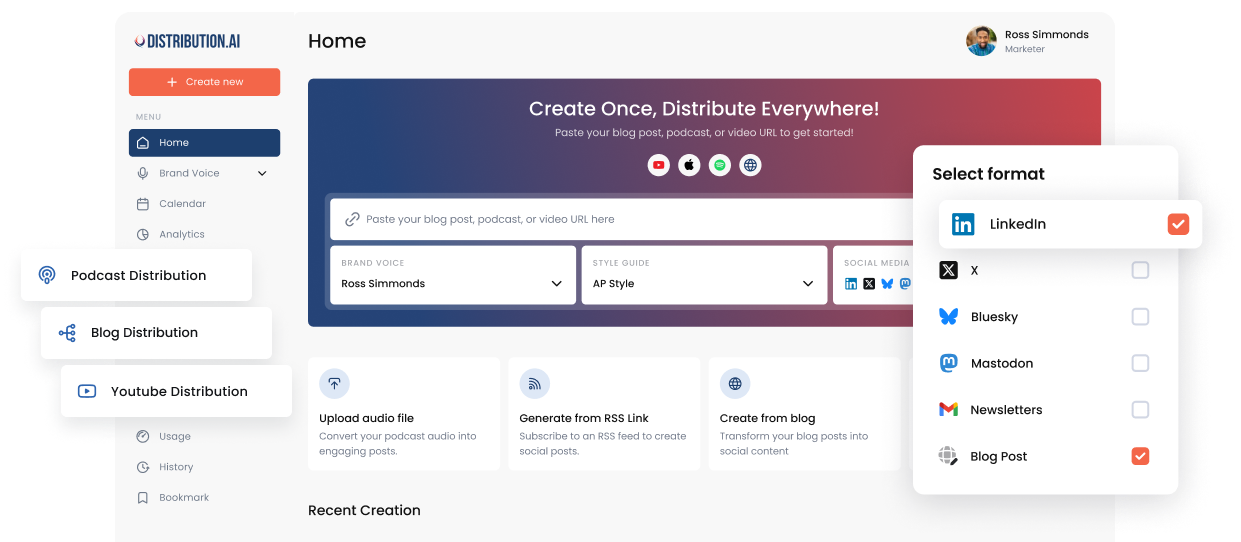
Once the guide exists, connect it to production. With the Distribution.ai MCP connector in Claude, you can create and edit brand voices and style guides right from the chat. Paste in the guide Claude just built and save it as a brand voice in your workspace.
From then on, every draft uses it. Paste a blog post, podcast episode or YouTube link and ask for LinkedIn and X posts. Refine with follow-ups like “make these punchier” or “shorter, no hashtags”. Then ask Claude to schedule them into your open posting slots. Nothing publishes right away. Every post lands on your calendar first, and if your workspace requires approval, posts wait for it.
New to the connector? Start with our step-by-step guide to connecting Claude to your social media accounts. ChatGPT users can follow the ChatGPT LinkedIn scheduling guide instead.
Brand voice examples by channel
One voice, adjusted per network. Here’s how a single idea shifts across channels while staying recognizably yours.
Lead with a specific observation from your work. Use short paragraphs and white space. End with a takeaway or a question that invites a real answer. For format ideas, see our guide to social media writing.
X
One idea per post. Cut every word that doesn’t carry weight. Threads work for frameworks, but each post should stand on its own.
Threads
More conversational than LinkedIn. Opinions and quick lessons do well. Keep the same vocabulary and banned list so the voice stays consistent.
Go deeper
Frequently asked questions
What is a brand voice guide?
A brand voice guide documents how your brand sounds in writing. It covers tone, sentence style, vocabulary, banned words and channel rules, with examples for each. Writers and AI tools use it to produce on-voice content.
How long should a brand voice guide be?
One to two pages for social media. Long guides get skimmed by people and diluted in AI prompts. Examples carry more weight than paragraphs of description.
Can Claude learn my brand voice?
Claude can follow a brand voice guide closely when you give it clear rules and real examples. It doesn’t remember your voice between chats unless the guide is saved in a Project, a Skill or a connected tool like Distribution.ai.
How often should I update the guide?
Review it every quarter, and any time your team keeps making the same edit to drafts. Each repeated edit is a missing rule.
Do I need a separate guide for each social channel?
No. Use one guide with a channel rules section. The core voice stays the same, and only length, format and hashtag rules change per network.
Make every draft sound like you
Save your brand voice once and apply it to every post you create and schedule.
No credit card required.
Author

Promote, repurpose & distribute your content with AI
Start 15-Day Free Trial