AI Agents for Social Media: What They Can and Can’t Do in 2026
AI agents for social media can draft, schedule and report on posts. See what they can and can’t do in 2026 and how to add approval steps.
 By
Quick answer
AI agents for social media can now draft posts from your existing content, check channel limits, fill a posting schedule and report on what went out. They still can’t judge context, own your brand risk or decide what matters this week. The setups that work in 2026 pair an AI social media agent with a clear approval step, so a human signs off before anything goes live.
Every social tool now says it has an agent. Some mean a chatbot in a sidebar. Some mean software that schedules, edits and cancels posts on your company LinkedIn page. The second kind has real access to your brand.
This guide breaks down what AI agents for social media can do today, where they fall short, and how to set one up with approval steps so your team keeps control.
Key Takeaways
- An AI agent for social media is software that can take actions on your behalf: create posts, schedule them, check your calendar and report back.
- Agents are strong at repetitive production work: repurposing, formatting for each channel, filling open slots and status checks.
- Agents are weak at judgment: timing around news, tone in sensitive moments, and knowing which idea is worth pushing.
- Human-in-the-loop approval is the control that makes agentic AI marketing safe to run on a brand account.
- MCP connectors let you run these agents inside ChatGPT or Claude, with permissions you can revoke at any time.
What is an AI agent for social media?
An AI agent for social media is a system that can plan and complete multi-step tasks across your social tools, instead of answering a single prompt. You give it a goal. It decides which actions to take, calls the tools it has access to, and reports what it did.
In practice, most agents in this category do some mix of four jobs:
- Create: turn a blog post, podcast episode or video into posts for each channel.
- Plan: place those posts into open slots on a calendar.
- Check: report what is scheduled, what published and what failed.
- Refine: rewrite posts on request, shorter, punchier, different tone.
The jump from AI writing tools to agents came from protocols like MCP (Model Context Protocol). MCP is an open standard that lets assistants such as ChatGPT and Claude connect to other apps. Anthropic announced remote MCP integrations for Claude on May 1, 2025, and custom connectors are now listed as available on Free, Pro, Max, Team and Enterprise plans, with Free limited to one custom connector (Anthropic Help Center, checked October 2026). OpenAI launched apps in ChatGPT, built on MCP, on October 6, 2025 (OpenAI).
Your social media agent can now live in the assistant your team already has open all day, such as through the Distribution.ai MCP connector.
What AI social media agents can do well in 2026
Agents earn their keep on work that is repetitive, rules-based and easy to check. Here is where they help most.
Repurpose existing content into channel-ready posts
Give an agent a link to a blog post, podcast episode or YouTube video and it can produce drafts for LinkedIn, X, Threads and more. Good tools check character limits per channel before anything is scheduled. This is the core idea behind Create Once, Distribute Forever: one strong asset should feed weeks of distribution.
Fill a schedule without breaking it
A useful agent knows your posting schedule. Ask it to “schedule those over the next week” and it can place posts into open slots instead of stacking them on the same morning.
Answer status questions in seconds
“What’s going out this week?” used to mean opening a calendar and scrolling. An agent can tell you what is scheduled, what published and what failed, then help you fix the failures.
Apply a brand voice consistently
Agents can work from saved brand voices and style guides, so every draft starts from the same place.
What AI agents for social media still can’t do
The limits come down to context. An agent only knows what it can see.
| Task | Agent today | Who should own it |
|---|---|---|
| Drafting posts from a source asset | Strong | Agent drafts, human reviews |
| Formatting and character limits per channel | Strong | Agent |
| Filling open calendar slots | Strong | Agent, with approval |
| Choosing which ideas deserve a push | Weak | Content lead |
| Reacting to breaking news or a crisis | Weak | Human, always |
| Replying in sensitive threads | Weak | Community manager |
| Tying posts to pipeline | Partial | Marketing ops |
They can’t read the room
A post that was fine on Monday can look tone-deaf on Wednesday. Agents don’t follow your industry news or your customer escalations.
They can’t set strategy
An agent can turn ten blog posts into a hundred social posts. It can’t tell you that three of those blog posts are the ones your buyers care about. Prioritization is still a human call, informed by data.
They can’t own accountability
When something goes wrong on a brand account, a person answers for it. That is the strongest argument for keeping a human approval step in every workflow.
Why human-in-the-loop approval matters
Agentic AI marketing works when the agent does the volume and a person does the judgment. Approval steps are how you split that work cleanly.
The market is moving in this direction. Agorapulse, for example, shipped an MCP integration with ChatGPT and Claude on January 13, 2026, and added inbox action approvals for “specific team members or AI agents” on September 10, 2026 (Agorapulse release notes, 2026). Approval for agent actions is quickly becoming a standard feature.
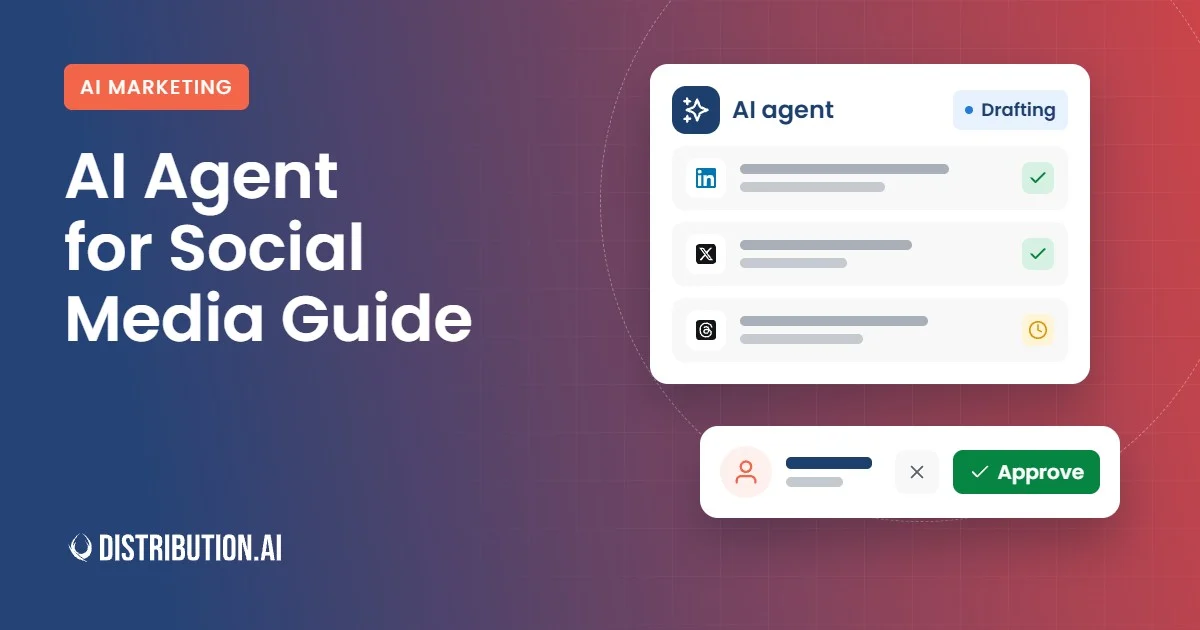
Distribution.ai takes the same stance. Through the connector, nothing publishes right away. Every post is scheduled and shows up on your calendar first. If your workspace requires approval, posts are staged and wait for approval in the app.
Watch out: an agent with write access to a brand account and no approval step is a risk, however good the model is. Turn approvals on before you hand the agent to the wider team.
How to set up an AI agent for social media with approval steps
Here is a practical checklist for running social media automation with approval, using an MCP connector inside ChatGPT or Claude.
Define the agent’s job
Write down what it may do (draft, schedule, report) and what it may not (reply to comments, post same-day, touch paid campaigns).
Set up the basics first
Connect at least one social channel and set a posting schedule in Distribution.ai under Settings. The agent fills slots; it shouldn’t invent them.
Turn on approvals
Assign roles and an approval workflow in your organization so agent-created posts wait for sign-off.
Connect the assistant
Add the connector URL in Claude (Settings, Connectors, Add custom connector) or create an app in ChatGPT developer mode. Our Claude setup guide and ChatGPT LinkedIn guide walk through each step.
Review the permissions
Know what each scope allows: read for content and calendar, write to create and edit, and posts:write to schedule. Revoke anytime under Settings, Connected apps.
Run a test week
Start with one source asset and one channel. Ask “Turn this blog post into LinkedIn and X posts,” then “Schedule those over the next week.” Review everything before approving.
Add a weekly check
Every Monday, ask “What’s going out this week?” and scan for anything that feels off for the moment.
A simple operating model for agentic AI marketing
Use a three-layer split. It keeps roles clear as you add more automation.
- The source layer. Humans create the original asset: the blog post, podcast, webinar or video. This is where your ideas and expertise live.
- The distribution layer. The agent turns that asset into posts, places them on the calendar and keeps the schedule full. Autopilot can even start drafts the moment you publish something new.
- The judgment layer. A person approves, edits or kills posts, and decides which assets deserve another round.
This is the gap between content distribution and social media scheduling. Scheduling is a task. Distribution is a system, and agents are now good enough to run the repetitive parts of it.
Ross Simmonds has written for years about why the work after you hit publish matters as much as the work before it. His guide to content distribution strategies and channel experimentation is a useful lens for deciding where your agent should spend its effort.
How to evaluate an AI social media agent
Before you buy, run every option through the same questions:
- Does it start from your existing content, or from a blank prompt?
- Can a human approve posts before they publish, and can you require that for everyone?
- Which channels can it schedule to directly, and which need extra steps?
- Can you see exactly what permissions it has, and revoke them in one click?
- Does it work inside the assistant your team already uses?
- Can it report results, so you can measure content distribution beyond likes?
Go deeper
Frequently asked questions
Are AI agents for social media safe to use on a brand account?
They are safe when you control what they can do. Use scoped permissions, require approval before posts go live, and keep the option to revoke access at any time.
What is the difference between an AI writing tool and an AI social media agent?
A writing tool produces text when you ask. An agent can take actions across your tools, such as scheduling posts, checking your calendar and cancelling a batch.
Can an AI agent post to social media without my approval?
Some can, depending on the tool and settings. With the Distribution.ai connector, nothing publishes right away: every post lands on your calendar first, and approval workflows still apply.
Do I need ChatGPT or Claude to use a social media agent?
No, but it helps. MCP connectors let you run the agent inside the assistant you already use. Check that your plan supports custom connectors or ChatGPT developer mode first.
Which social channels can AI agents schedule to?
It varies by tool. The Distribution.ai connector schedules to LinkedIn, X, Threads, Facebook, Mastodon and Bluesky. Instagram and Pinterest are scheduled from the app because they need an image.
Will AI agents replace social media managers?
They replace repetitive production tasks. Strategy, community, timing and accountability still need people, and those are the parts of the job that drive results.
Put an agent on your distribution, keep the final say
Turn your blogs, podcasts and videos into scheduled posts, with approvals built in.
No credit card required.
Author

Promote, repurpose & distribute your content with AI
Start 15-Day Free Trial