Pinterest Marketing: How to Create Pins That Attract High-Intent Leads
Learn how to set up Rich Pins, research keywords and build a repeatable system that attracts buyers on Pinterest.
 By
Pinterest recorded 661 million monthly active users (MAUs) in Q3 2026 .
And some of them are your audience looking for ideas and inspiration, waiting to become your loyal customers down the line.
You simply need to create engaging Pins that capture their attention and send them to your website or e-commerce store for conversion.
This article explains how you can design a Pinterest marketing strategy around your brand’s offerings to generate high-intent leads.
Key Takeaways
- Pins that attract customers have quotable copy (specific, keyword-rich titles and descriptions) with content alignment across image/video, text and destination URL.
- Business Accounts are always recommended over personal accounts. The former unlocks Rich Pins, Analytics and shopping features, which are foundational to running Pinterest marketing campaigns.
- Pinterest keyword research targets exploratory, aspirational queries (not problem-solving ones) and is done with search bar autofill, related tiles, Trends and the Ads keyword planner.
- Scroll-stopping Pins use high-quality lifestyle images, 8–10 word overlays, a 2:3 ratio (1000×1500) and short videos with a hook in the first 2–10 seconds.
- A repeatable system means boards built around keyword clusters, batched monthly content, 3–5 fresh Pins daily and weekly analytics reviews.
- Track outbound clicks, CTR, saves, Pin-level conversions and audience insights to know what to scale.
What Kind of Pins Attract Customers
Pins that have quotable copy and have content alignment are more likely to show up in search results (in Pinterest, search engines and AI research tools).
Quotable copy refers to highly specific titles and descriptions that provide useful information to your audience and include keywords organically. This extends to titles and descriptions of boards, profile name and bio (“About” section).
Content alignment occurs when the written copy (like title and description) aligns with the creatives (images and videos) and the context of the outbound link (e.g., e-commerce product page).
Other than that, your Pins also need to be supported by a well-set-up Pinterest Business account that enables Rich Pins. These Pins fetch structured metadata from your website for your content pieces.
Structured metadata like title, price, product category and availability gives the Pinterest Assistant (an AI-powered, visual-first chatbot that works as a personalized search engine) more context.
So, there are a few prerequisites to creating Pins that attract buyers:
- A strong Pinterest business account that enables features like Rich Pins, Analytics and ads.
- Pinterest-focused keyword research (different than traditional SEO campaign-focused keyword research).
- Copywriting and creative design best practices for Pinterest audience.
- Repeatable Pinterest content marketing strategy that you can scale as needed.
- Identifying key metrics you need to monitor when marketing on Pinterest.
Pinterest Business Account Foundation
A Pinterest Business Account is a free professional profile you can create for your brand on the visual platform. It gives you access to features that help you use Pinterest for marketing:
- Pinterest Analytics: Track key metrics like impressions, Pin clicks, outbound clicks, saves and engagement rate.
- Ads: Boost your posts to reach more Pinterest users and measure the success rate of your paid campaigns.
- Website link: Connect your official website to display your brand name and logo on every Pin created from your website.
- Rich Pins: These Pins automatically fetch metadata like title, description, price, availability, etc. from your commercial pages (like an e-commerce product page) in real time for your Pinterest audience.
- Shopping features: Data feed sync, product Pins, “Shop” tab on profile and a blue check mark (through the Verified Merchant Program that increases credibility and reach).
- Pinterest Tag & API: Track user behavior on your website to properly attribute conversions to Pinterest (or any other source).
To set up a conversion-focused Pinterest Business Account, follow these steps:
- Profile name (65 characters): Include the brand name and a keyword descriptor that summarizes your core offering.
- Bio (160 characters): Mention who you serve and what you make (or offer). Try to include 2–3 core graphed keywords (more on this below) around your niche.
- Category: Pick a niche that’s closest to your business category so Pinterest’s algorithm can slot your pins through the right discovery streams.
- Claimed website link: Verify ownership via the DNS TXT record or the HTML tag Pinterest provides.
- Enable Rich Pins: Submit a single URL to the Pinterest Rich Pin Validator. Approving one link propagates it sitewide.
How to Do Pinterest-Focused Keyword Research
Pinterest keyword research finds visual and discovery-driven phrases that your future customers use when shopping, planning or looking for inspiration. It is different from traditional keyword research (done for SEO campaigns) in two key ways:
- Intent: Pinterest keywords target exploratory queries that are centered around style, mood, aesthetics and aspirations (e.g., boho living room ideas). Traditional SEO usually targets direct, problem-solving queries (e.g., how to decorate my living room).
- Ranking factors: For Pinterest, your keywords should be meaningfully included in image text overlays, video captions and titles and descriptions (for both Pins and Boards). Google usually relies on domain authority and backlinks on top of content.
You can follow these two steps to perform keyword research for your Pinterest marketing campaigns.
1. Find Relevant Keywords from Pinterest
The following four sources will help you discover phrases and queries that your audience typically uses:
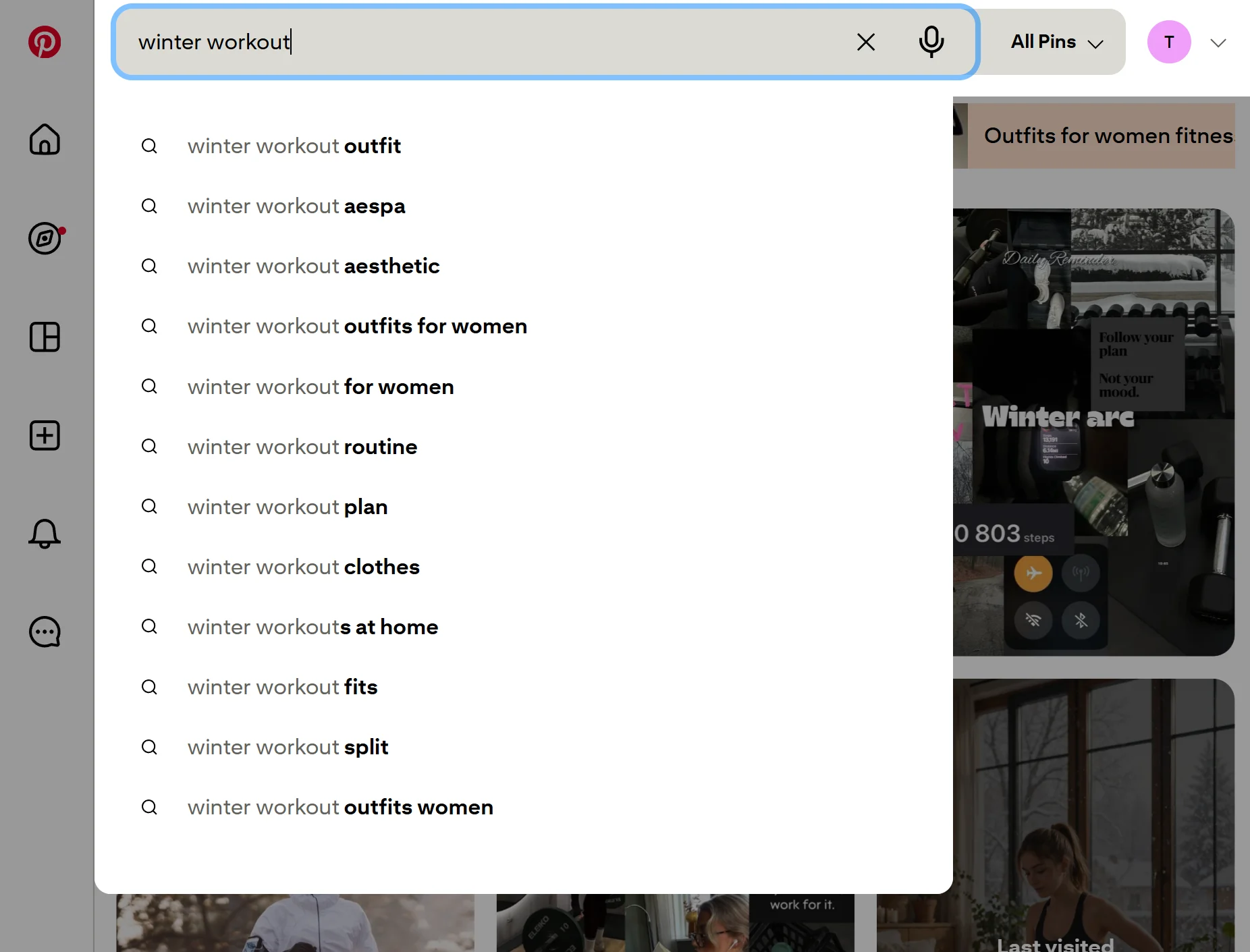
- Pinterest search bar autofill: Type in a seed term around your brand’s core offerings (e.g., home office) and record the autosuggestions. These are what your potential customers are typing right now. You can also use slight variations.
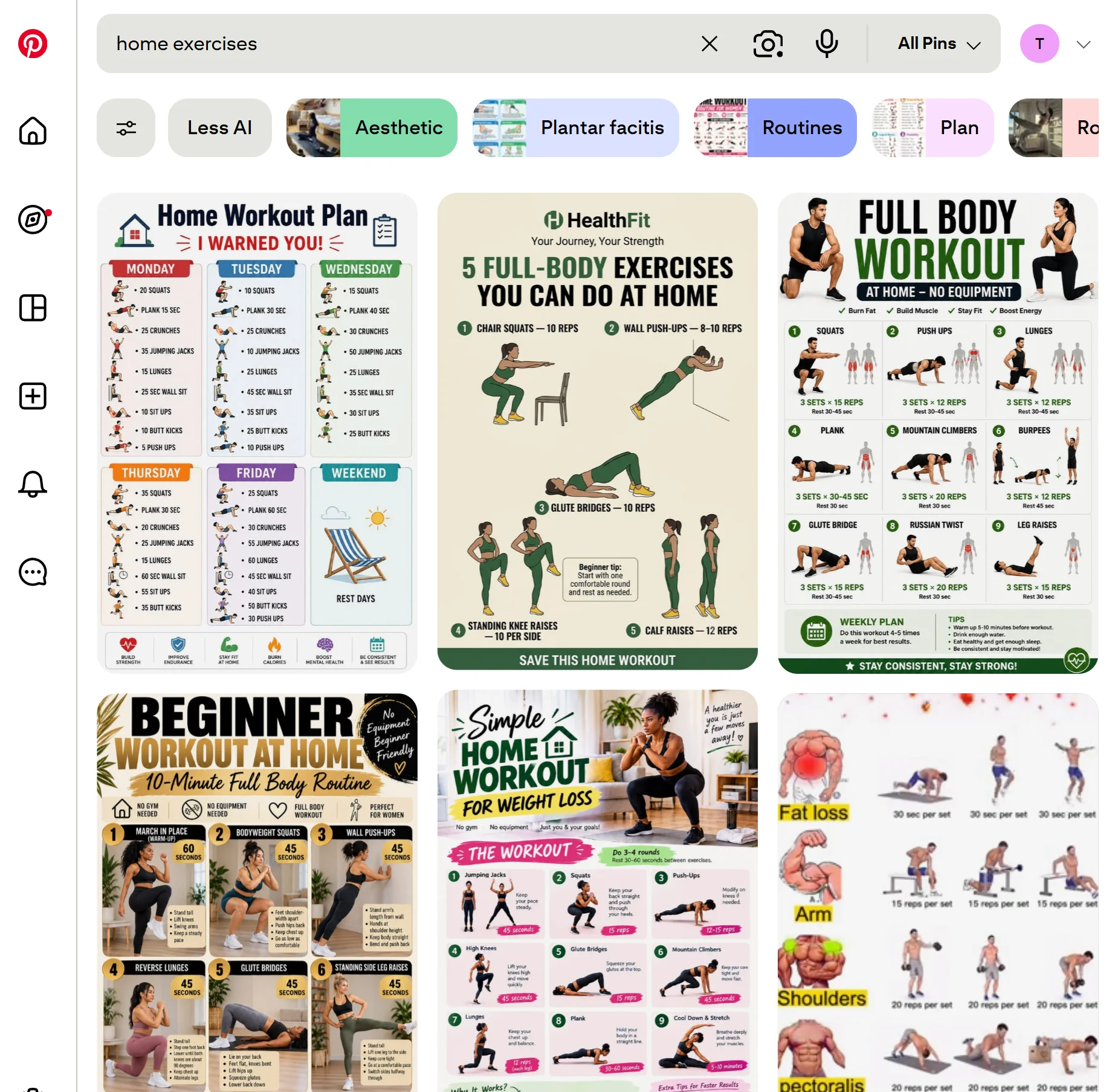
- Related keywords: Every search results page on Pinterest shows keyword tiles that extend your seed term (e.g., modern home office ideas). Save 10–15 of them.
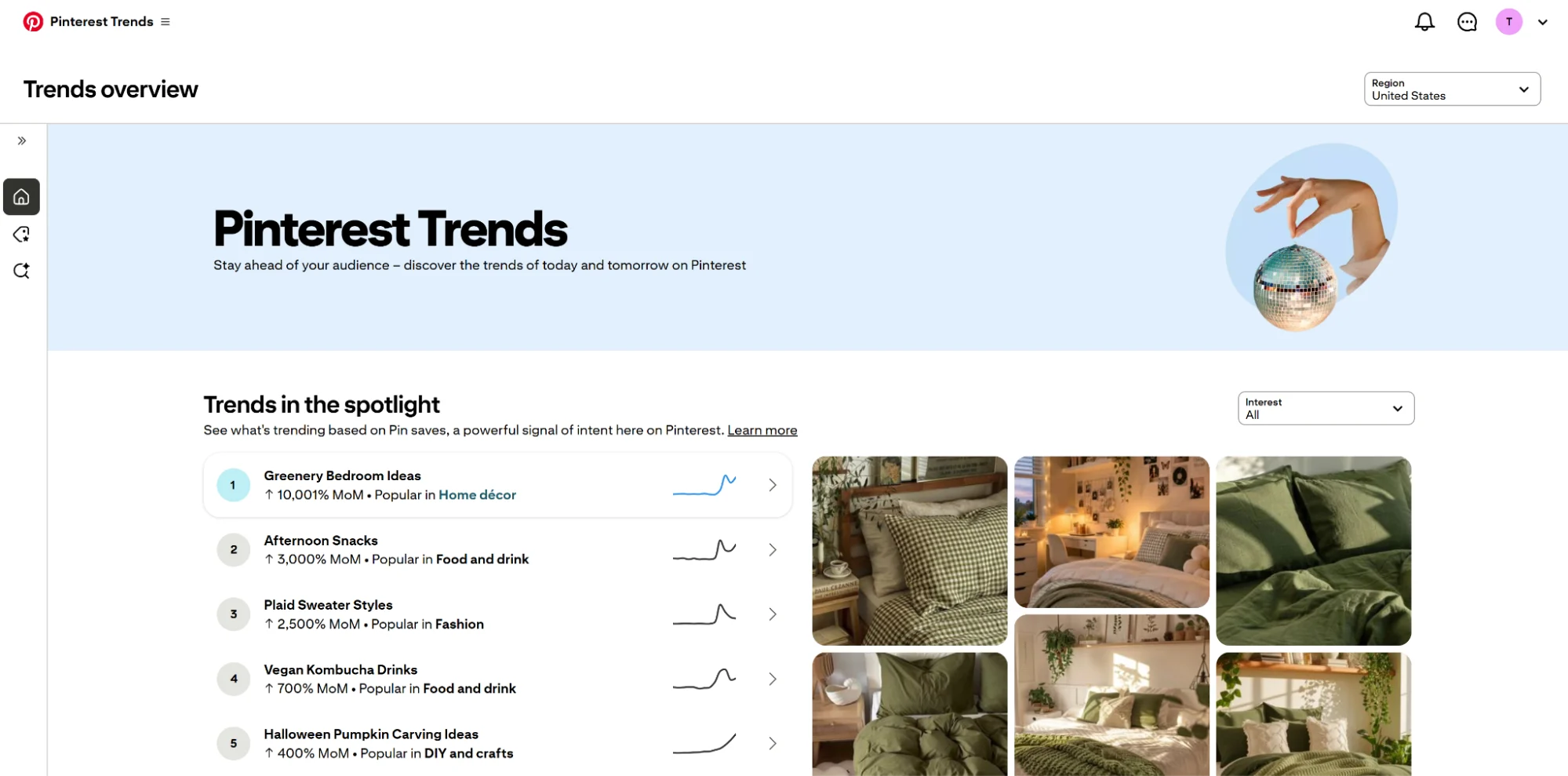
- Pinterest Trends: Put in your seed terms and view seasonal search volumes. It will help identify seasonal behavior of your audience and plan your campaign at the right time of the year.
- Pinterest Ads keyword planner: Even if you don’t plan to use ads, the planner will display the keyword volume estimates (e.g., 1K–2.5K) that will help with prioritization.
Then, put all the seed terms, autosuggest results, related titles and Trends queries in a spreadsheet.
2. Tag and Cluster Keywords
Tag keywords based on search intent, like informational, navigational, aspirational or commercial. An effective way of knowing the search intent is to look at the kind of Pins that show up on the platform for those keywords.
Then, group similar keywords by product or service pages on your website to streamline your campaign planning down the line. This will help you break these groups into clusters of 5–8 keywords.
Finally, for each cluster, pick one primary keyword, which will be used in the title, and 4–5 secondary keywords, which will be included in the description.
How to Create Pins That Get Seen and Saved
Every Pin should have on-brand copy and high-quality creatives to ensure it reaches the right audience and delivers value.
Writing Engaging Pin Copy
Your Pin’s title and description should feel like a recommendation from a friend. It should be quotable and expressive through specific details like numbers, verbs, location and sensory words. For example, “buttery leather under $100” and “20-minute tropical dinner recipe.”
When incorporating keywords, try to include the primary keyword within the first few words or the first sentence. It is ideal to mirror the exact phrase your audience will type. The rest of the description should hold secondary keywords and a soft CTA.
Note that your landing page copy counts as Pin copy because Rich Pins pull your website content’s title tag, meta description, Open Graph title, author details, price and availability. It is recommended to conduct an on-page SEO audit of the destination pages for best results.
The final component of improving your Pins’ discoverability via copy is metadata. For every Pin, fill in the title, description, destination URL and alt text. Each of these elements provides additional context to Pinterest’s search algorithm.
Designing Scroll-Stopping Pins
Well-designed pins should have high-quality visuals (images and videos), the right dimensions, relevant overlay text or captions and branding elements.
You can follow these best practices for image Pins:
- For products, high-resolution lifestyle images in real environments perform better than flat shots on white backgrounds.
- The text overlay should be within 8–10 words and written in high-contrast fonts for easier readability. Also, too much text can make it difficult for Pinterest’s Visual Language Model (VLM) to extract the context.
- Educational content, like infographics, should be scannable, enabling the reader to quickly understand the core theme in 2–3 seconds.
- Avoid extreme ratios like 16:9 and 1:3. These images shrink or get truncated in the search results.
Similarly, you can make engaging video Pins by:
- Including a hook in the first 2–10 seconds of the video (depending on the full length, which can range from 4 seconds to 5 minutes) that tells the key takeaway or mentions the topic’s significance.
- Keeping the clip as short as possible. Although Pinterest supports up to 5 minutes, videos within 20–60 seconds can provide better engagement rates.
- Optimizing for silent viewing through captions, text overlays or visual demonstrations.
- Picking a high-contrast cover thumbnail that attracts your audience’s attention in the search results before autoplay kicks in.
The best image aspect ratio is 2:3, with 1000×1500 as a safe default. Try to keep your pixel dimensions within 1000×2100 to avoid cropping in the search results. You can also use square (1:1; can be optimal for carousel Pins) and vertical (9:16; primarily for video Pins).
Finally, your branding elements should be subtle and located within ~80% of the central area. Insert the logo in the bottom corner and lock in a couple of fonts, a color palette and reusable templates (for both images and videos) to strengthen the brand identity further.
A Repeatable Pinterest Marketing Strategy
The four steps below will help you build a system to create engaging Pins for your audience:
1. Build Boards Around Keyword Clusters
Create Pinterest boards for your keyword clusters. Each board should focus on one keyword cluster. This ensures that your content is properly organized in your Pinterest profile.
Use the primary keyword in the board title and first line of the description. The following lines in the description can include the secondary keywords.
A good rule of thumb is to place the broad brand-level boards at the top and niche down as you go forward. Such a hierarchy sends clear topical signals to Pinterest. Typically, 6–12 boards should be enough to cover core topics and sub-topics.
2. Create a Month’s Content in Batch
The first step toward producing Pinterest content is to set a target. While there isn’t a fixed number, growing brands should aim to publish 3–5 Pins/day to build awareness and attract high-intent traffic.
Note that not all of the Pins published per day have to be brand new. They simply have to be fresh, that is, have a new image, video, title, description or URL. The fresh-Pins strategy is covered in the following section.
Therefore, you need 15–20 original content pieces per month, which translates to 4–5 brand new Pins per week. A good rule of thumb is to create a week’s content at once.
An effective approach here is to produce Pinterest content from your existing assets, such as blog posts, videos, whitepapers, webinars and how-to guides. It will accelerate the creative process and ensure complete alignment between Pins and landing pages.
Each weekly batch should mix formats, such as static images, videos, carousels, product Pins and infographics. It will give you a wider reach by catering to multiple content preferences and help you understand what format works best for your niche.
When scheduling Pins for publication during Pinterest content calendar planning, aim for 3–5 posts per day. The algorithm rewards consistency and helps you avoid spam flags.
3. Set a Fresh-Pin Publishing Cadence
Pinterest rewards freshness (image, video, copy or URL) over repins. In practice, you should consistently update one or more elements in a particular Pin to let the platform’s algorithm know that your content is new.
You can aim to create 3–5 fresh Pins per day, which involves adding a new image, changing the video, updating the target link or rewriting the title and description. Updating different elements will help you produce 3–4 Pin variations per destination URL.
When creating your week’s Pinterest content, write multiple alternative titles and descriptions and create different cover images and clips. Then, you can schedule the fresh Pin updates for the following weeks or months.
It is important to ensure that the alternative creatives and copy match the context of the destination URL and the board’s theme. A mismatch can send mixed signals to the platform’s algorithm, which can affect your content’s reach.
4. Measure What Works on Pinterest Analytics
You can track the following key performance indicators (KPIs) in Pinterest Analytics to iteratively optimize your Pinterest marketing strategy down the line:
- Outbound clicks: The number of users who clicked on the embedded Pin link to go to your website.
- Click-through rate: The percentage of impressions that become outbound clicks. It reveals which designs and copy attract high-intent traffic best.
- Saves: It reveals how valuable your content is and sends a quality signal to Pinterest’s algorithm because Saves extend your Pins’ reach to new users’ networks.
- Pin-level conversions: On-site user activity like purchases and signups that originate from Pinterest for attribution. You need to set up Pinterest Tag & API for this.
- Audience insights: Information like demographics and interests will help you during Pinterest content calendar planning for the next campaign.
Scale Your Pinterest Marketing with Distribution.ai
One of the biggest challenges when executing a Pinterest marketing campaign is creating fresh content every week. Designing images, recording videos, editing the design and writing copy can easily take a chunk of your day.
And then, you also need to create variations to publish fresh Pins.
Distribution.ai solves this by repurposing your existing assets into Pins and producing new content from ideas.
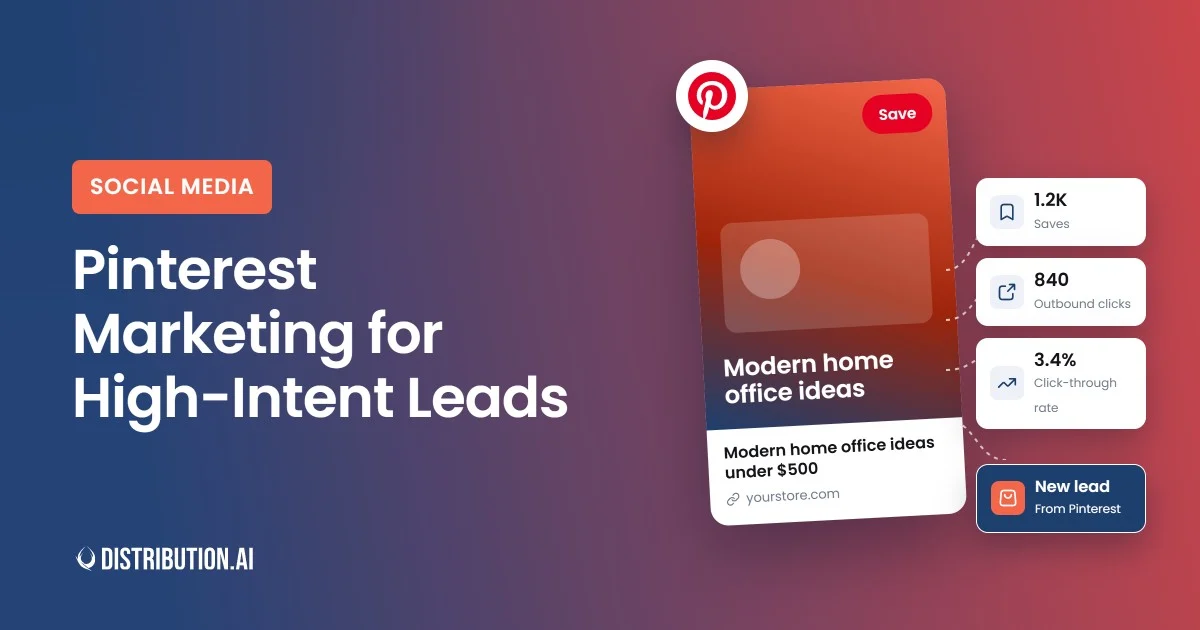
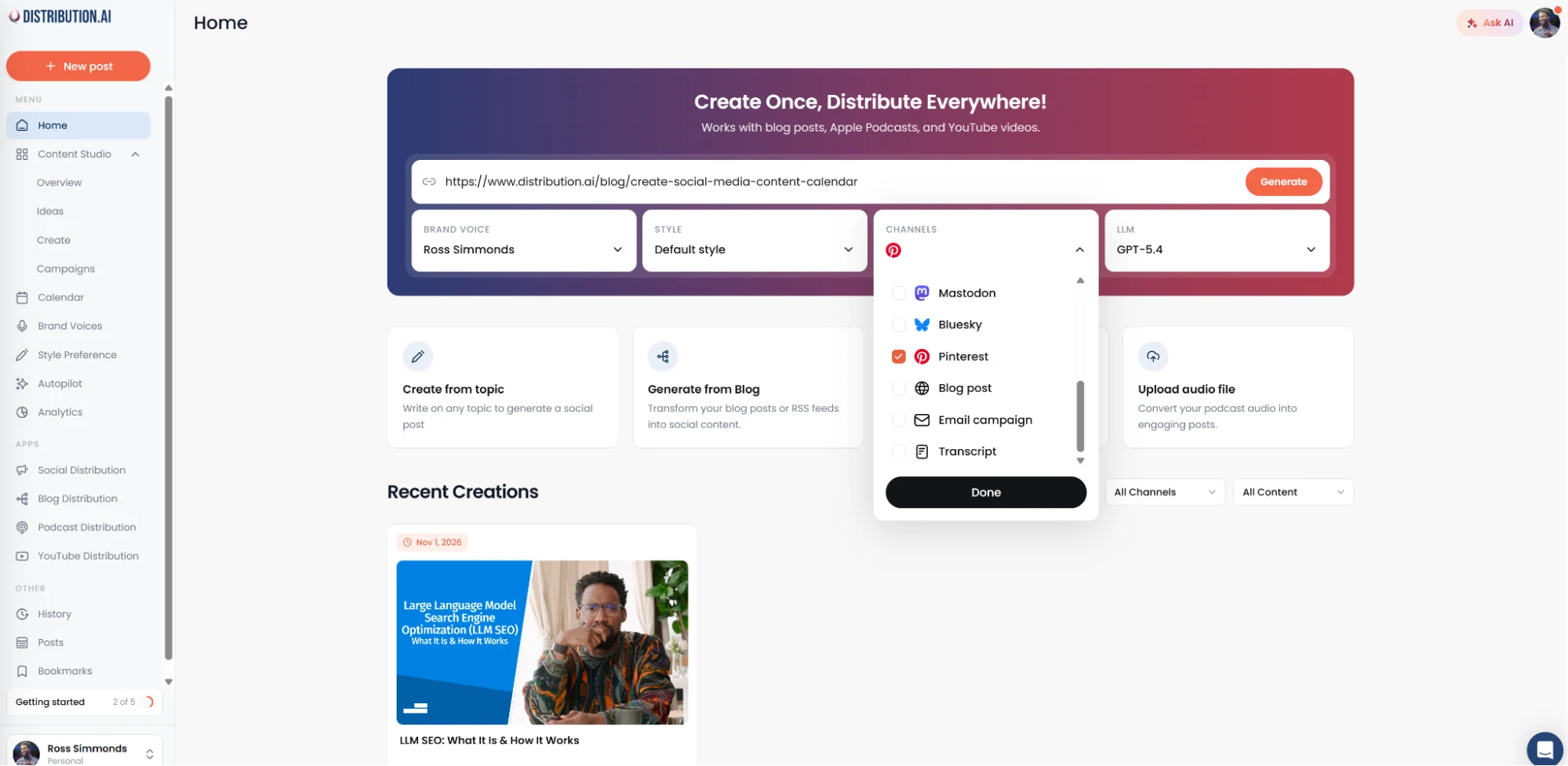
For repurposing, you need to paste the published link to an article or YouTube video, select Pinterest from the dropdown and click “Generate.”
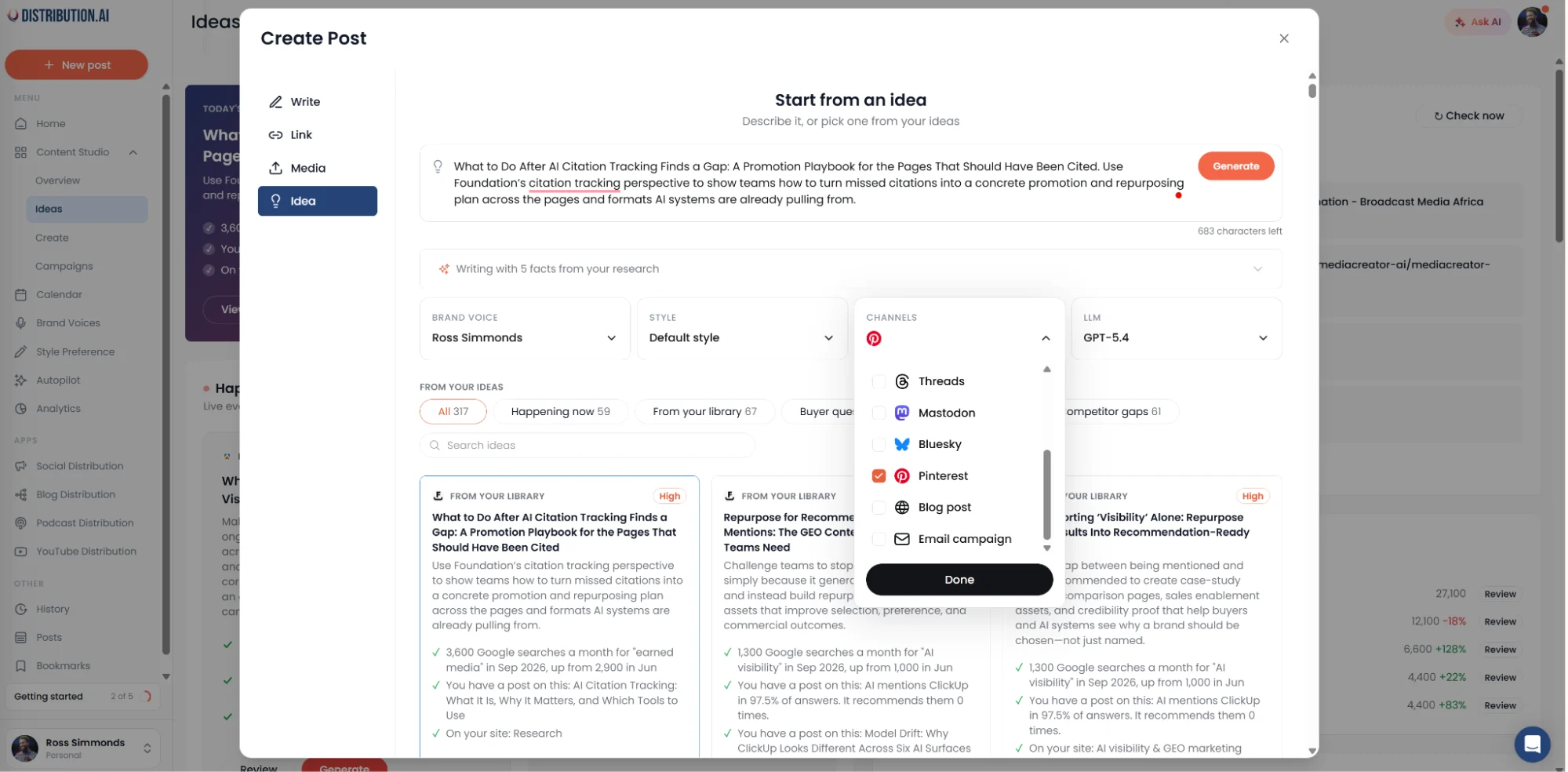
Alternatively, you can describe your idea and provide talking points to get multiple Pin variations in under a minute.
Then, you can polish them further before scheduling them for publication without leaving Distribution.ai.
*No credit card required. Cancel anytime.
Frequently Asked Questions
1. What Is a “Fresh Pin” and Does It Have to Link to a New URL?
A fresh Pin is any Pin with at least one new element, which can be an image, video, title, description and URL. It doesn’t need a new URL. The update signals newness to Pinterest’s algorithm, improving visibility in search results.
2. Is Pinterest Marketing Worth It for B2B or Service Businesses?
Yes, B2B and service-based businesses can publish visually rich, educational and research-focused content on Pinterest. An effective approach for such brands is to repurpose their existing assets like articles and videos into exploratory and aspirational Pins to attract high-intent leads.
3. How Long Does It Take to See Results From Pinterest Marketing?
The time depends on various factors like competition within your niche, content quality and publishing cadence. You can expect meaningful results (outbound clicks and saves) after 3–6 months of consistent publishing.
4. How Does Distribution.ai Help With Pinterest Marketing?
Distribution.ai turns your existing articles, videos and ideas into Pinterest-ready content pieces in under a minute. You choose from the variations and schedule them for publication after polishing them without leaving the platform. This streamlines the overall workflow significantly by accelerating content production.
5. Can I Create Brand New Pins With Distribution.ai in Minutes?
Yes. There are two ways to do it. First, paste the link to a published content piece (like an article or a YouTube video). Second, describe your idea or provide the key talking points and get on-brand content in under a minute.
Author

Promote, repurpose & distribute your content with AI
Start 15-Day Free Trial