Content Distribution Channels: How to Choose the Right Mix [With Examples]
Learn about owned, earned, and paid content distribution channels with real examples. Find the right mix for your goals and scale your distribution efforts.
Even the best content assets can’t drive conversions without a distribution plan. They exist, but almost no one finds them.
Content distribution channels get your content in front of the right audience. Choosing the right ones determines whether your content builds authority and converts readers long after it’s published. They’re an integral part of any content marketing strategy.
This guide breaks down every channel type with real examples, shows you how to choose the right mix for your goals and team size, and gives you a repeatable system to distribute without burning out.
What Are The Types Of Content Distribution Channels
Owned, earned, and paid are the three content distribution channels most marketers use. Here’s a breakdown of all three channels so you know which one works best and for what purpose.
| Channel Type | Cost | Control | Best For | Time to Results | Content Distribution Channel Examples |
|---|---|---|---|---|---|
| Owned | Low | High | Long-term organic growth | Slow but compounds | Blog, email newsletter, podcast, YouTube |
| Earned | No direct cost | Low | Brand credibility and authority | Slow and unpredictable | Press coverage, guest posts, social shares, backlinks |
| Paid | High | High | Fast reach and targeted campaigns | Immediate | PPC, paid social ads, sponsored content, newsletter sponsorships |
Owned content distribution channels
Owned channels are platforms that you own and control.
Your website, blog, social media accounts, podcast, YouTube channel, and email newsletter are owned content channels that you use for your brand’s messaging. They’re the best for building a content system that compounds over time and helps nurture audience relationships.
For example, you can create a company website for your visual identity and brand building. An optimized blog can bring in organic traffic, and email marketing campaigns can help you nurture leads. Social media marketing can act as an owned channel when used for organic posting, but reach depends on platform algorithms that you don’t control.
Use owned channels when:
- Building long-term organic traffic
- Nurturing a warm, existing audience
- Running on a tight budget with no ad spend
Where owned channels fall short:
- Cold outreach
- Campaigns with hard deadlines
- Fast visibility or immediate reach
Earned content distribution channels
Earned content channels are third-party spaces where others feature or share your content without any direct payment. Say a content creator talks about your product in their YouTube video, or someone shares your content on social media without being paid to do so.
Guest posts on industry publications, press coverage, and mentions in newsletters or communities like Quora and Reddit fall under earned channels.
One of the biggest advantages of earned channels is credibility. It’s the coverage you don’t pay for that makes it far more trustworthy than something you publish yourself.
Below are a few ways to increase your earned media coverage.
- Publish original research or insights that your industry doesn’t have
- Contribute guest posts and expert commentary to publications your buyers already read
- Participate in Reddit or Quora discussions and respond with genuine answers
- Make it easy for customers to share testimonials and product reviews
A few brands that have earned distribution well are Ahrefs, HubSpot, and Zapier. Ahrefs and HubSpot typically earn coverage with their original studies and State of Marketing report, respectively. The data gets cited across blog posts, social media, publications, and newsletters. Zapier’s earned distribution is based more on product utility. Users share workflows, tutorials, and recommend Zapier across communities. Additionally, all three brands have 1000+ product reviews across G2 and Capterra.
Paid content distribution channels
Paid channels are third-party platforms where you pay to promote your content to a specific audience. A few examples include Pay-Per-Click (PPC) ads, paid social media ads on LinkedIn, Meta, or Instagram, sponsored content, native advertising, newsletter sponsorships, and paid influencer partnerships.
In paid media marketing, you can define your target audience by industry, job title, company size, demographics, or behavior in ways that owned and earned channels can’t. While PPC ads help generate quality leads when paired with SEO and social media strategy, sponsored content with the right publication can help you reach more people through a source they already trust.
Paid channels work best for:
- Amplifying content that’s already performing well organically
- Launching time-sensitive campaigns
- Reaching cold audiences who don’t know your brand yet
- Retargeting warm audiences
When Atlassian wanted to reintroduce Confluence to a broader audience, they ran a full-funnel paid campaign on LinkedIn using Sponsored Content, Thought Leader Ads, and CTV Ads.
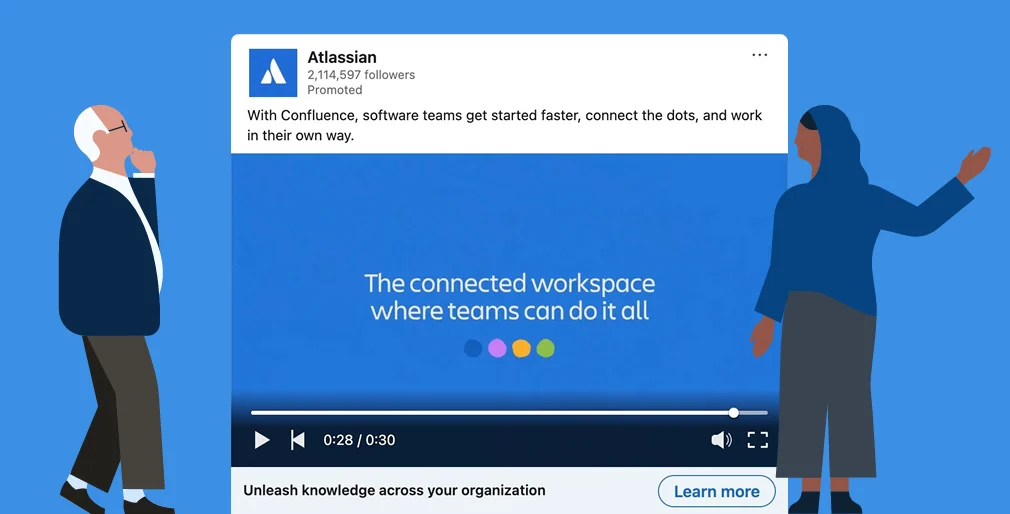
The campaign drove a 17% lift in aided brand awareness, a 120% increase in lower-funnel engagement, and a 57% incremental reach beyond LinkedIn’s core feed.
Paid distribution gave Atlassian immediate access to the right decision-makers across personas they couldn’t have reached through owned or earned channels alone.
However, paid channels aren’t ideal for:
- Building long-term brand credibility
- Sustaining visibility without spending
- Reaching audiences with high ad fatigue or ad blocker usage
How to Choose the Right Content Distribution Channels
Consider your campaign goals and your target audience when choosing content distribution channels. With so many options across owned, earned, and paid media, select the ones that align with your audience rather than spreading yourself thin across all of them.
Follow these steps to make an informed decision.
Define your goals first
Get clear on what you want to achieve. If driving organic traffic is the goal, start building your owned channels first. For building brand awareness and reaching more audiences, invest in social media channels and paid media. If you want to generate leads, email newsletters and ads might work based on your industry. So, list your goals, then map your content distribution channels.
Know your target audience
Find out which channel(s) your audience uses the most and what content formats they engage with.
If your audience is B2B buyers and decision-makers, LinkedIn and industry newsletters will outperform Instagram every time. If you’re targeting a younger audience, short-form video on TikTok or Instagram Reels may drive more reach than a blog post.
Use social media analytics and Google Analytics to identify where your existing traffic and engagement come from. Let the data tell you where your audience is before you commit resources to a new channel.
Match your channel to your content type
Tailor your content to fit the platform. Here are a few practical rules to follow:
- Publish your long-form content, like guides and research reports, on your website and share them via email newsletters
- Share product demos or industry insights on social media platforms like X or LinkedIn
- Host audio and conversational content on podcasts
- Upload video content to YouTube first, then repurpose it into shorter clips for social media channels
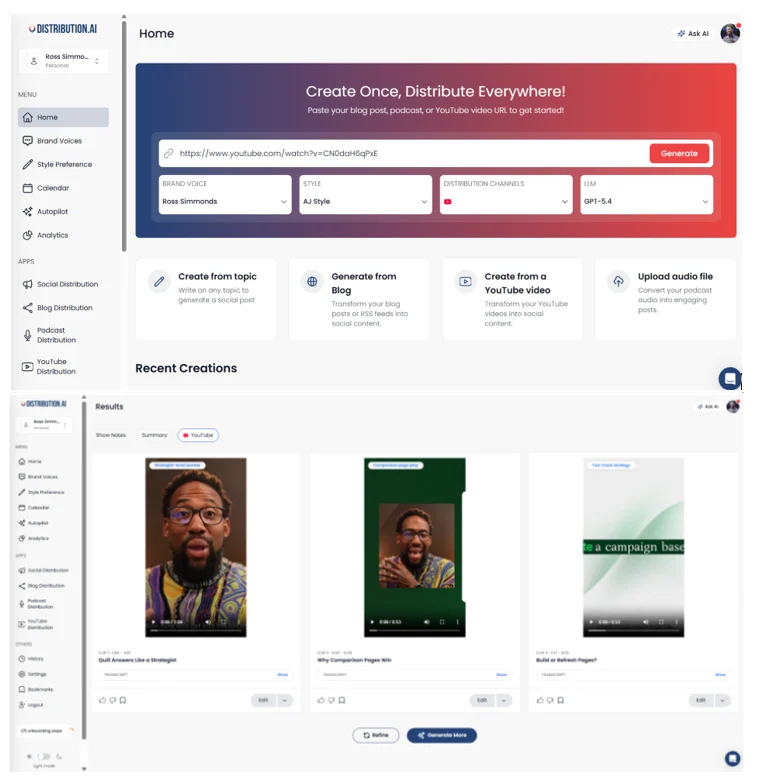
Distribution.ai can help you create these short clips in minutes. Copy-paste your YouTube video URL, choose the distribution channel YouTube Shorts, and generate. Once the process is complete, you get clips of your video along with a summary and show notes.
Categorize channels by funnel stage
Once you set your goals and know your audience, the funnel stage you are targeting becomes clear. Match your channel to where your audience is in the funnel to make your distribution more effective.
- Search engines, social media platforms, paid social ads, and press coverage for the top-of-funnel audience
- Email newsletters, YouTube, communities, and forums for mid-funnel
- Retargeting ads, email sequences, and direct outreach for bottom-of-funnel
Consider your budget and resources
Select the channels you can consistently invest in. If you’re a lean team, two channels done well will outperform five channels done inconsistently. Plus, you’ll burn your resources without yielding any results. A good practice is to start with owned channels, build them up, and then put your money into paid channels like targeted social media advertising.
Test, measure, and refine
Assign measurable objectives to every channel you choose. Suppose you start with LinkedIn as a distribution channel. Your objective could be 400-500 impressions per post and 20 profile visits per week within the first 60 days. For email newsletters, it could be a 30% open rate and 3% click-through rate within the first three months.
After you zero in on your distribution channels, the challenge is to post content consistently. We’ve got some ways that can help you distribute content the smart way.
5 Ways to Distribute Content at Scale
The best way to distribute content is the one that reduces your effort and ensures consistent posting, regardless of how busy your days are.
Plan your distribution
Build out a plan instead of creating and posting content on a whim.
For every piece of content, decide upfront which channels it will go to, in what format, on which dates, and who’ll be responsible for execution.
A B2B SaaS marketing team publishing a new case study, for example, might plan their content distribution like this:
| 1 | Case study | Long-form post with key results | |
| 2 | Case study stat | Email newsletter | Featured insight with CTA |
| 3 | Blog post | X | Thread pulling three key points |
| 4 | Blog post | Value-first comment with link | |
| 5 | Podcast episode | Short quote graphic |
Repurpose every asset across formats and channels
One of the best ways to maximize the value of a content piece is repurposing. Plus, it saves you hours of brainstorming. One long-form asset contains enough material to fuel weeks of distribution across multiple channels.
A single blog post can become an email newsletter, a LinkedIn carousel, a series of social media posts, a short-form video script, and a podcast talking point. Similarly, a webinar recording can become a blog recap, a highlight clip for Instagram, a quote graphic for X, and a follow-up email sequence.
And if you get a tool like Distribution.ai, you can repurpose content effortlessly. You simply need to add your blog post, podcast, or video link, and the platform automatically generates social media snippets, video clips, blog posts from podcasts, show notes, transcripts, and even newsletters. It ensures every piece of content generated is tailored to the channel or platform you choose and follows the same brand voice for consistency.
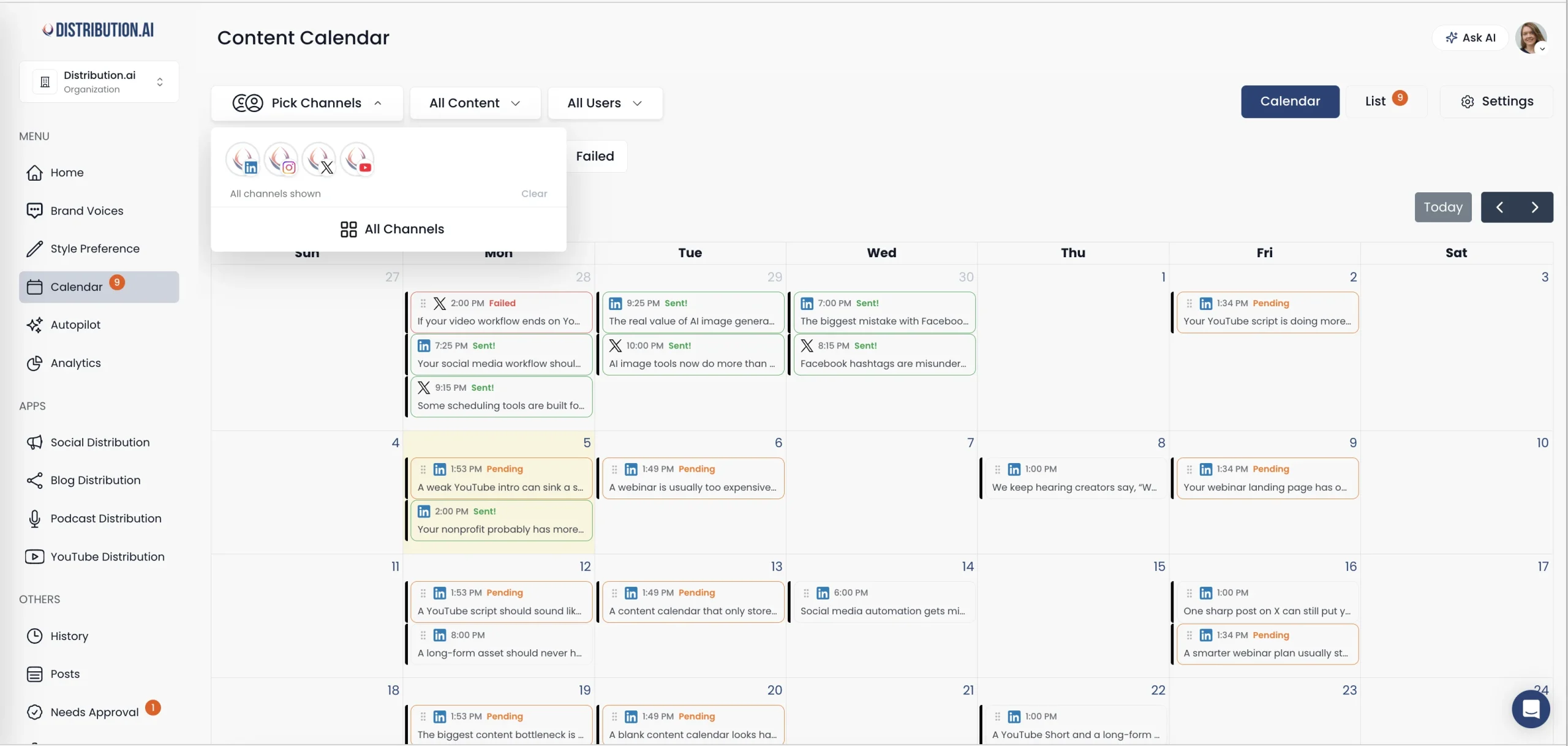
Here’s how a user put Distribution.ai into action and got results.
Establish a consistent publishing cadence
Publishing three times a week and sustaining it works better than publishing daily for two weeks and then going quiet. Creating a realistic publishing schedule enhances brand visibility over time because your audience learns when to expect content from you, and algorithms reward accounts that post regularly.
For example, a content team at a mid-size marketing agency might commit to two LinkedIn posts per week, one email newsletter every Tuesday, and one new blog post every other week. This rhythm is sustainable and helps you build visibility.
Syndicate your existing content to reach new audiences
Content syndication is a content distribution strategy that means republishing your existing content on third-party platforms to reach audiences that wouldn’t find your owned channels organically.
A few examples include publishing on Medium, LinkedIn Articles, or contributing to industry newsletters and publications to reach audiences who have never heard of your brand.
A key aspect of syndication is canonical tagging. When you syndicate a blog post on Medium or another platform, make sure the canonical URL points back to your original article. This brings in traffic to your owned channels while expanding your distribution reach.
Use paid distribution to amplify what’s already working
Paid distribution accelerates your organic content distribution efforts. The most effective approach here is to identify your top-performing organic content. For example, choose a blog post driving strong search traffic or a LinkedIn post generating high engagement and use it in your paid media to extend its reach to cold audiences.
This approach works because you know that the content resonates. So, you amplify the message so it reaches people beyond your existing pool.
How to Measure Content Distribution Performance
Track the core distribution metrics of your channels to understand how well they’re performing. Here’s a breakdown of the metrics you should track.
Key metrics to track by channel
Owned channels
- Website traffic is the number of visitors who land on your content via search engines. Track this in Google Analytics to understand which blog posts and pages are pulling in organic traffic without paid spend. If a post consistently drives traffic, it’s worth updating and repurposing.
- Email open and click-through rates tell you whether your subject line and email content are compelling enough to drive action. For B2B SaaS email marketing campaigns, an open rate between 28-42% and a click-through rate of 3-7% are considered good.
- Time on page measures how long readers spend on your content. A high time on page signals that your content is genuinely useful. A low time on page on a long-form piece usually means the content isn’t delivering value.
- Search engine ranking determines where your content appears in search engine results pages for your target keywords. Track this regularly using Ahrefs or Semrush. A piece ranking on page two for a high-value keyword is worth a refresh and a redistribution push across your content marketing channels to move it to page one.
Earned channels
- Backlinks signal to search engines that your content is credible and worth ranking. Track these in Ahrefs or Semrush and pay attention to the domain authority of linking sites.
- Referral traffic means the visitors arriving at your website from external sources like guest posts or community shares. High referral traffic from a specific earned channel tells you it’s worth investing more in that format.
- Social shares and mentions show how often your content is shared or mentioned across social media platforms without paid promotion. Use social media analytics and Google Alerts to track brand and content mentions. A spike in social shares after publishing content usually points to a topic or format worth repeating.
- Media mentions cover the number of times your brand or content is referenced in media outlets, newsletters, or industry publications. Positive press coverage boosts brand recognition significantly and is one of the clearest signals that your earned distribution is building real authority.
Paid channels
- Click-through rate (CTR) measures the percentage of people who clicked your ad after seeing it. A low CTR on a paid social ad signals a creative or targeting problem. Test different headlines, visuals, and audience segments before scaling your paid content distribution spend.
- Cost per lead (CPL) shows how much you’re spending to acquire each lead through a paid channel. This is to see whether paid distribution is generating a return worth the investment. Track CPL by channel and campaign to understand where your budget is driving the most lead generation value.
- Conversion rate shows the percentage of people who took a desired action after clicking through from a paid ad, whether that’s starting a trial or booking a demo. A high CTR with a low conversion rate usually points to a landing page problem.
- Impressions and reach highlight how many people saw your paid content and how many unique users were exposed to it. It’s useful for brand awareness campaigns. Pair with engagement metrics to understand if your reach is leading to interactions.
Build a feedback loop
Besides tracking metrics, creating a feedback loop for your content distribution efforts can help you review your content performance metrics on a regular cadence. Based on this, you can cut underperforming channels and reallocate resources to channels driving real results.
For example, set up a team that reviews distribution data every month.
If you notice your LinkedIn articles or posts generating strong referral traffic to the blog, but your X posts collecting impressions with almost no clicks, shift your resources. Rather than splitting effort equally, focus more on sharing social media content on LinkedIn and reduce X to a minimal presence. Redirect saved time toward email marketing campaigns that are converting at a higher rate.
That’s what a feedback loop helps with: it turns your content performance data into a leaner, more focused content distribution strategy over time.
Tools like Distribution.ai make this easier by centralizing your content performance metrics across all channels in one dashboard, so you can see what’s working across LinkedIn, Instagram, X, and Facebook without switching tools or platforms.
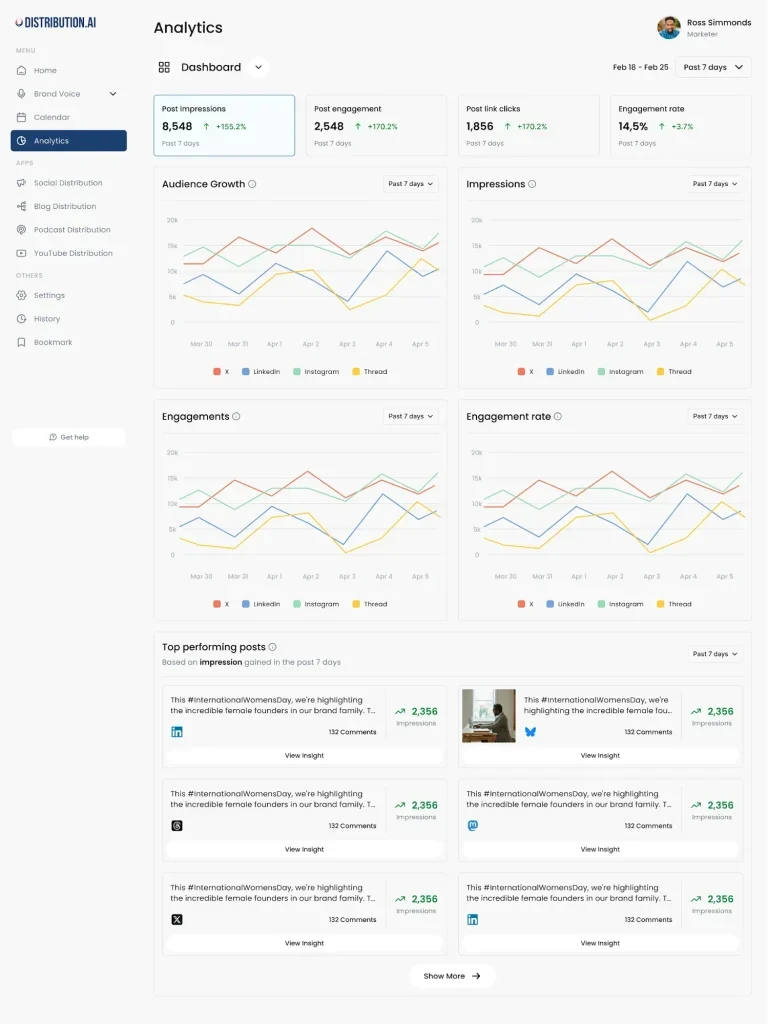
Start With Your Content Distribution Planning Today
If you’re spending 80% of your time creating content and only 20% distributing, your content will never reach the larger audience.
A content distribution system helps you expand your content’s reach and building one doesn’t necessarily require a large team or budget. You need clarity on which channels your audience uses, a plan, and a consistent cadence you can sustain.
Start with your owned channels. Build earned credibility over time. Use paid to amplify what’s already working. Repurpose every asset across formats so one piece of content fuels weeks of distribution across multiple channels.
And if you have a lean team, tools like Distribution.ai can help you turn every blog post, podcast, and video into platform-ready posts across LinkedIn, Instagram, X, Facebook, and email automatically, from one dashboard.
Frequently Asked Questions
What are content distribution channels?
Content distribution channels are the platforms and methods you use to share, promote, and amplify your content to reach your target audience. They fall into three categories: owned channels like your blog and email newsletter, earned channels like press coverage and social shares, and paid channels like PPC ads and sponsored content.
How many content distribution channels should I use?
Start with two or three channels you can show up on consistently. Spreading your distribution efforts across too many channels at once leads to inconsistent posting and poor results. Build a rhythm on your core owned channels first, then layer in earned and paid channels once you have a sustainable cadence and content performance metrics to guide your decisions.
What is the best content distribution channel for a small marketing team?
For small teams, owned channels offer the highest long-term ROI with the least ongoing spend. Start with an SEO-optimized blog for organic traffic and an email newsletter for direct audience nurturing. Both compound over time and give you full control. Add earned channels like guest posts and community participation once your owned foundation is in place.
Is content syndication the same as content distribution?
Content distribution is the broader process of sharing your content across owned, earned, and paid channels. Content syndication is one specific tactic within distribution: republishing your existing content on third-party platforms like Medium or industry publications to reach new audiences. Syndication extends reach without creating new content.
How often should I distribute content across different channels?
Consistency matters more than frequency. For most teams, two to three social media posts per week, one email newsletter per week, and one to two blog posts per month is a strong starting point. Use your content performance metrics to adjust cadence based on what drives the most engagement and referral traffic.
What is the difference between content distribution and content promotion?
Content distribution is the systematic process of getting content in front of your target audience across multiple channels, including owned, earned, and paid media. Content promotion is a subset of distribution focused specifically on amplifying a single piece of content through paid or earned channels. Distribution is the ongoing system; promotion is the campaign-level push behind specific content.
Can the same content be distributed across all channels without changes?
Tailoring content to fit the platform improves engagement and reach significantly. A LinkedIn post, an Instagram caption, and an email newsletter require different formats, lengths, and tones even when they communicate the same core message. Repurposing content means adapting it to each channel natively, instead of copy-pasting the same text everywhere.
Promote, repurpose & distribute your content with AI
Write 10x faster, engage your audience, & never struggle with the blank page again.
Start 15-Day Free Trial
Frequently Asked Questions
Author

Promote, repurpose & distribute your content with AI
Start 15-Day Free Trial