How to Build a Content Repurposing Workflow for Faster Content Distribution
Learn how to build a scalable content repurposing workflow that turns long-form assets into multi-channel distribution engines and maximizes marketing ROI.

Marketing teams pour hours into creating in-depth content pieces, such as blog posts, long-form video content and podcast episodes.
Then, they hit publish and move on to the next thing.
Sound familiar?
That “one-and-done” approach is one of the biggest reasons why content loses momentum. You invest all that creative energy, and then the piece just… sits there, slowly collecting dust in your content library.
A content repurposing strategy flips that, maximizing the ROI of your creative efforts.
Basically, you create ten short-form social media posts from one long-form asset, which are distributed across multiple platforms.
But you already know that. The real bottleneck isn’t the absence of a content strategy that prioritizes distribution through repurposing.
It’s the lack of a scalable system.
Without a repeatable content repurposing workflow, teams end up doing this ad hoc, grabbing a quote here, cropping an image there, and the effort fizzles out within weeks.
A proper workflow turns repurposing into a growth engine that drives consistent content distribution without burning out your team.
In this article, let’s look at how to build a content repurposing workflow from scratch, one that helps you create more content and reach new audiences to get you significantly more ROI from every piece you publish.
5 Steps to Build Your Content Repurposing Workflow
Building a content repurposing framework needs to be intentional. Here are five steps that give you a repeatable system for turning your best work into a multi-channel content engine.
1. Identify Assets with High-Leverage Repurposing Opportunities
The Goal: Find evergreen or top-performing assets that have already proven their value and are ready for multi-platform adaptation.
Before you start chopping up blog posts into social media posts, you need to figure out which assets actually deserve the spotlight. The best candidates are what you might call “pillar” content, such as comprehensive guides, long-form articles, research reports, webinars or podcast episodes that cover a topic in depth.
You can identify them with a content audit that digs into your analytics to find what’s already performing well. These include blog posts that are pulling organic traffic months after publication or YouTube videos that keep generating comments.
These are your high-performing content pieces, and they’ve already been validated by your audience.
The next step here is to prioritize these assets. A good rule of thumb is to put the evergreen content pieces at the top. This could be a detailed guide on marketing strategy for B2B SaaS or a technical SEO checklist for busy teams.
Such pieces have a much longer shelf life than a recap of last quarter’s trends within your niche.
Moreover, the repurposed content from evergreen assets, by definition, is evergreen. Consequently, they will deliver value long after you’ve published them.
Simply put, don’t reinvent the wheel. Build your repurposing strategy around what’s already working, and you’ll have a much stronger foundation for everything that follows.
2. Create Atomic Content for Multiple Platforms
The Goal: Deconstruct long-form pillars into bite-sized, independent pieces of content tailored for different channels.
Once you’ve identified your best assets, it’s time to break them down into what’s sometimes called “atomic content.” They are small, self-contained pieces that can stand on their own across various platforms.
A single long-form blog post might yield a dozen LinkedIn posts, a handful of tweets for X, an eye-catching infographic, short videos for Instagram Reels and a carousel for thought leadership on LinkedIn.
The key is adapting the narrative style and format to fit each platform. What works as a 2,000-word blog post doesn’t translate directly to a punchy social media post.
You need to extract the key takeaways, such as the provocative quotes, the surprising data points and the step-by-step frameworks, and reshape them into content formats that feel native to wherever they’ll be published.
For instance, a professional, insight-driven tone works well for LinkedIn, whereas sharp, emotional hooks are more effective on X.
This is where a lot of teams get stuck, because manually creating all these different formats is genuinely time-consuming.
Until now.
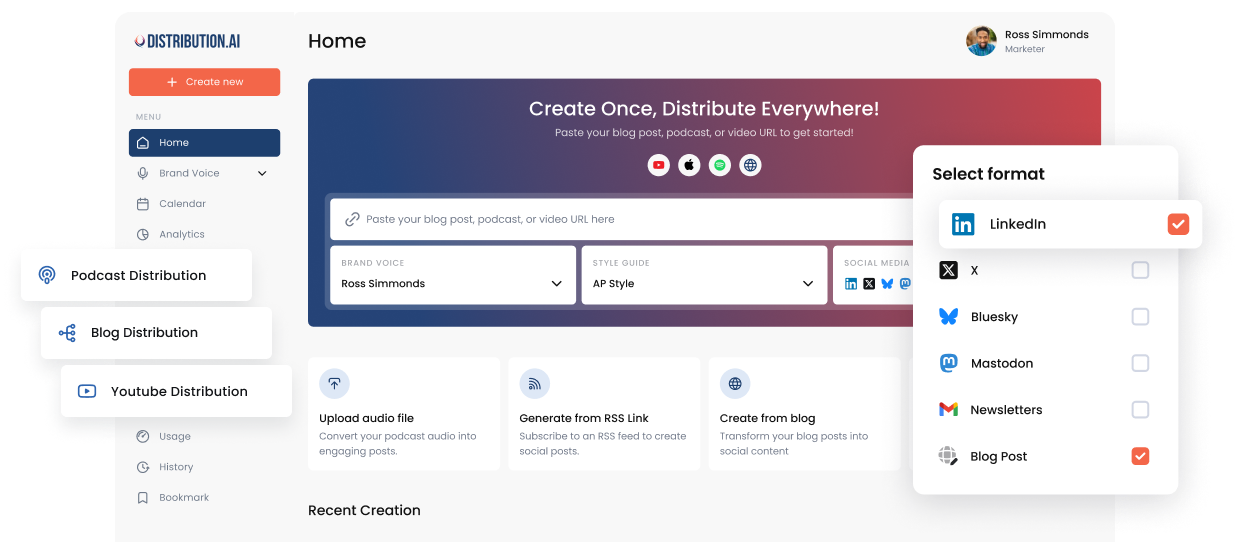
Distribution.ai, a content repurposing suite, does it all for you in under a minute!
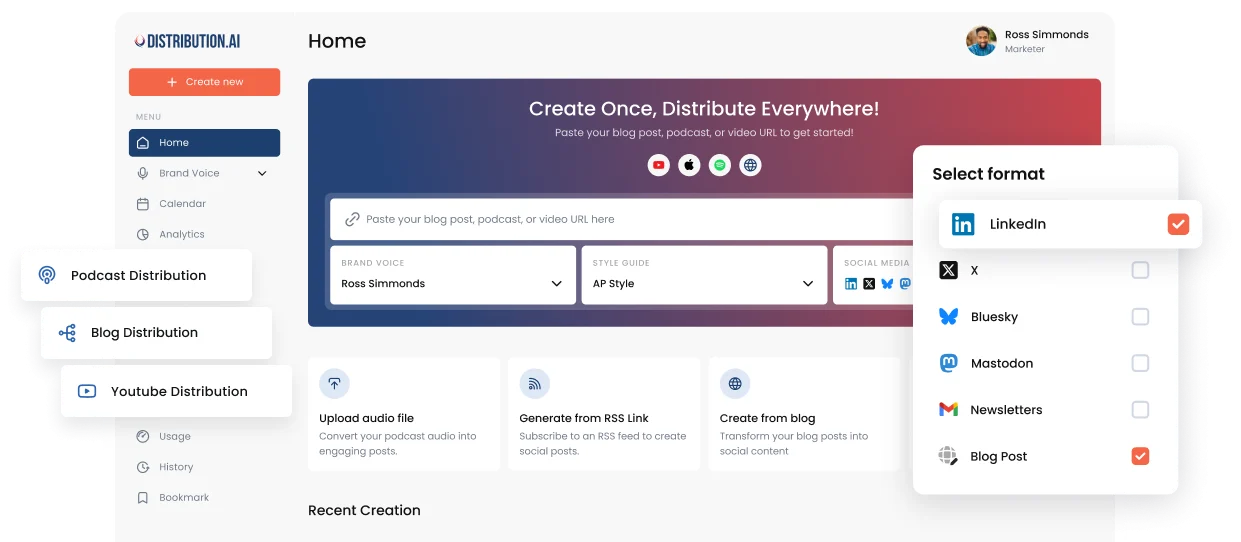
You feed it a link to your published article, YouTube video or podcast, and it uses AI to generate social posts for various platforms almost instantly.
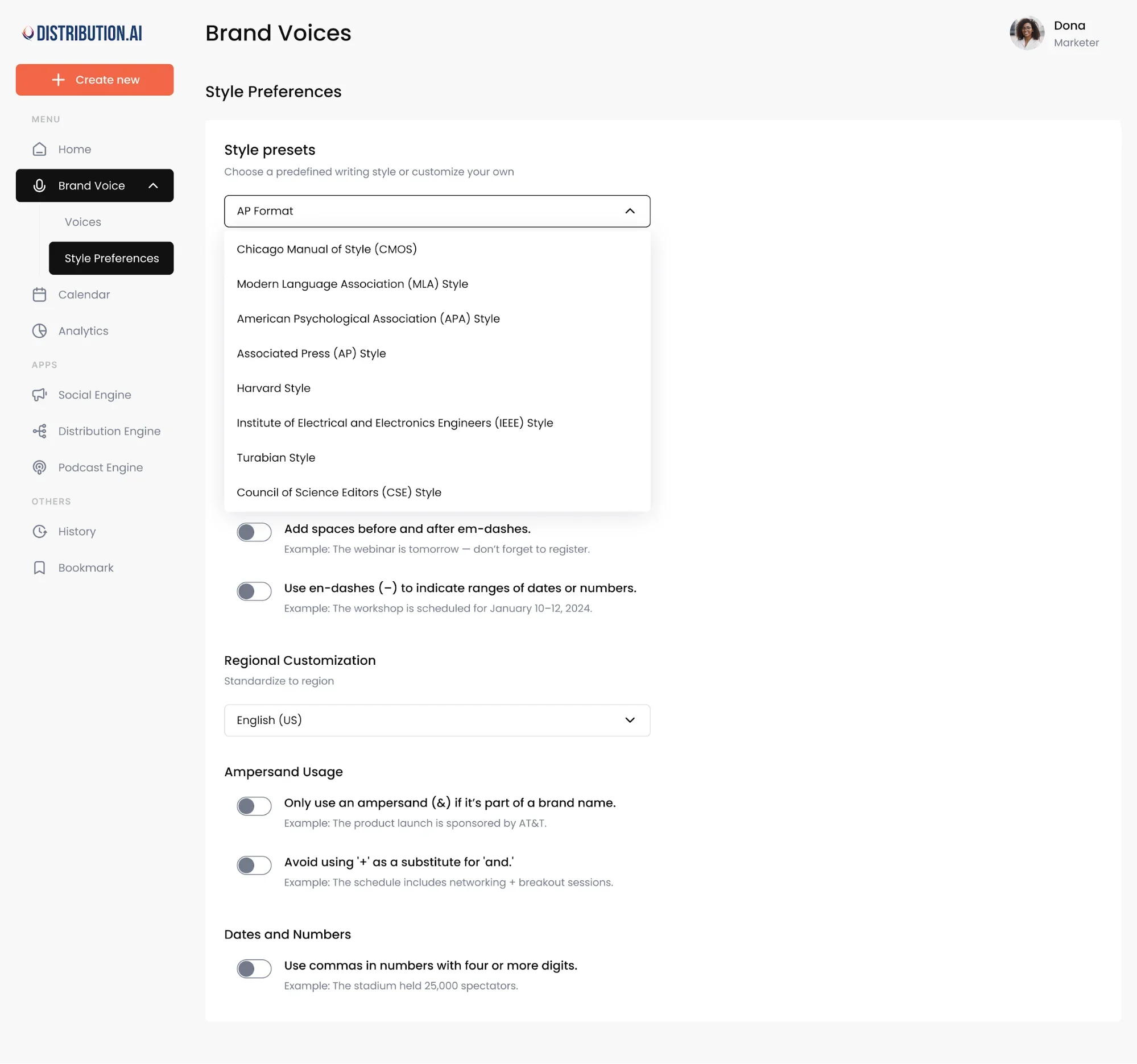
Of course, you give it your brand’s style and tone guidelines and pick the LLM that you think will work perfectly for your message. That means the repurposed content actually sounds like you, reducing editorial overhead down the line.
The autonomous Distribution Agents of the platform handle the heavy lifting of creating content for each long-form content type. This ensures a streamlined approach when you quickly want to produce several atomic content pieces.
3. Review and Schedule Posts for Your Audience
The Goal: Maintain a consistent “always-on” brand presence by planning the distribution of repurposed assets across a strategic timeline.
This step is about building a content calendar that keeps your brand visible across social media channels by delivering more value that meets your audience’s expectations.
Before anything goes live, run every repurposed piece through an internal review. Check for factual accuracy, content relevance, logical flow and consistent brand voice.
It’s tempting to skip this when AI handles the drafting, but a quick human review is what separates polished content from something that feels off.
Distribution.ai facilitates this through the tone and style customization features we mentioned earlier to ensure the initial drafts are close to your expectations. This makes your review process more about fine-tuning rather than heavy editing or rewriting.
After the content pieces are approved, you can use Distribution.ai’s built-in calendar to schedule content for multiple platforms at once.
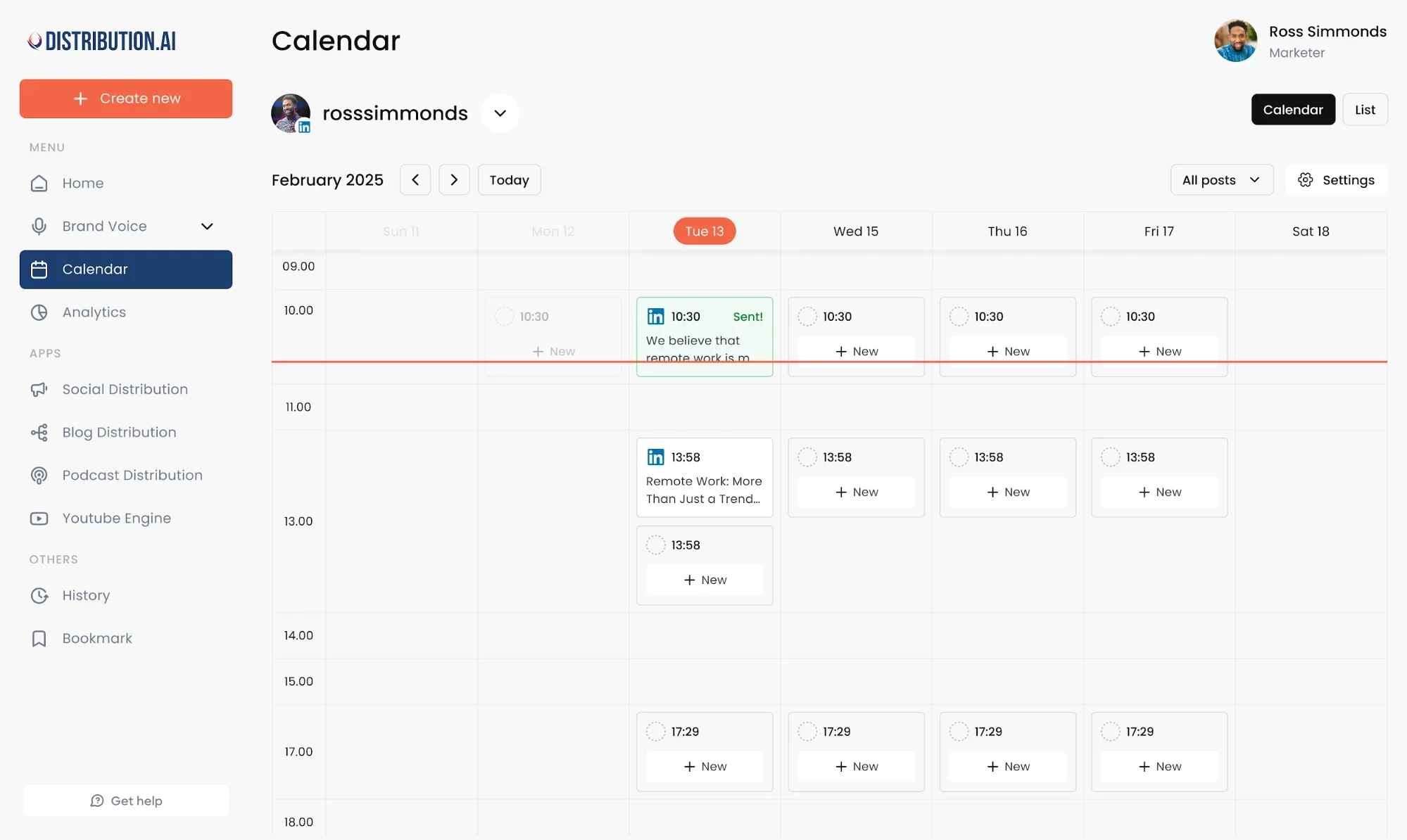
However, avoid pushing the content out too frequently. Flooding your audience’s feed can dilute your brand’s presence, affecting engagement. It’s better to treat your calendar as a drip campaign that allows each repurposed piece to breathe.
A well-planned schedule ensures your target audience sees a steady stream of fresh content from you, which builds familiarity and trust over time. That drives demand generation and audience engagement.
4. Leverage Automation to Scale Content Repurposing
The Goal: Remove the manual labor from the creative process, allowing teams to produce significantly more content in the same amount of time.
Here’s where things get really interesting. Steps 1 through 3 still involve a fair amount of hands-on work, such as auditing content, creating atomic assets, reviewing and scheduling.
Automation does it all on its own to scale your content repurposing process.
It pulls long-form structured content from your existing channels, which include your blog feed, YouTube channel and podcast feed, and automatically transforms it into bite-sized pieces tailored for various social media platforms.
Distribution.ai’s Autopilot feature is designed for exactly this.
You connect it to your content sources, and it monitors for new assets automatically. When you publish new blog content or upload a YouTube video, the system kicks in to pull the content, generate social posts and queue them for review or direct publishing.
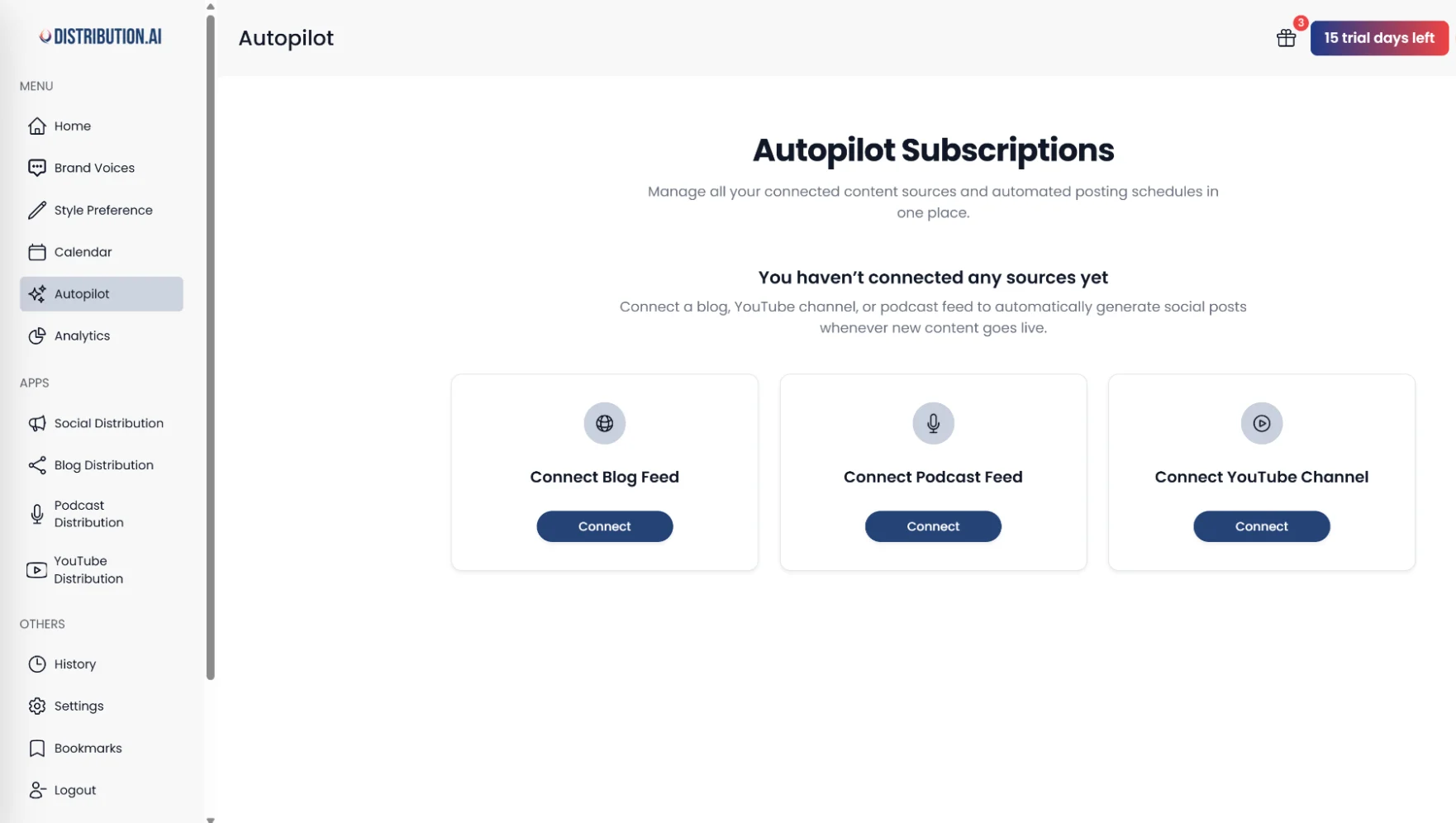
It takes care of content distribution without requiring your constant oversight.
This shift is important for how your team thinks about their role, too. Instead of spending hours drafting and formatting social posts from scratch, your team adopts an “editor-first” mindset.
Generative AI handles the heavy lifting of content creation, and your people focus on what they do best: refining the message and making sure everything aligns with your broader marketing strategy.
It’s a fundamentally different way of working, and it makes sense for lean teams that need to do more with less.
5. Track Performance and Iterate Your Approach
The Goal: Close the loop by identifying which repurposed formats resonate most, allowing for data-driven refinements to your workflow.
A content repurposing workflow iteratively improves your approach to help you get better results with time. And you can do that by monitoring key performance metrics.
Start with impressions and engagement for each repurposed piece. Impressions reflect the reach of your piece and engagement gives insights into whether it’s relevant to your audience.
Then, you can zero in on the formats, such as short videos and written content, that deliver the best results or the platforms that generate the most clicks to your website.
These performance insights will tell you where to double down and what to adjust.
Additionally, it’s essential to A/B test different hooks and calls-to-action when promoting long-form content. The insights here will uncover a granular understanding of what tone and style cuts through the noise while maintaining your brand’s identity.
And you can do it all with Distribution.ai’s integrated Analytics dashboard. The unified view tells you how your repurposed content is performing across multiple social channels.
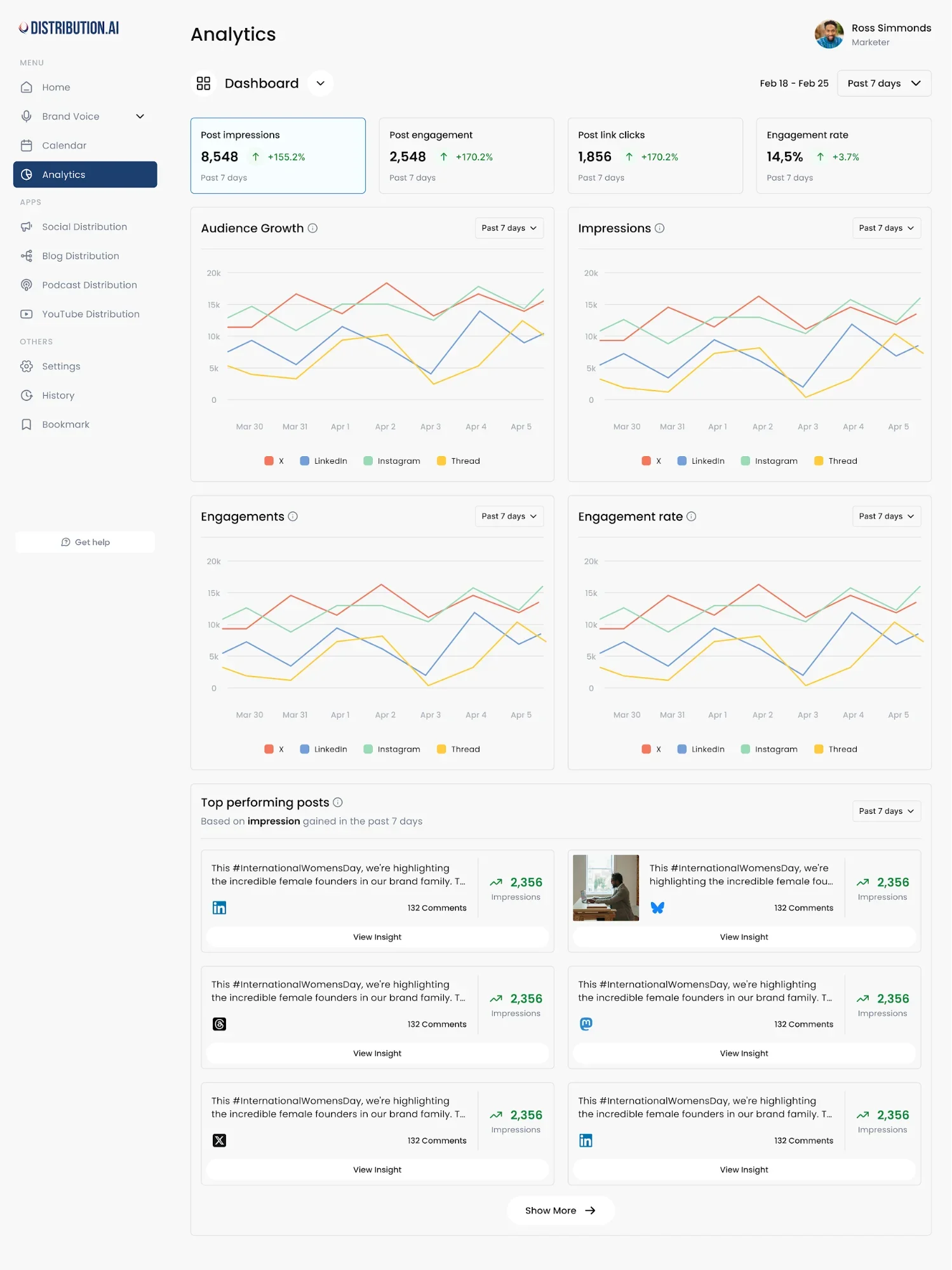
With everything in one place, you can quickly spot the winning formats or approaches that drive meaningful ROI, such as lead generation or organic engagement.
Repurpose Content Effortlessly at Scale with Distribution.ai
Content distribution is the difference between having great ideas and actually getting those ideas in front of people.
You can create the most valuable content in your industry, but if it only lives in one place, you’re leaving an enormous amount of reach and revenue on the table. That’s why repurposing content is a core part of any marketing strategy.
Distribution.ai makes that effortless without compromising speed and quality by replacing the fragmented marketing tech stack most teams struggle with.
Rather than a separate tool for writing, scheduling, reviewing and analytics, Distribution.ai brings it all under one roof.
The platform was built with a distribution-first approach centered around content repurposing.
Its AI drafting assistant creates content for multiple social media platforms from long-form multimodal assets based on your tone and style guidelines. You can instantly schedule them in its calendar and track their performance in real-time through the integrated dashboard.
Ready to maximize your content’s ROI through scaled repurposing?
Promote, repurpose & distribute your content with AI
Write 10x faster, engage your audience, & never struggle with the blank page again.
Start 15-Day Free Trial
Frequently Asked Questions
Author

Promote, repurpose & distribute your content with AI
Start 15-Day Free Trial