Content Localization for Shorts, Reels & TikTok: 2026 Guide
Learn how content localization helps Shorts, Reels, and TikTok feel native in international markets while boosting watch time and conversions without reshooting.

You can post the same video to Shorts, Reels, and TikTok. Most teams do.
The problem is expecting the same video to perform the same way.
These platforms look similar, but they reward different behavior. Shorts leans into utility and search. Reels favor polish and community signals. TikTok rewards participation and cultural fluency.
Once you’re publishing to international markets, that gap gets bigger. The words, pacing, visual elements, and cultural references that feel natural in one market can feel off in another.
That’s why content localization matters. In this guide, we’ll break down what each platform rewards in 2026, and how to localize your content without sacrificing quality.
What Is Content Localization?
Content localization is the process of adapting your content for a specific market so it feels natural to the people you’re trying to reach.
It’s not just translating words from one language to another.
A translation process can get the meaning across, but content localization goes further. It accounts for cultural nuances, cultural references, local context, and audience preferences, so the message lands the way you intended.
That can mean rewriting on-screen text in the native language, adjusting examples for local audiences, or changing visual elements that don’t make sense in a new region.
It can also include local search results, the user journey, and even parts of the user interface if you’re localizing product content.

In short, localized content is what happens when you localize your content for the target audience, in their own language, for their specific market, without sacrificing quality.
Content Localization vs Translation: What’s the Difference?
Translation helps people understand the words. Content localization helps the message land.
If you’re going into international markets, the difference shows up fast.
A direct translation can be technically correct and still feel “off” to local users because it ignores cultural context, cultural references, and how people actually speak in their own language.
| Translation Process | Content Localization Process |
|---|---|
| Converts text from one language to a target language | Adapts content for a specific market and intended audience |
| Focuses on accuracy of words | Focuses on meaning, tone, and local context |
| Often misses cultural nuances | Accounts for cultural preferences and cultural sensitivities |
| Usually text-first | Includes visual elements, examples, UI copy, and formatting |
| Works for basic understanding | Works for engagement and conversion rates in foreign markets |
Why Content Localization Matters More Than Platform Specs
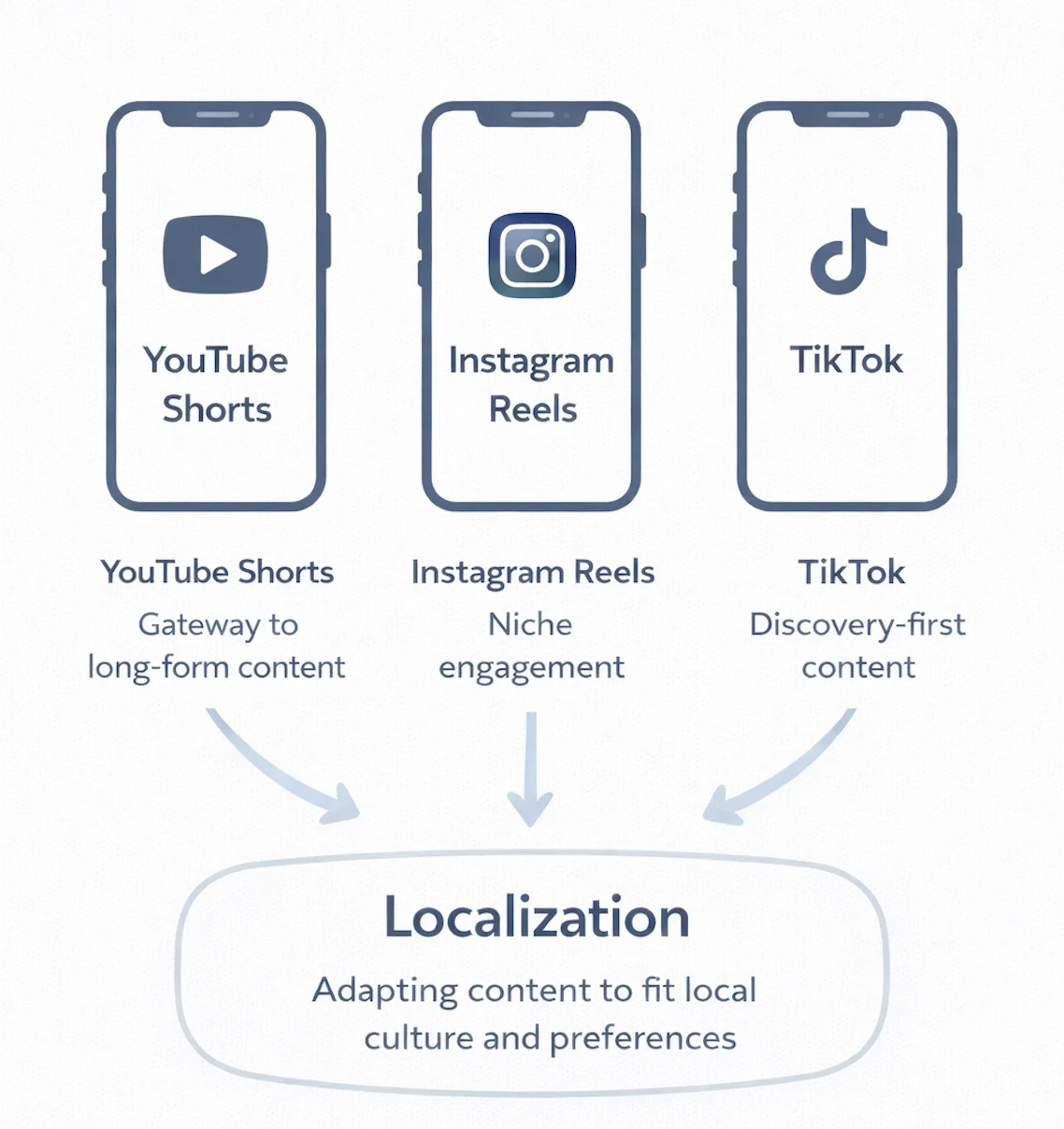
The platforms look the same at a glance: vertical video, trending sounds, text overlays.
But post the same clip on Shorts, Reels, and TikTok for two weeks and the illusion breaks.
Because the real difference isn’t the specs. It’s the context.
1. YouTube Shorts
YouTube Shorts generates 70 billion daily views, but its real power isn’t in those views, it’s in what happens next.
Shorts is the gateway into YouTube’s full ecosystem. Someone hits a 45-second clip, then takes the next step into a longer tutorial, a product walkthrough, or a case study on the same topic.
That’s also why Shorts has a different shelf life than the other platforms. When your content is useful, the algorithm can keep resurfacing it when people search for related keywords weeks or months later.
From a content localization standpoint, this matters. Your best Shorts either solve a problem right there, or tee up the full story so cleanly that clicking through feels like the obvious move.
2. Instagram Reels
Instagram users spend 50% of their time on the app watching Reels, but they’re not just discovering random clips.
Reels sit inside relationships. Your content gets surfaced through creators people already follow, friends, and algorithmic recommendations shaped by years of Instagram curation.
That’s why Reels rewards content that feels like it belongs in a specific corner of the platform: the color palette, the typography, the pacing, even the micro-niche humor your community recognizes.
One more thing: people tend to engage most with short-form videos and simple static images when interacting with brands on Instagram. Keep it tight, keep it clean, and localize your content so it feels native to your target market.
Reels can go wide, but more often it goes “right”: the right local audiences, in the right mood, at the right moment.
3: TikTok
TikTok will hand your idea to a small panel of strangers, study what they do, and either keep passing your clip around or move on.
TikTok users spend an estimated 52 minutes per day on the platform, and the app is frank about novelty. It rewards the courage to try something that doesn’t match your last ten posts.
Duolingo found TikTok success by embracing “unhinged” marketing, growing from 50,000 to over 8 million followers with a 19.9% engagement rate, nearly 5x the median engagement rate for brands.
It also cares less about your follower count and more about whether this specific video makes local users stop scrolling. And the comments, when you invite them, can be half the content.
A solid content localization strategy on TikTok is about cultural fluency: the local language, cultural references, cultural nuances, and the pacing that feels native to that target audience
Different physics means different choices. If you force the same cut of the same video across multiple markets and international audiences, you’ll always feel like you’re leaving your reach on the table.
The Same Idea, Three Native Versions
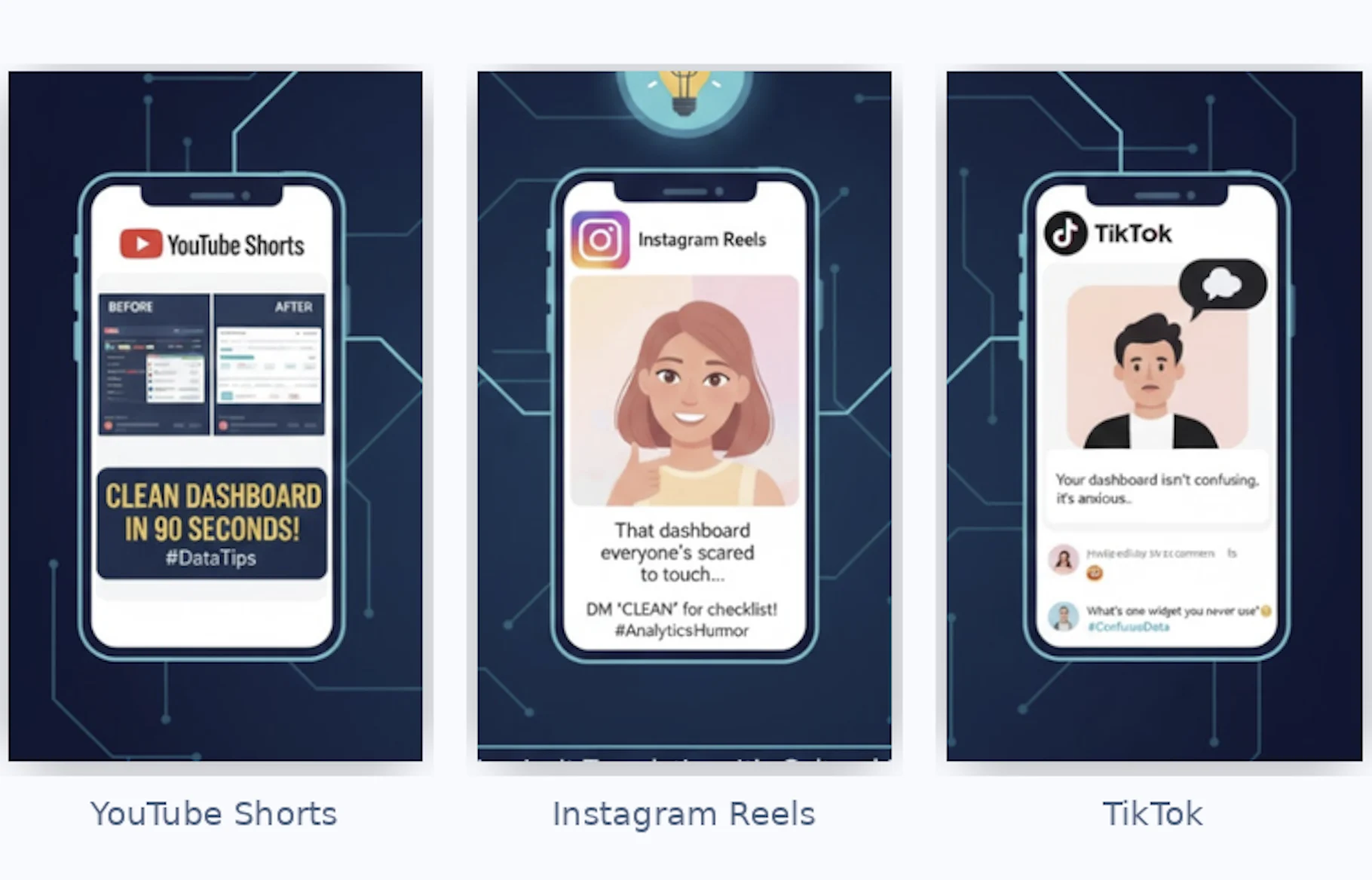
Say you’re a B2B brand teaching one tactic about how to clean up a messy analytics dashboard. Same idea, same message.
But if you post it “as is” everywhere, you’re basically asking three different platforms to behave the same way. They won’t.
1. YouTube Shorts
Shorts is a gateway. People snack on the clip, then decide if you’re worth a longer watch.
Open with a clean promise (“Fix this dashboard in 90 seconds”), show the before/after fast, and end with a clear next step that sends them to the full tutorial.
2. Instagram Reels
Reels live inside familiarity. Your target audience is often one swipe away from friends and creators they already trust.
So polish matters. Visual elements matter. Even the tone matters. Keep it tight, make it look like it belongs on their feed, and use a simple CTA that builds the relationship (“DM me ‘CLEAN’ for the checklist”).
3. TikTok
TikTok is discovery-first.
It throws your video at strangers and watches what they do with it. Start with a line that stops the scroll, keep it conversational, and invite the comments to help shape the content. On TikTok, the replies can be half the video.
That’s content localization in real life. It’s adapting content for the local context of each platform so your localized content feels native to the intended audience.
How to Build a Localization System
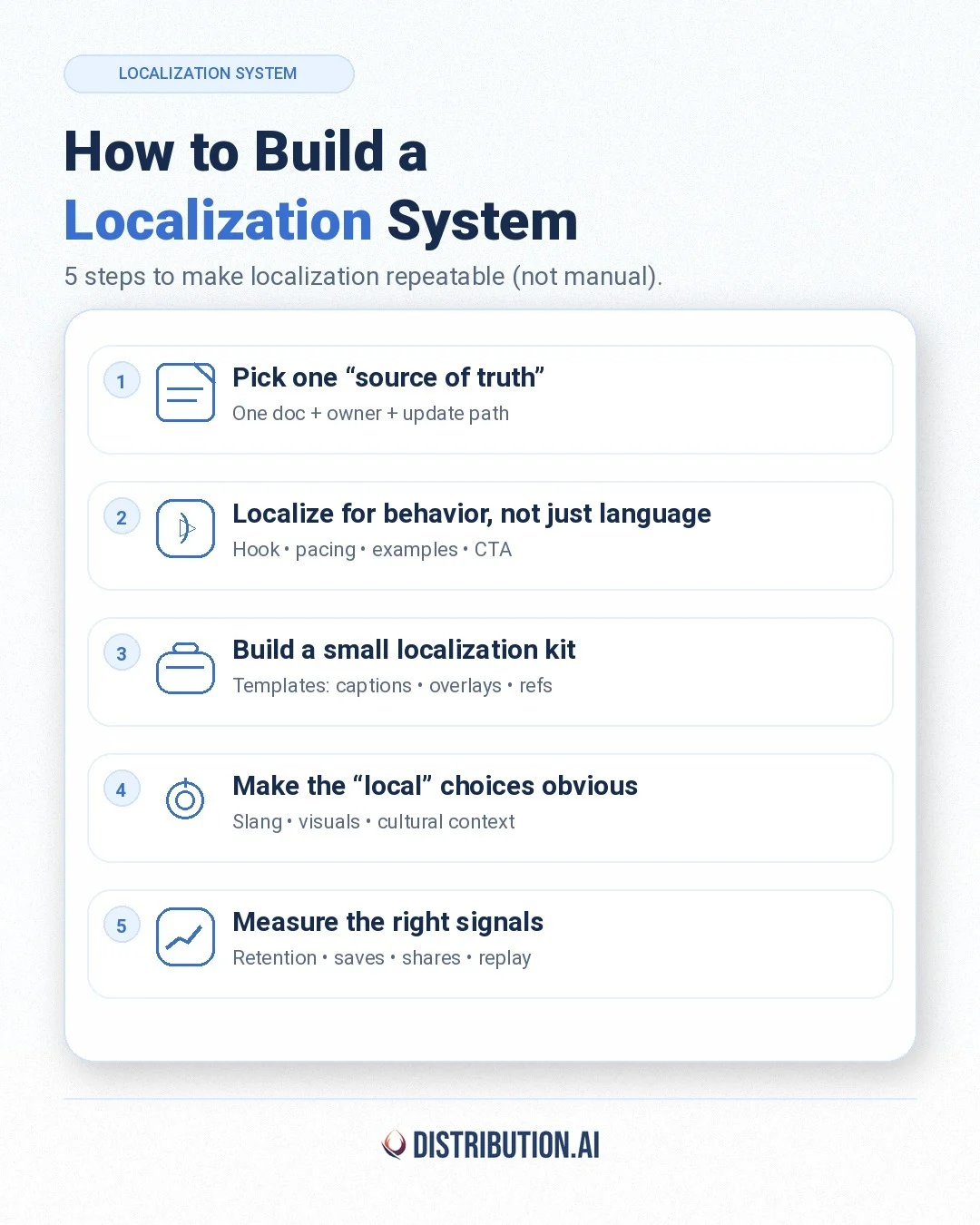
If you want content localization to work, it can’t be a heroic effort. It has to be a repeatable content localization process you can run every week without sacrificing quality.
Start with a simple content localization strategy:
1) Pick One “Source Of Truth”
Choose the best-performing version of the idea, then treat everything else as a localized cut. One message, one angle, one intended audience.
2) Localize For Behavior, Not Just Language
Content localisation isn’t only a translation process. It’s a cultural adaptation. It’s a local context. It’s knowing what your target audience actually rewards on that platform.
3) Build A Small Localization Kit
Keep three things consistent across every version:
- Your brand promise (same page, same key messages)
- Your visual elements (fonts, colors, templates you can reuse)
- Your voice (how you talk, what you believe, what you don’t tolerate)
4) Make The “Local” Choices Obvious
Swap cultural references. Adjust examples. Use the local language where it matters.
If you’re publishing for international audiences across different languages, don’t ship the same caption and call it localized content.
5) Measure The Right Signals
A good localization strategy shows up in engagement and conversion rates.
Track key performance indicators like watch time, saves, shares, and click-throughs by target market, not in one global average.
Content Localization Mistakes That Kill Performance
1. Numbers and Money
If you mention pricing, discounts, or savings, show the local currency.
Even if you sell in USD, acknowledging the local symbol and format signals “this was made for your market,” which is a big part of successful content localization.
2. Regulatory Landmines
Claims that are fine in one country can be risky in another.
For a solid content localization strategy, keep a small list of pre-approved phrases per target market (especially for medical, finance, and legal) so your localization process does not become a scramble.
3. Emoji and Gestures
Visual shorthand is cultural. A gesture or emoji that reads friendly in one place can read rude in another, especially across international audiences.
When in doubt, use simpler visual elements and let the words carry the intent in the native language.
4. Humor
Sarcasm and wordplay are brittle in the translation process.
If you want localized content that performs across different languages, aim for clean, human humor that survives cultural nuances rather than jokes that depend on one language.
5. Subtitle Placement
Languages expand differently. Your English captions might fit perfectly, then break in German or Arabic.
Leave room, test on mobile, and do not trap subtitles under your own on-screen text if you want an effective content localization strategy that scales.
What to Post Where in 2026
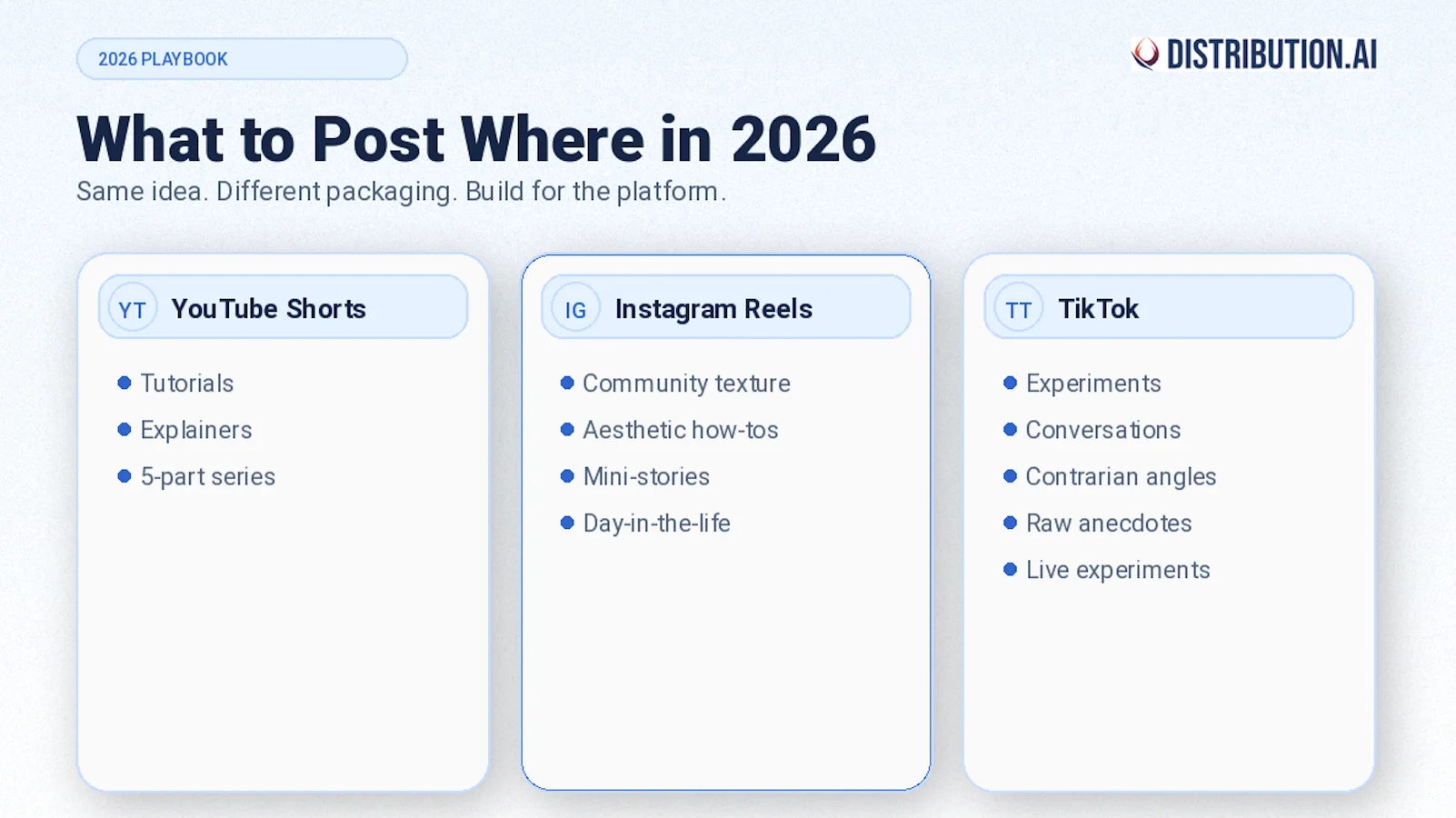
Now that we understand how each platform thinks, let’s talk about what grows where.
1. On YouTube Shorts
Post pieces that either solve a clear problem fast or tease something deeper.
83% of marketers say that videos under 1 minute are best for engagement, and Shorts rewards concise value delivery.
What works:
- Tutorials that resolve in 60 seconds
- “Explainers that actually explain” with on-screen steps
- Product micro-demos that lead to a full video in your channel
- Myth-busting with receipts (cite your sources in the description)
- Five-part series where each part is complete on its own
Shorts are polite to evergreen content.
A well-made explainer from six months ago can still surface when someone searches for that exact problem.
2. On Instagram Reels
29% of all social consumers anticipate making more purchases based on something they saw on Instagram. Reels are where taste meets transaction, but the taste comes first.
What works:
- Mini-stories that build your world
- Aesthetically pleasing how-tos with a consistent visual language
- Day-in-the-life fragments that feel intimate, not performed
- Light skits your community will get (inside jokes earn their keep here)
- “You asked, we answered” clips with genuine personality
If you’re going to flex customer love on Reels, keep it human. Reposts, stitches, raw testimonials. The second it feels staged, people scroll. Reels rewards belonging, not broadcast.
3. On TikTok
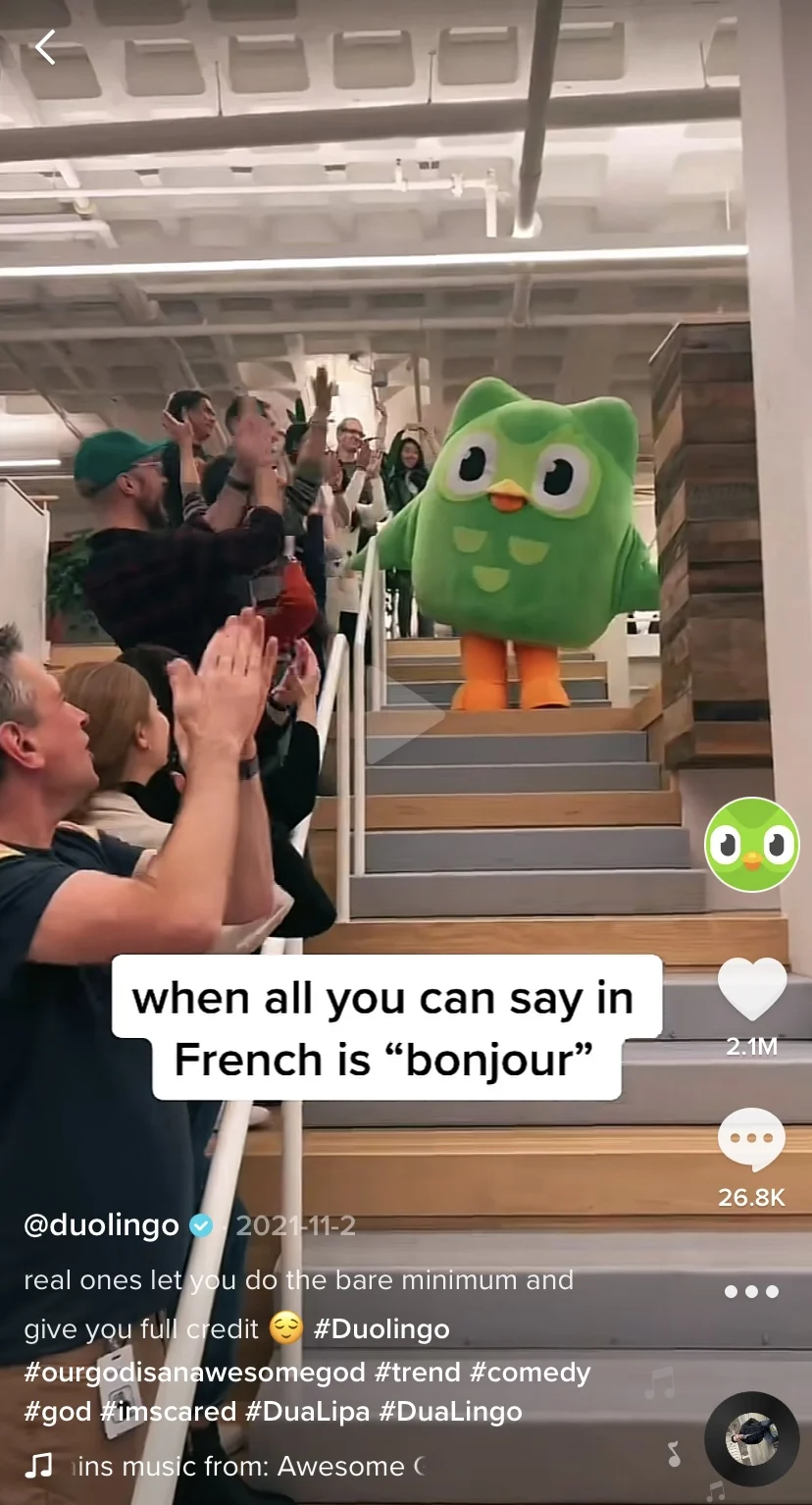
Duolingo’s TikTok strategy combined authentic content with trending formats, achieving over 90 million video views and reaching 38 million unique users with a follower growth rate of 1,400%.
The lesson? TikTok rewards courage.
What works:
- Contrarian takes that match local cultural nuances, not generic advice.
- Stitches and replies to creators your local audience already follows.
- Build-in-public clips that feel current, not overproduced.
- Prompts that invite duets/comments, because interaction is part of the content.
- Messy human moments that translate across different languages better than slogans.
- Small experiments you can repeat across multiple markets once you see what hits.
TikTok is elastic on length, but when you’re entering international markets, short wins first.
Earn attention, then go longer.
Use those results to tighten your content localization strategy and turn the winners into localized versions for Shorts and Reels.
The Platform Quirks That Matter More Than Specs
Here are the small tactics that separate clips people finish from clips people skip:
- Faces and hands pull attention. Not because algorithms “prefer faces,” but because humans do. Show the person. Show the hands doing the thing.
- On-screen text is a layer, not a crutch. Use it to clarify, punctuate, and preview what’s next. Keep it readable on a small screen. Don’t let it fight your subtitles.
- B-roll that earns its keep. Show the thing. Show the consequence. Show the payoff. Every cut should either clarify or delight.
- Silence can be a hook. A two-second beat before a reveal is a flex on feeds that never shut up.
- Show your keyboard. If you’re explaining something on a computer, a quick shot of hands doing the thing does more than a list of tips read aloud.
- Direct address still works. “Hey, you who keep saving tutorials and never trying them” is better than “Hey guys.”
None of these are rules. They’re the little habits of videos that get replayed.
What Repurposing Actually Looks Like When It’s Done Well
You make one strong piece of thinking and you let it bloom. The trick is to repurpose thoughtfully.
Here’s what that looks like in practice:
- A 2-minute TikTok “rant with receipts” about hiring myths becomes a 35-second Shorts cut that tees up your long-form interview with a recruiter.
- The same idea becomes a Reels carousel (yes, sometimes a carousel reaches more of your Reels audience than a video) with a short matching clip that brings the slides to life.
- For Germany, you swap the “resume” language for “CV,” adjust examples to reference German job boards, and re-record two lines to fit the local tone.
- For Brazil, you reference a local job board, update the screenshot, and adjust the pacing to match how Brazilian audiences consume captions (slightly slower, more forgiving).
- Everywhere, you keep the thesis intact. Different doors into the same room.
When you do this consistently, your library feels like a body of work, not a pile of clips.
Conclusion
If you want Shorts, Reels, and TikTok to perform in 2026, stop treating them like three upload destinations. Treat them like three different rooms with three different crowds.
The advantage is not a fancier edit. It is a repeatable content localization strategy that respects local context. Language, pacing, cultural references, visual elements, and even the call to action should match the market and the intended audience.
That is how localized content earns attention and trust in international markets without sacrificing quality.
This is where tools like Distribution.ai help you out.
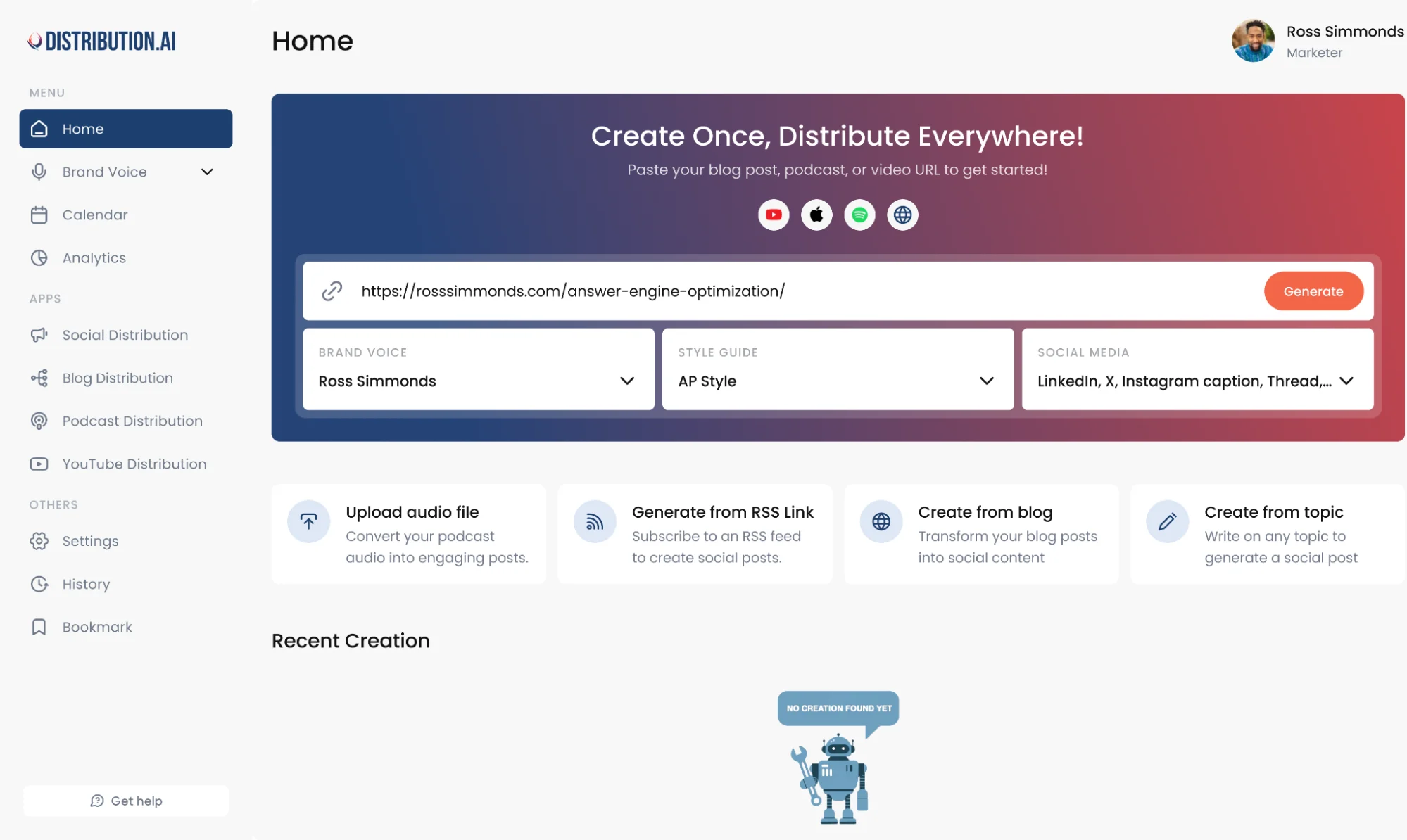
It helps you take one strong idea and turn it into platform ready versions with the right voice, formatting, and scheduling, so your team can focus on taste and results instead of rebuilding the same content from scratch.
If you’re serious about a solid content localization strategy for international audiences, build the system once, then let it run.
Promote, repurpose & distribute your content with AI
Write 10x faster, engage your audience, & never struggle with the blank page again.
Start 15-Day Free Trial
Frequently Asked Questions
Author

Promote, repurpose & distribute your content with AI
Start 15-Day Free Trial