How the Twitter Algorithm Works [Ways to Reset Algorithm + Growth Strategies]
Learn how the Twitter algorithm works in 2026, including ranking factors, engagement signals and proven strategies to grow your reach on X.
X/Twitter helps marketers reach their target audience quickly.
The social media platform boosts your content’s visibility to its user base instantly, allowing you to attract a larger audience and more potential buyers.
At the same time, it’s rarely straightforward.
If you have used the channel before, you know that posts on X get quickly buried. The sheer volume of content that’s created on the platform daily can stretch your audience’s attention further.
Moreover, even sporadic engagement with off-topic content can minimize the amount of relevant Tweets (or posts) on your feed, making it challenging to keep up with the latest trends in your niche.
In this article, let’s understand how the Twitter algorithm works so you can reset it for your brand and build a content engine to grow your visibility on the platform.
What Is the Twitter Algorithm?
The Twitter algorithm is a recommendation system that uses a machine learning model to decide which posts show up on your screen, in what order, and how often.
Every time you open X, the algorithm is quietly sorting through millions of tweets and picking the ones it thinks you’ll care about most.
The platform organizes content into three distinct feeds, each shaped by the algorithm in different ways:
- For You: This is the default algorithmic feed that you see the moment you open the platform. It blends posts from accounts you follow with out-of-network content (tweets from people you don’t follow but the algorithm thinks you’ll find interesting), based on your usage history and user behavior.
- Following: Here, you can find tweets from your followed accounts only in reverse chronological order. The algorithm doesn’t push any other content in this feed.
- Explore: This is the content discovery engine of the platform. It surfaces trending topics, relevant hashtags, popular accounts in your niche and popular posts tailored to your interests and location.
All three feeds are personalized for you to maximize stickiness.
How the Twitter Algorithm Decides What You See
The platform’s algorithm follows a structured, multi-step process to ensure you see users’ posts that you find interesting and are most likely to engage with.
1. Candidate Sourcing
In the first step, the system gathers a wide range of content from across the platform.
It includes these types of content:
- Posts from accounts you or your Twitter/X network follow
- Posts identical to what you currently like
- Reposts from your Twitter network
From this massive pool of potential fit candidates, the algorithm then narrows things down and decides what actually makes it to your screen.
2. Ranking
Once the candidate pool is assembled, the algorithm ranks them based on how likely you will find them attention-worthy.
The ranking system achieves this by weighing content from your followers and out-of-network Tweets on a combination of key ranking signals:
| Recency | Fresh content almost always outperforms older posts, especially for posts on popular themes. |
| Relevance | Posts that align with your interests and past interactions history are pushed higher. |
| Engagement | Likes, replies, retweets and quote tweets all count as positive signals. |
| Content Type | Rich media like images and video posts tend to get more reach than text-only posts. Threads and conversation threads also perform well. |
| Account Credibility | Your follower-to-following ratio, account age, verification status and subscription status (premium users get a boost) all factor in. |
| Past Interactions | If you regularly interact with a particular user’s content, you will get more posts similar to theirs on your feed. |
| Network Activity | What other users in your network like, reply to and share influences what the algorithm surfaces for you. |
Key factors that influence what appears in your Twitter/X feed.
In short, the algorithm rewards content that sparks genuine interaction and comes from credible accounts. This ensures you see accurate content that is most likely to be helpful to you.
3. Building Different User Feeds
After ranking, the platform takes those scored posts based on algorithm ranking signals to assemble your feed.
The system builds a balanced mix of in-network content (from people you follow) and out-of-network content (from accounts you don’t follow). It also varies the format by mixing text posts, images, video posts, threads and quote tweets so your feed doesn’t feel monotonous.
Then comes filtering. The algorithm removes low-quality, spammy, offensive, unverified or potentially harmful content before it reaches your eyes. This quality control step ensures that the content users post is helpful to others and makes the platform more engaging.
Note that the “For You” and “Explore” tabs are fully algorithmic, while the “Following” tab shows posts from accounts you follow in reverse chronological order. If you ever want a break from algorithmic ranking, the Following feed is your escape hatch.
Why You May Need to Reset Your X/Twitter Feed
Sometimes your feed just feels… off.
You’re scrolling through content that has nothing to do with your current goals and your timeline is cluttered with accounts you barely remember following.
While it might feel like the algorithm is acting weird, there are two key reasons behind it:
- You trained it accidentally: A single curious click on a random post can snowball into a flood of similar tweets. You may have been following too many noisy or off-topic accounts or hate-engaging with content you dislike. All of these signals tell the algorithm that you find them interesting because you spend time on them.
- Topic drift: Your interests, your role, your content preferences or your brand strategy may have shifted, but the algorithm hasn’t caught up. Old signals, especially when they are strong and long-standing, keep shaping your feed.
Regardless of the reason, it’s annoying and costly for marketers.
You will rarely see content that’s relevant to your audience or niche, and you will miss news and conversations that are valuable to your brand.
Additionally, the content you put out will be pushed to the wrong audience: the irrelevant accounts you follow and their followers.
In such a scenario, you need to reset your usual feed so you only get relevant content that drives business value. The first step in that direction is to learn the nuances of the algorithm.
Recent Twitter Algorithm Updates You Should Know About
The Twitter algorithm is constantly evolving, and staying current with these changes can make your content strategy. Here are the updates that matter most right now:
- Trending topics boost: X now actively promotes tweets about breaking news or viral niches. Timely content with relevant trending hashtags gets extra visibility.
- Faster timeline refresh: The home feed refreshes more frequently, showing newer tweets and increasing how many posts you see in a day. Spreading out posts at different times can capture audience peaks throughout the day.
- Quality and safety emphasis: Tweets flagged as extreme, harmful, spammy or low-effort are downranked. The platform favors thoughtful, informative content over clickbait when building feeds.
- Smaller accounts amplified: If a smaller account, especially a premium subscriber, posts quality content that’s specific to a niche, it can outperform content from larger accounts with more followers. This update ensures that X users always get the best content.
How to Reset the Twitter Algorithm
Broadly, you need to proactively and strategically retrain the algorithm by engaging with content and accounts that are relevant to your brand.
This approach undoes the two causes mentioned above that fill up your Twitter/X feed with random content.
You can do it in the following five steps:
1. Unfollow Irrelevant Accounts
Start with an honest audit of who you’re following. Chances are, your follow list is a layered history of past interests, old jobs, trend cycles and curiosity clicks.
Every account you follow sends a signal to the algorithm about what you want to see, so if you’re still following accounts that don’t align with your current goals, you’re actively training the algorithm in the wrong direction.
You need to unfollow all such accounts and pages.
If an account is particularly noisy, consider blocking it. Blocking prevents any of their content from appearing in your recommendations or replies, cutting off all algorithmic association between your account and theirs.
2. Switch to the Following Feed
The Following feed is your clean room, away from the algorithmic mess that will take time to get cleared up. This feed only shows posts from accounts you’ve chosen to follow, displayed in reverse chronological order.
Restricting your Twitter activity to the Following feed falls in a more conservative direction, which means you will see less content.
However, what you do see will be directly relevant to your brand. If you spend more time here, you are highly likely to only engage with content that’s valuable to you, retraining the algorithm faster.
3. Use Negative Signals Aggressively
This doesn’t mean hate-engaging with posts you disagree with (that actually makes things worse). It means using the platform’s built-in tools to tell the algorithm what you don’t want.
You can tap “Not Interested” on posts that are irrelevant, mute accounts or keywords that clutter your feed and report content that’s genuinely spammy or harmful.
Every one of these actions is a clear negative feedback signal, and the algorithm learns from them quickly. If you do it for long enough, your feed will change to show the content that you want.
4. Clean Up Your Interests
You may be surprised to know that X lets you manage your interests on a granular level.
Head to Settings & Privacy > Privacy and Safety > Content you see > Interests, and you’ll uncheck the configurations that bring you irrelevant content.
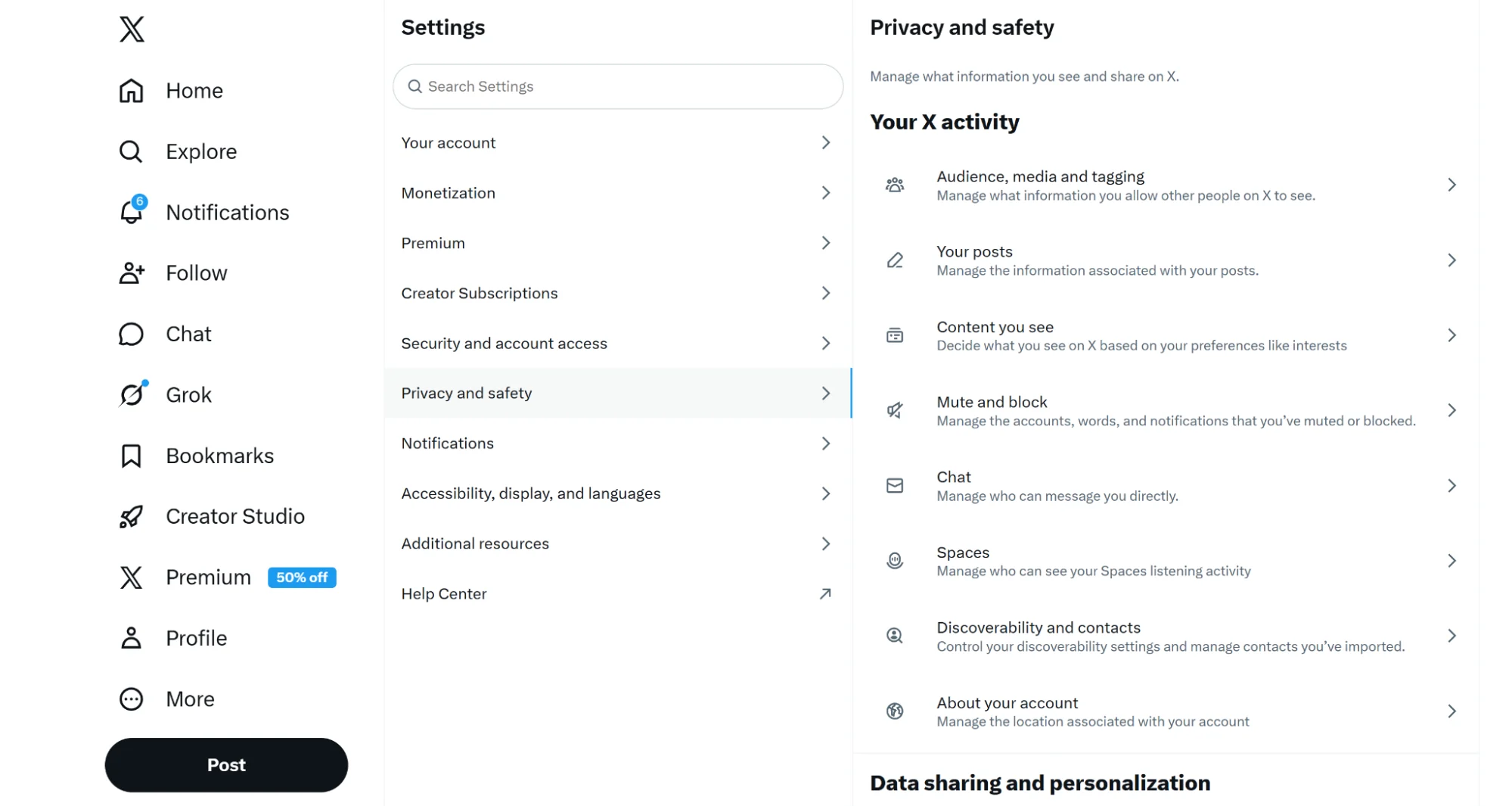
At the same time, follow useful accounts that post content that is valuable to your brand and long-term marketing goals. This tells the platform’s algorithm what you’d like to see more of.
5. Retrain with Targeted Twitter Activity
Once you’ve cleaned the slate, it’s time to actively rebuild by engaging with niche-relevant accounts on purpose. This involves liking their posts, replying thoughtfully and reposting content that aligns with your brand.
While engaging with your audience, make sure you stay organic and natural. If you force your comments, your effort will appear as “salesy” to your audience.
Moreover, authentic contributions to conversations increase your account’s authority among the general Twitter/X audience.
For teams managing multiple accounts, a cloud phone for social media can help keep engagement signals separate, reducing the mixed activity that may affect recommendations and content discovery.
All of this tells the platform’s algorithm that your interests have changed. It will gradually start showing you less of what you used to find valuable and more of what matters to you now.
X/Twitter Growth Strategies: How to Win With the Algorithm
While you reset your algorithm with consistent efforts, you also need to post quality content regularly to grow your brand’s presence on the platform.
1. Pick a Few Core Themes
The fastest way to confuse the algorithm (and your audience) is to post about everything.
A better approach is to target two or three core topics.
This helps the recommendation algorithm understand what your account is about, which means it’s more likely to serve your posts to users with similar interests.
Additionally, you need to optimize your bio and pinned post to match the core themes you constantly talk about. It will help if you subscribe to Twitter Blue to give your content an extra boost.

This is where a social media management tool like Distribution.ai really shines. Experiment by scheduling posts at the recommended times and tracking post performance to see what works best for your target audience.
2. Write to Engage
The algorithm amplifies posts that generate interactions in the form of replies and comments. So before posting, ask yourself, “What will make my audience want to respond?”
You need to share actionable advice, verifiable data, firsthand experiences and opinionated takes in your brand’s style. Posts with a unique, clear point of view outperform safe, generic content.
It can also be beneficial to weave in behind-the-scenes moments and personal stories to give your core message an emotional edge.
That said, avoid engagement-baiting.
The algorithm (and Twitter users) can spot “LIKE if you agree!” tactics from a mile away. Your goal is to invite your audience to participate in the conversation naturally by asking thoughtful questions and making people feel like their reply matters.
3. Follow Platform-Native Formats
X rewards content that feels native to the platform. That means you need to mix up your formats: short posts, threads, images, quote tweets and timely replies.
Moreover, the Twitter audience here likes snackable content, so keep things concise and simple to help them grasp your message quickly.
One of the most effective moves to put this approach into practice is by creating a repeatable content series.
This could be weekly breakdowns, myth-busting posts, teardown threads or lessons-learned recaps that you can repeat over time. These formats build familiarity with your audience and make it easier for people to recognize the value of your content the moment they see it.
Plus, repeatable formats are easy to repost, which helps you reach and nurture new audiences over time without creating content from scratch.
4. Join Relevant Conversations Early
When a conversation is just starting to pick up steam in your niche, jumping in early can give you outsized visibility. If you’re one of the first voices offering a sharp perspective, your reply rides the wave as the original post gains traction.
But be selective.
Hopping on every conversation that may go viral will dilute your brand’s authority and can confuse your audience.
A better approach here would be to selectively engage with trending news or discussions that are related to your core focus. This will help you cover more ground within your niche while maintaining quality.
Create Engaging Content for Twitter Growth with Distribution.ai
Optimizing your feed and resetting the algorithm gives you a clean slate. At the same time, you need more than that to attract relevant audiences and make them believe in your brand.
And to achieve that, you need to post highly relevant and valuable content.
However, creating platform-native content from your brand’s perspective, week after week, while also replying to comments and DMs, is a lot.
This is where Distribution.ai comes in.
You can produce a week’s worth of Twitter content in under 10 minutes with the platform by simply uploading a link to an existing long-form content.
Just paste the link to a blog post, how-to guide, whitepaper, podcast, webinar or YouTube video, and Distribution.ai will immediately produce Twitter-friendly snackable assets in your tone and style.

Then, you can use the tool’s built-in scheduler to set them to publish for the week and track how they perform.
Ready to accelerate your growth on Twitter?
Frequently Asked Questions
1. What Is the 4-1-1 Rule on Twitter?
The 4-1-1 rule is a content ratio: for every six posts, share four pieces of curated content from others, one repost and one self-promotional post. A simple and easy way to do that is to repurpose your existing content with AI. Distribution.ai is such a platform where the AI Agent converts your existing long-form pieces, such as blog posts and YouTube videos, into Twitter/X threads and posts instantly.
2. Is the X/Twitter Algorithm Really Bad for You Right Now?
Not necessarily, but it can feel that way if your feed is miscalibrated. The algorithm surfaces what it thinks you want based on your past content preferences and habits. If those signals are messy, your feed will be too. A reset can help dramatically.
3. How Do You Grow on Twitter (X) in 2026 With the New Algorithm?
The algorithm in 2026 favors accounts that post regularly around clear themes, interact authentically and create content that sparks conversation. In practice, you need to post 3–5 times a week on one niche and reply to comments within the first hour.
4. What Are Some Tips on Beating the Twitter Algorithm as a Creator?
Post when your audience is active, lead with strong hooks, use rich media, reply to comments on your own posts quickly and build conversation threads. Getting likes, comments and reposts tells the algorithm to push your content wider.
5. How Do I Boost My Twitter Algorithm?
Post content consistently, and comment and repost relevant content from existing creators. It’s key to share trending and relevant information in platform-native format, which is short-form and direct.
You can produce more content by repurposing your existing long-form content, like blog posts and podcast episodes.
6. How Do I Change My Twitter Algorithm?
Clean up your interests in settings, unfollow irrelevant accounts, use the “Not Interested” option liberally, switch to the Following feed temporarily and deliberately engage with content that matches your goals. Over time, the algorithm recalibrates.
7. What Is the Best Time to Post for Maximum Visibility?
It depends on your audience, but generally, weekday mornings and early afternoons can give you better results on X. These are the times when your audience is likely to be leisurely scrolling through the feed, increasing your chances. Check your analytics to find when your top-performing posts went live and plan around that.
8. How Do Trends and Hashtags Work With the Algorithm?
Trending topics and relevant trending hashtags can boost your visibility when they align with your niche. The algorithm surfaces trending conversations in the Explore tab, and joining them early gives your posts more reach, but only if they’re genuinely relevant to what you normally post about.
9. How Often Should Brands Post on X to Grow?
Aim for at least one to three posts per day and stay active in replies and conversations. Posting too many tweets without substance can hurt you. You need to balance quality and consistency rather than targeting sheer volume.
10. How Long Does It Take to Retrain the Twitter Algorithm?
Most users notice changes within one to two weeks of deliberate effort. The more consistent your new usage patterns are, the faster the algorithm adjusts to your updated preferences.
For instance, you can like, comment or repost 15–20 posts from the same niche daily, while ignoring unrelated content can noticeably shift your feed in under 10 days.
11. What Is the Best Way to Grow on Twitter Without Spending All Day Posting?
Repurpose your existing long-form content into multiple tweets, batch-create posts in advance, use scheduling tools and only interact with high-value conversations in your niche. Additionally, you can spend 20–30 minutes daily replying to larger accounts or popular posts in your space to drive more reach.
12. What Engagement Matters Most for Growth on X?
Replies and conversation threads carry the most weight. Quote tweets and meaningful reposts are next. Likes help, but they’re the lightest signal. The algorithm values active, two-way engagement over passive consumption.

Promote, repurpose & distribute your content with AI
Write 10x faster, engage your audience, & never struggle with the blank page again.
Start 15-Day Free Trial
Frequently Asked Questions
Author

Promote, repurpose & distribute your content with AI
Start 15-Day Free Trial