Pinterest Best Practices for Brands
Follow these Pinterest best practices to improve Pin visibility, run smarter ads, and track the metrics that matter most in 2027.
 By
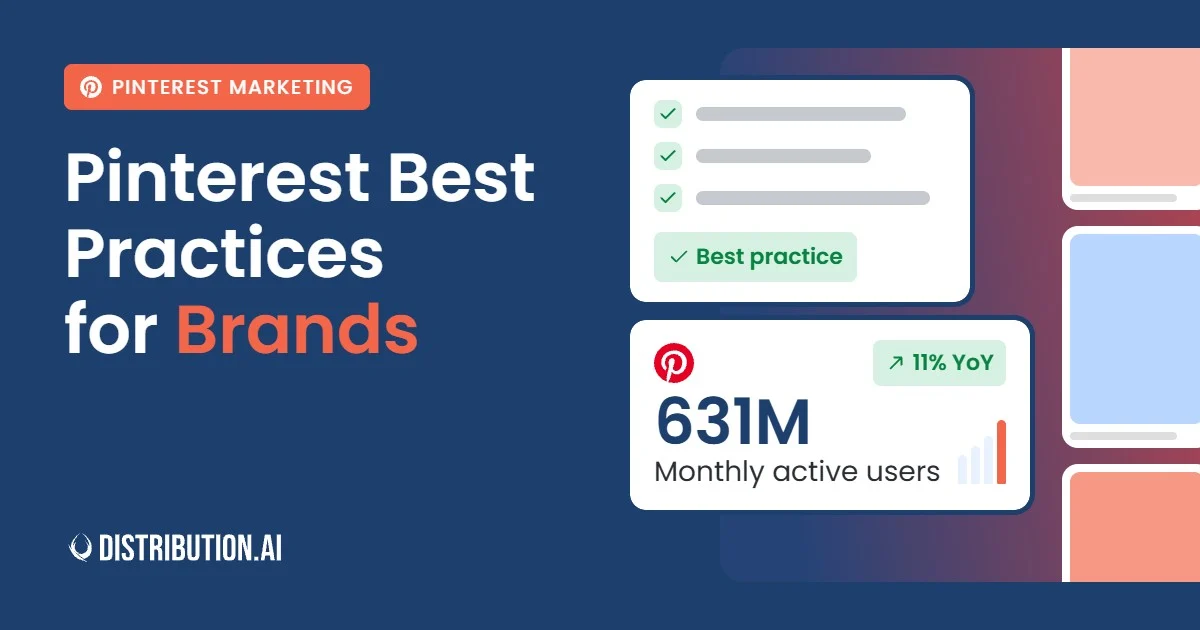
Pinterest’s Q1 performance in 2026 revealed that it has 631 million MAUs globally, which is an 11% increase from last year.
In other words, Pinterest is more relevant than ever among your audience for entertainment, education, ideas and inspiration.
However, distributing your message on Pinterest can be difficult for brands due to how the platform has evolved and the nuances of Pins that drive engagement. And it’s even more challenging for brands starting out.
This article provides all the best practices with explanations and implementation tips you need in 2026 to grow your Pinterest presence and attract buyers to your website or online store.
Key Takeaways
- Pinterest’s algorithm ranks your content on four signals: domain quality, Pin quality, Pinner quality, and keyword relevance.
- Your Pinterest audience searches with intent words around planning, inspiration and aesthetics, so the keywords that work on Google may not work here.
- Stick to 2:3 for standard images, 9:16 for video, and keep logos and text within the central 80% of the frame.
- Reposting the same creative hurts your Pinner quality score, but repurposing existing assets with new titles, descriptions and boards keeps your calendar full and signals activity to the algorithm.
- Boards are ranking infrastructure. Narrow, keyword-specific boards get indexed by Google and give the algorithm context to surface the Pins inside them.
- Pick one North Star metric tied to your current goal, such as outbound clicks for sales and engagement rate for awareness.
1. Understand How Pinterest’s Algorithm Works
The visual search and discovery platform looks at four core ranking signals to determine how widely it should promote your Pins.
I. Domain Quality
Pinterest trusts claimed business websites that are safe and deliver a good user experience (e.g., fast load times, mobile responsiveness, etc.).
Additionally, it values low bounce rates and how well your domain-linked Pins perform on the platform.
II. Pin Quality
Pin quality refers to the reach and engagement level on Pinterest. Typically, a higher engagement rate tells the algorithm that your content is trustworthy and useful.
There are different kinds of Pins on the platform:
- Core Pin formats:
-
- Image Pins: Single photo or graphic with a title, description and destination link.
- Video Pins: Vertical clips that can range from 4 seconds to 5 minutes.
- Carousel Pins: Multi-image Pins that your audience can swipe through.
- Collage Pins: Interactive Pins created with Pinterest’s collage tool
2. Rich Pins: Dynamic Pins that automatically pull metadata from a linked website.
3. Product Pins: Synced from your online shopping platform’s catalog.
Each pin should have consistent branding, in terms of typography and logo placement, to subtly encourage users to explore your offerings.
When designing Pinterest content, optimize for high-value actions like Saves, outbound clicks, close-ups, aspect ratio, image and video quality and comments.
III. Pinner Quality
Pinner quality is the credibility of your Pinterest profile. It reflects your trust score as a creator and curator on the platform.
Pinterest values reliable and active accounts and suppresses spammers. This translates to following consistent posting schedules, sharing fresh content, engaging with others and avoiding spammy behavior (e.g., reposting the same Pin repeatedly).
Note that your Pinterest credibility is built over time as your older posts start getting traction from others.
IV. Topic and Keyword Relevance
The topic of your Pin should match the keywords in the metadata and your target audience’s search queries. The relevance is critical to provide the visual platform’s algorithm with proper context so it can surface your content for matching search terms and phrases.
Understanding the above four Pinterest ranking signals enables you to shape your content creation process that enhance them. The following best practices will help you do that.
2. Set Up Your Pinterest Business Account for Visibility
Setting up your Pinterest account the right way will help you curate your Pins effectively and establish a credible presence on the platform.
A. Pinterest Business Profile Set Up
There are four key elements in your Pinterest business profile:
- Account name: Start with your brand’s name and 4–5 words describing what you do (e.g., Distribution.ai: Content Repurposing Platform).
- Bio: Concisely and clearly mention what you do. This can be a problem you solve or a need you address. Keep it within 8–12 words.
- Profile photo: Brands can upload their logo.
- Cover image: Keep it relevant to what you do. You can overlay text, but keep it under five words. Place the logo subtly for branding.
The above four elements are usually a one-time thing. It is beneficial to revisit them once every six months to ensure relevance, particularly for evolving companies.
B. Pinterest Tag and Conversion API
Pinterest Tag is a code placed on your website that connects a user’s activity on your Pins and website. For instance, if someone clicks through while seeing a Pin, the Pinterest Tag attributes the visit to that particular content piece.
Conversion API is a fail-safe version of the Pinterest Tag that sends all website activity to Pinterest, regardless of the traffic source.
For example, if two buyers completed a purchase, one came from Pinterest and the other from LinkedIn, the Conversion API will send both activities to Pinterest.
However, it will credit each visitor activity appropriately. The conversion from other digital platforms won’t be credited to Pinterest. This visibility is essential for accurate distribution channel attribution and allows you to look for lookalike audiences.
Moreover, Conversion API is essential for cross-device and delayed attribution. Let’s say someone saw a Pin on Monday and a similar post on LinkedIn on Tuesday. Even if they click through on LinkedIn, the API will recognize that the visitor saw a Pin on Monday.
C. Catalog Ingestion and Rich Pins
Catalog ingestion sends your e-commerce product data directly to Pinterest through CSV, XML or API. It converts each product listed on your website into a shopping Pin with live prices and real-time stock availability. This is particularly helpful for e-commerce brands or digital product sellers who have multiple images per listing.
Rich Pins extract additional organic website metadata, such as headlines or descriptions, to provide extra context on your Pins. This feature uses Schema.org or Open Graph to fetch these details.
3. Follow the Pin Dimension Guidelines
Each Pin on the platform supports images, videos or a mix of both. The different dimensions and aspect ratios for various formats are:
| Standard Image Pin | 1000 × 1500 px | 2:3 |
| Square Pin | 1000 × 1000 px | 1:1 |
| Extra-Tall Pin | 1000 × 2100 px (truncated beyond 1:2.1) | 1:2.1 |
| Vertical Video Pin | 1080 × 1920 px | 9:16 |
| Board Cover | 1000 × 1000 px (renders as 1:1 square) | 1:1 |
Table showing the dimensions and aspect ratios for different Pin content formats
When adding logos or any other branding elements to images and videos, keep them within the central ~80% to avoid clipping by hover buttons, rounded corners and attribution bars.
4. Conduct Dedicated Keyword Research for Pinterest
Pinterest keyword research will help you identify trending and in-demand topics within your niche. It follows a different approach than website SEO-focused keyword research because Pinterest users phrase intent differently.
On Pinterest, your audience’s search queries contain terms related to planning, creative inspiration and aesthetic names.
The four key sources to determine primary relevant keywords for your Pinterest campaigns are:
- Pinterest search bar autocomplete: Surfaces what users typically search for the most within a particular topic or domain.
- Guided search bubbles under results: This is equivalent to relevant search terms you see on Google.
- Pinterest Trends: It is released annually by Pinterest and contains data-backed insights on what your audience may expect down the line.
- Top-ranking competitor Pins: Mark the keywords that show competitor Pins and scan the metadata of those content pieces.
Based on the above research, build a keyword cluster per brand pillar or product category. Then, map each keyword to a funnel stage to create the right kind of content for it.
When producing content, you can refer to each cluster to design assets and utilize keywords organically. Another Pinterest SEO best practice is to include keywords in the overlay text on Pinterest images as applicable.
5. Make Your Pins’ Content Engaging
You can follow these creative best practices that can make your images and videos more engaging on Pinterest:
- Communicate the topic at first glance: One second for images and 2–10s for videos (depending on length, which can be between 4s–5m).
- Avoid text-heavy images and video frames: It will overload your audience, causing them to disengage. Stay between 4–8 words.
- Use consistent typography: This becomes your brand’s identity without appearing too on-brand or salesy.
- Test multiple variants per URL: It will tell you which creative attracts and engages best per Pin.
- Visually appealing creatives: Upload high-quality images and graphics so the right audience will find it instantly engaging.
Apart from the above, follow other content creation and optimization tips to improve the quality of your multimedia content. For example, for videos, it is adding captions and use a transition in the first few seconds.
6. Conduct Keyword Optimization for Pin Titles and Descriptions
Proper keyword targeting for the Pin titles and descriptions improves their visibility on Pinterest and Google. These are the first thing a human or a bot sees to check if it matches their needs.
Pin titles and descriptions should include the primary keyword. Titles have a 60-character limit, so lead with the primary keyword or use it within the first few words.
Pin descriptions have a 500-character limit, but only the first 50–100 show in the feed. Here, insert the primary keyword organically in the first sentence and always end the description with a soft CTA.
Apart from Pin titles and descriptions, set your Pinterest boards’ visibility to “public” for SEO benefits. Then, add alt text to images for SEO and accessibility.
7. Structure Your Pinterest Boards for Search Visibility
Pinterest’s algorithm uses your board’s context to learn about the Pins within it, which is key to their visibility for the right keywords. Moreover, the board’s titles and descriptions are indexable by Google.
For the titles and descriptions, you can follow the Pin title and description optimization tips shared above. Describe the Pin in the title and explain what it entails in the description.
It is essential to match each Pin’s topic to the board’s theme. Irrelevant Pins in a Pinterest Board dilute SEO and also confuse your audience.
- The overall architecture of the Pinterest content library looks like:
- A top-level board per product category/content pillar.
- Narrow, specific boards over broad catch-alls (“Healthy Dinner Recipes” beats “Recipes”).
- Seasonal and campaign boards (Q4 holiday, back-to-school).
- Supporting/adjacent boards to broaden reach without going off-brand.
8. Consider Using Pinterest Ads to Boost Pins
Pinterest Ads allow you to promote Pins in user feeds and search results. You can reach a wider pool of intent-driven buyers using visual discovery and keyword interest.
Here are the various ad formats you can focus on:
- Core formats for Pinterest advertising:
-
- Standard (static image) ads: Single-image vertical pins (2:3 aspect ratio recommended) are best for driving website traffic.
- Video ads: Autoplay-enabled promoted video pins are available in standard and max width configurations; best optimized for 6-15 seconds.
- Carousel ads: Swipable ads featuring 2-5 images or video cards; each can feature a distinct URL.
- Shopping ads: These ad creatives pull dynamic product information, such as pricing, directly from your catalog.
- Collection ads: Ads with a large primary hero image or video above three smaller product cards.
- Idea ads: Multi-page interactive vertical cards designed for mobile devices, combining images, video clips and text overlays.
- Interactive and premium formats:
-
- Showcase ads: Promoted app pins displaying a main title card alongside four interactive feature cards.
- Quiz ads: One of the best Pinterest ads that engages directly with your audience through questions (maximum three).
- Premiere spotlight ads: Video-only, high-impact Pins with reserved placement in Pinterest feed to maximize reach.
A good Pinterest ad best practice is to start with popular posts with bottom-of-the-funnel (BOFU) content. As these are the Pins your organic audience already liked, the ad copy will have a higher chance of resonating with newer users.
When running Pinterest Ad campaigns at scale, keep one objective per campaign and tie ad groups to audience and keyword clusters. The keyword cluster should be related to a pain point or a need of your audience.
You can target users based on demographic data to make sure your Pins are seen as relevant content on people’s feeds. It is also key to understand seasonal moments to improve your bidding strategy for the social network.
After you gather some data, discover which topics or Pins deliver the best results for better interest targeting and optimizing ad spend. Moreover, you will also know which of the different ad formats suit best for your niche and audience.
Finally, refer to Pinterest Trends data to identify which topics or niches are most likely to become popular down the line. This will help you prioritize or boost the right Pins.
9. Track Success Metrics with Pinterest Analytics
Here are some important performance metrics you can monitor natively in Pinterest Analytics:
- Impressions: Number of times your Pins or ads appear on users’ screens.
- Saves: Number of times users add your Pin to one of their own boards for future reference.
- Outbound Clicks: Number of clicks that send users from your Pin to your landing page (or any other external link).
- Pin Click-Through: Percentage of total impressions that resulted in users clicking to open your Pin in close-up view or navigating to your link.
- Engagement Rate: Percentage of total impressions that resulted in an action, such as save, comment, etc.
- Top Boards: Collection of boards with the most impressions, saves or engagement.
- Top Pins: Curated ranking of your individual posts on Pinterest based on metrics like impressions and engagement.
To quickly get a glimpse of whether your Pinterest distribution efforts are effective, choose a North Star metric depending on your current marketing objectives.
For instance, if your current priority is sales, focus on outbound clicks. Similarly, if your campaign objective is to increase brand awareness, your North Star will be engagement rate.
Why Pinterest Marketing Gets Difficult for Brands
The biggest challenge in consistently running on-brand Pinterest campaigns is content creation.
Creatives for Pinterest have to be in the right format and structure. The copy in the image and metadata should also follow platform-specific SEO guidelines.
For busy marketing teams, spending hours every week to create dedicated content for Pinterest can be difficult.
The second challenge is creating Fresh Pins from existing multimedia assets. It involves uploading an image or video that is already published on Pinterest, and changing the title and description (while ensuring that it is contextual and useful) for a different board.
The Fresh Pin strategy maximizes the value of your image and video creation effort and keeps your publishing calendar full without creating from scratch.
The third challenge is related to performance tracking. If you are posting on Pinterest or planning to do so, chances are that you are already active on other social distribution channels, such as LinkedIn and Instagram.
In such cases, Pinterest becomes yet another platform that requires admin effort for reporting and analytics.
Pinterest Marketing is Easier with Distribution.ai
Distribution.ai simplifies Pinterest marketing in three ways:
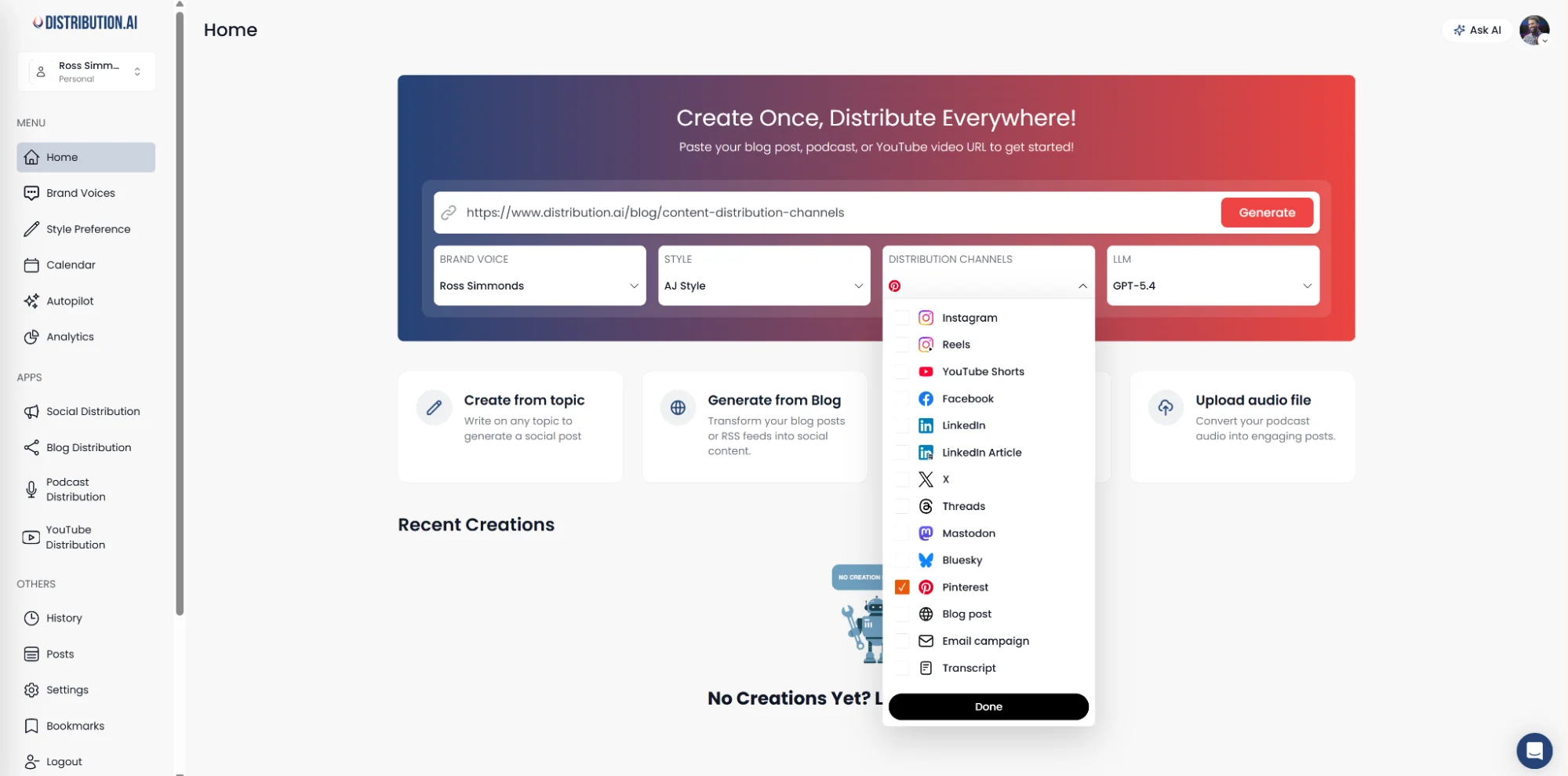
- Repurposes your existing content to create new, engaging Pins in the right dimensions with SEO-friendly metadata.
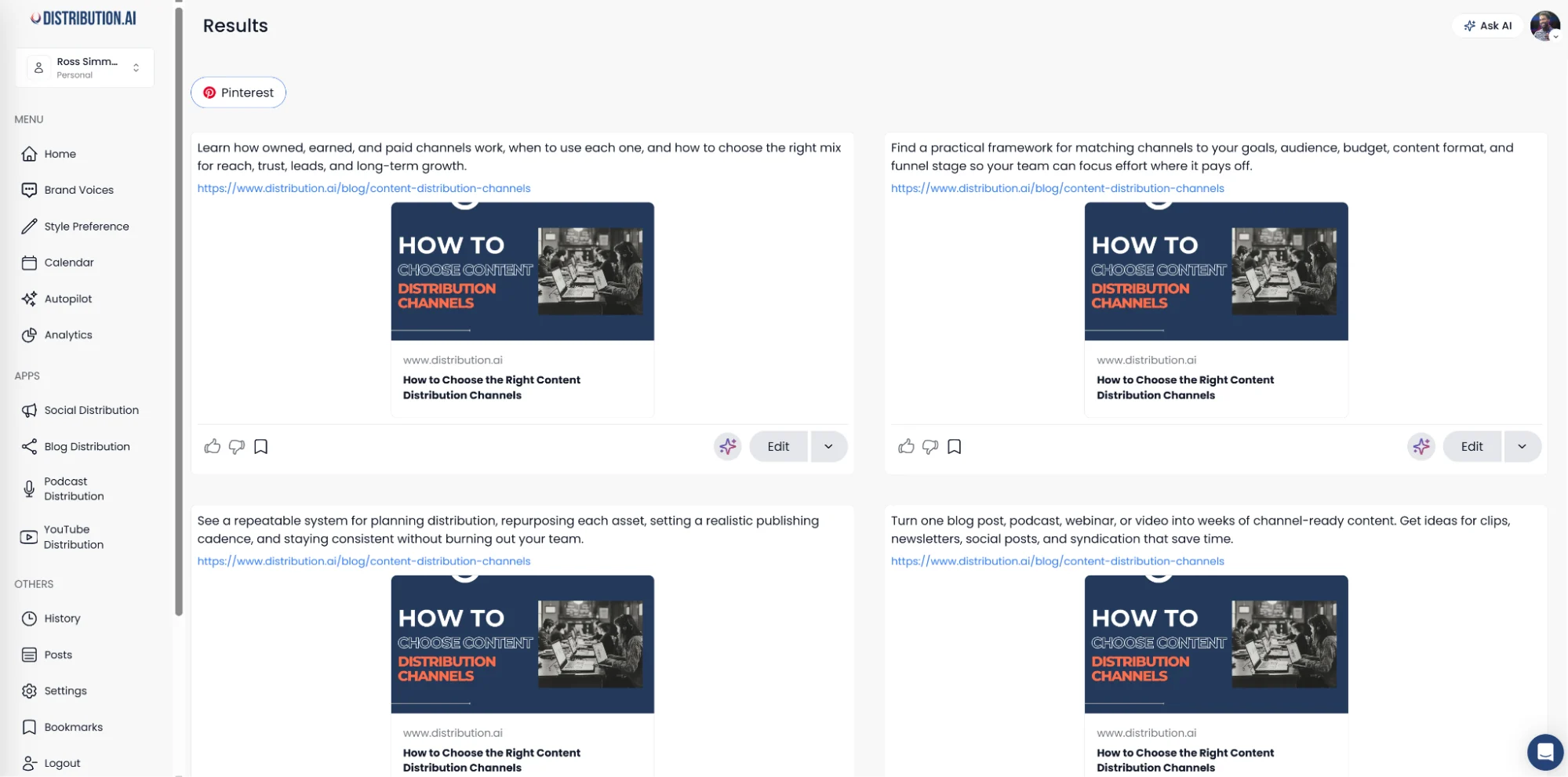
- Produces variants of titles and descriptions to support your Fresh Pin strategy.
- Unifies your social media analytics by bringing key metrics from multiple channels, including Pinterest, Instagram, Facebook, etc., to one place.
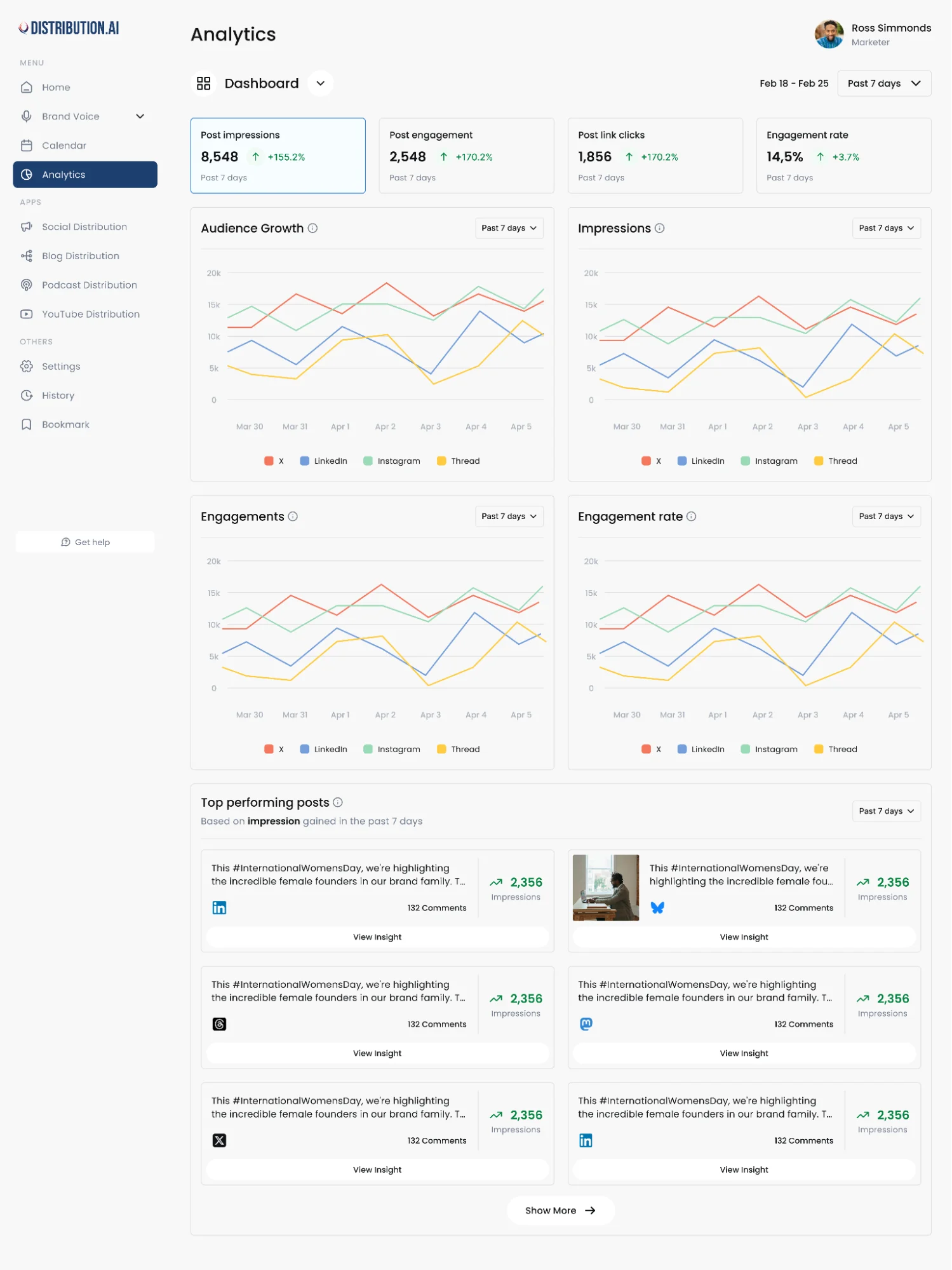
You can create and schedule your first Pin in just 10 minutes! Yes, it’s that easy.
*No credit card required. Cancel anytime.
Frequently Asked Questions About Pinterest Marketing Best Practices
1. What is Pinterest Marketing?
Pinterest marketing is the practice of creating Pins and boards that attract a relevant audience with high purchase intent to their website or e-commerce store. It involves producing visual assets and captions that are optimized for search and discovery for inspiration-driven content.
2. What Are the Top 3 Pinterest Marketing Best Practices for SEO?
The top 3 Pinterest SEO best practices for marketing are:
- Conduct platform-specific keyword research using the search bar, Trends and competitor Pins.
- Optimize titles (60 characters) and descriptions (500 characters) by incorporating the primary keyword early.
- Create theme-specific public boards with keyword-rich titles and descriptions.
3. What Are the Top 3 Pinterest Video Best Practices?
These top 3 Pinterest video best practices will help maximize your reach:
- Use the 9:16 aspect ratio at 1080×1920 px and keep logos and text within the central 80% to avoid clipping.
- Communicate your topic or core takeaway within the first 2–10 seconds.
- Keep on-screen text between 4–8 words for easier readability and add captions to facilitate audio-free watching.
4. Can Distribution.ai Repurpose or Create Pinterest Content?
Yes, you can repurpose existing and create new Pinterest content with Distribution.ai. Paste the link to or upload your published blog posts and videos to repurpose them into Pins. You can also describe your content idea to get multiple drafts for your Pinterest audience.
Frequently Asked Questions
Author

Promote, repurpose & distribute your content with AI
Start 15-Day Free Trial