How to Get Your Content Cited by ChatGPT, Claude and Perplexity
How to get cited by ChatGPT, Claude and Perplexity: what AI search citation studies show, Ross Simmonds’ three-layer model and an 8-step plan.
 By
Quick answer
To get cited by ChatGPT, Claude and Perplexity, publish clear, current pages that answer specific questions, earn rankings in traditional search, and distribute your ideas to the places AI systems read, such as Reddit, YouTube and industry publications. Studies of AI search citations show that rankings, freshness and presence across many sources all affect which pages get cited.
Buyers now ask AI assistants for vendor shortlists, how-to steps and definitions. When an answer cites a source, that source gets the click and the credibility.
This guide covers what the research says about LLM citations, a practical framework for earning them, and a checklist you can use this week. Every study is dated, because this area moves fast.
Key Takeaways
- Search rankings still matter for AI citations, though recent data shows many cited pages rank outside the top 10.
- Fresh content gets cited more. Updating important pages is part of generative engine optimization.
- Different assistants lean on different sources. Wikipedia and Reddit show up often.
- Ross Simmonds’ three-layer model frames AI visibility as SEO/GEO/AEO, distribution and memory working together.
- Distribution puts your ideas in more places AI systems read, which gives you more chances to be cited.
How AI assistants choose which sources to cite
When you ask ChatGPT or Perplexity a question that needs current information, the assistant usually runs one or more web searches, reads a set of pages, and writes an answer that cites some of them. Many assistants also break one question into several related searches. Foundation calls this query fan-out, and it explains why a page can get cited for a question it never targeted directly.
Each assistant works differently and none publishes its full selection logic. The best evidence comes from large studies of AI answers. Here is what the main ones found.
What the research says about AI search citations
| Study | Scope | Key finding |
|---|---|---|
| Ahrefs, Jul 21, 2025 | Google AI Overviews | 76.1% of cited pages ranked in the top 10 |
| Ahrefs, Mar 2, 2026 | 863K keywords, Google AI Overviews | 37.9% of cited pages ranked in the top 10; 31.2% ranked 11 to 100; 31.0% ranked outside the top 100. YouTube was 5.6% of cited URLs |
| Profound, Jun 2025 | 680M citations across AI platforms | Wikipedia was 7.8% of ChatGPT citations; Reddit was 6.6% of Perplexity citations |
| AirOps, Aug 4, 2025 | Pages cited by ChatGPT | Over 70% of cited pages were updated in the previous 12 months |
| AirOps via Search Engine Land, Apr 16, 2026 | 50,553 ChatGPT responses | Pages ranking first were cited 58.4% of the time vs 14.2% at tenth; pages with JSON-LD were cited 38.5% vs 32.0% without |
Read these with care. The two Ahrefs studies used different datasets and methods, so the drop from 76.1% to 37.9% is a directional signal. The two numbers can’t be compared directly. Ahrefs itself points to query fan-out and better detection as part of the change. The safest reading across all five: rankings help a lot, freshness helps, and a large share of citations come from sources beyond your own website.
Ross Simmonds’ three-layer model of AI visibility
Ross Simmonds, founder of Foundation and Distribution.ai, describes AI visibility in three layers. It is a useful way to plan the work, because each layer needs a different kind of effort.
The SEO/GEO/AEO layer
Your own pages, built so search engines and answer engines can find, understand and quote them. This is technical health, rankings, structure and clear answers.
The distribution layer
Your ideas showing up beyond your site: on LinkedIn, Reddit, YouTube, podcasts, newsletters and industry publications. These are the third-party sources AI systems read and cite.
The memory layer
What models associate with your brand over time. When your name, your point of view and your category show up together across many sources, assistants are more likely to bring you up unprompted.
Ross argues that distribution is what earns citations in his piece on visibility in LLMs. Foundation goes deeper on the memory idea in AI memory marketing.
How to get cited by ChatGPT, Claude and Perplexity: 8 steps
- List the questions your buyers ask. Pull them from sales calls, support tickets and search data. Write them the way a buyer would type them into ChatGPT.
- Answer each one clearly near the top of a page. Put a two to three sentence answer up front, then the detail. Assistants quote short, self-contained answers.
- Rank in traditional search. Every study above shows a link between rankings and citations. Keep doing the SEO basics.
- Keep important pages fresh. Update facts, dates and examples on your key pages at least once a year. Our guide to redistributing old blog posts covers how to refresh and reshare them.
- Add structured data. Use schema markup that matches the page type, such as Article, FAQ or Product.
- Publish original data and points of view. Assistants need a source for specific claims. Original research gives them one, and it gives other sites a reason to link to you.
- Distribute every piece beyond your site. Turn each article into LinkedIn posts, Reddit contributions, YouTube clips and newsletter sections so your ideas appear in more places. Foundation’s work on Reddit AI citations shows why community platforms matter here.
- Measure your share of citations. Track which prompts cite you and your competitors, and how that changes over time.
Watch out: AI referral traffic often shows up as direct traffic in analytics. Ross covers what this looks like in practice in ChatGPT made your AI traffic invisible for a week. Track citations directly as well as clicks.
Why distribution drives AI visibility
Your website is one source. AI assistants read thousands. The Profound data above shows platforms like Wikipedia and Reddit making up a meaningful share of citations, and the Ahrefs data shows YouTube appearing among cited URLs. If your ideas only live on your blog, you are competing for a small slice of the citations available.
Distribution changes that. Each time a blog post becomes a LinkedIn post, a short video, a podcast talking point or a Reddit answer, your point of view appears in another place a model might read. Over time that builds the memory layer.
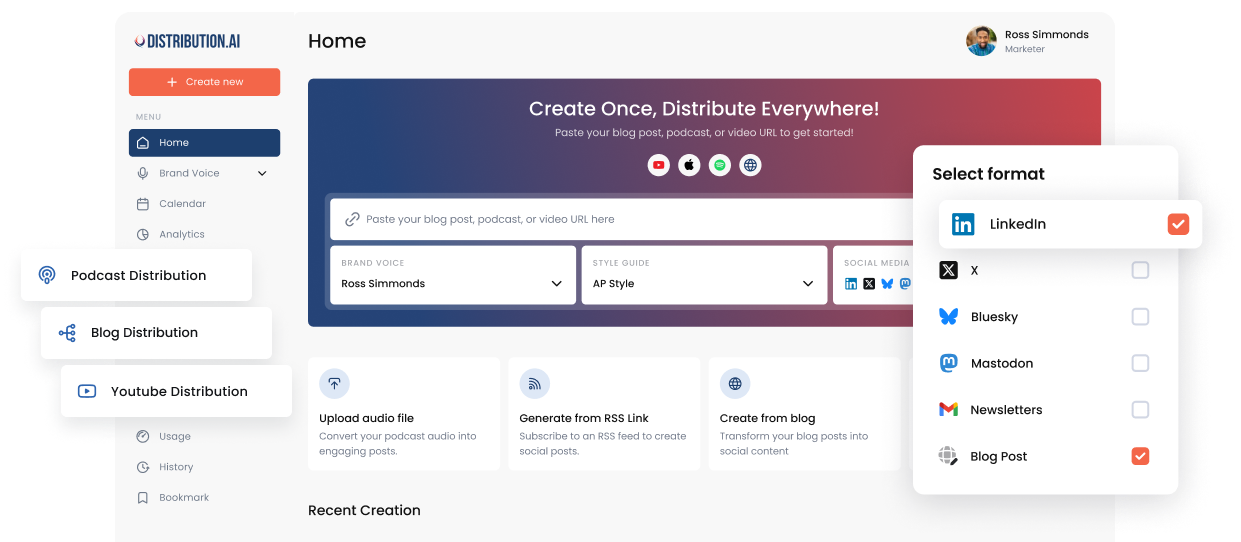
This is the work Distribution.ai is built for. Autopilot watches your blog, podcast or YouTube channel and creates channel-ready posts the moment something new is published. If you work inside ChatGPT or Claude, the MCP connector lets you turn a link into posts and schedule them from the chat, with every post landing on your calendar first. For more on why this matters, see Content Distribution vs Social Media Scheduling. If podcasts are part of your mix, our post on getting podcasts cited in AI answers covers that format.
How to track whether you are getting cited
Start simple. Pick 20 to 50 prompts that matter to your pipeline. Run them in ChatGPT, Claude, Perplexity and Google AI Overviews every month. Record which sources get cited and whether your brand is mentioned.
As the program grows, move to a dedicated AI visibility tool and connect citations to traffic and pipeline. Foundation’s guide to GEO metrics covers what to measure, and our post on how to measure content distribution shows how citations fit alongside traffic and pipeline.
Go deeper
Frequently asked questions
How do I get my website cited by ChatGPT?
Publish pages that answer specific questions clearly, rank them in traditional search, keep them updated, and distribute the ideas on platforms like LinkedIn, Reddit and YouTube. Large studies link rankings and freshness to citations.
Do Claude and Perplexity cite the same sources as ChatGPT?
Often they differ. Profound’s 2025 data found Wikipedia prominent in ChatGPT citations and Reddit prominent in Perplexity citations. Test your key prompts in each assistant.
Does SEO still matter for AI search citations?
Yes. Studies from Ahrefs and AirOps show a clear link between ranking well and being cited, though a 2026 Ahrefs study found many cited pages rank outside the top 10.
What is generative engine optimization?
Generative engine optimization, or GEO, is the practice of making your brand and content more likely to appear and be cited in AI-generated answers. It overlaps with SEO and adds distribution and citation tracking.
How long does it take to get cited by AI assistants?
It varies with your current rankings, the competition for the topic and how widely your ideas are distributed. Track a fixed set of prompts monthly so you can see change over time.
Put your ideas everywhere AI looks
Turn every blog post, podcast and video into channel-ready posts automatically, so your point of view shows up across more sources.
No credit card required.
Author

Promote, repurpose & distribute your content with AI
Start 15-Day Free Trial