Content Distribution vs Social Media Scheduling: Why Posting Isn’t Enough
Content distribution vs social media scheduling: why posting isn’t enough, plus a 5-part content distribution strategy checklist for B2B teams.
 By
Quick answer
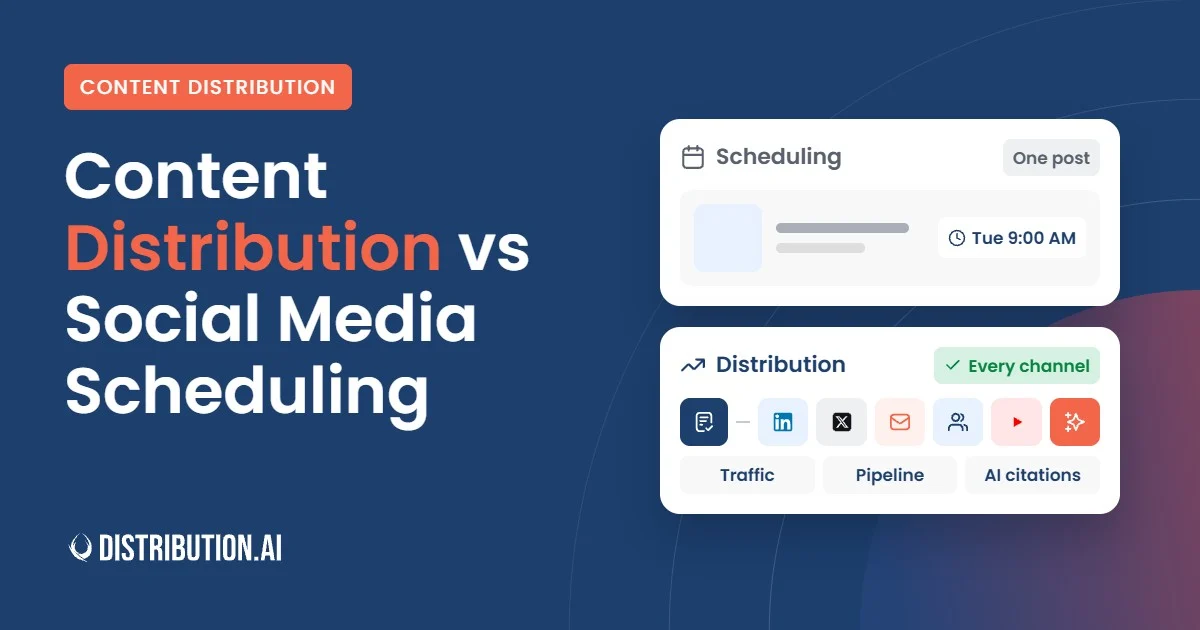
In content distribution vs social media scheduling, scheduling is a task: putting posts on a calendar. Content distribution is a strategy: getting each asset in front of the right people, across many channels and AI search, repeatedly over its whole life. Scheduling tools handle the timing. A content distribution platform decides what to say, where, how often and for how long.
Most B2B teams have a scheduling tool. Far fewer have a distribution system.
The gap shows up the same way every time. A team publishes a strong article, schedules two posts about it on launch day, and moves on to the next piece. The article never reaches most of the people it was written for. This post breaks down content distribution vs social media scheduling, why the difference matters for pipeline, and how to build a content distribution strategy that keeps working after launch week.
Key Takeaways
- Social media scheduling tools answer one question: when does this post go out?
- Content distribution answers five: what to say, to whom, on which channels, how many times and how you’ll know it worked.
- B2B buyers now discover companies through AI assistants as well as feeds, so distribution has to reach the places LLMs learn from.
- Every asset should have a distribution plan measured in months, with new angles each time it resurfaces.
- Automation makes this practical. Repurposing, scheduling and resurfacing can run on autopilot with human approval.
Content distribution vs social media scheduling: the core difference
Social media scheduling tools are calendars with publishing access. You write a post, pick a time, and the tool sends it. That’s useful. It saves you from logging in at 9:00 AM on a Tuesday.
Content distribution starts earlier and runs longer. It begins with an asset, like a blog post, podcast episode, webinar or video. Then it asks how that asset can reach every audience that would care about it, in a format native to each place, over and over.
Ross Simmonds has argued for years that most teams overinvest in creation and underinvest in distribution. His guide to content distribution and his book Create Once, Distribute Forever make the case that a single great asset, distributed well, will outperform a stack of assets that each got one post.
| Social media scheduling | Content distribution | |
|---|---|---|
| Starting point | A finished post | A source asset (blog, podcast, video, webinar) |
| Main job | Timing and publishing | Reach, repetition and format fit |
| Time horizon | Launch day or launch week | Months, often years |
| Channels | Social feeds | Social, email, communities, search and AI answers |
| Output per asset | One to three posts | Dozens of channel-native pieces |
| Success metric | Engagement on each post | Traffic, pipeline and AI-search citations |
Why posting isn’t enough for B2B content distribution
Three things changed how B2B buyers find companies. Each one makes a schedule-and-forget approach weaker.
1. Feeds reward native content
A link dropped into LinkedIn with a one-line caption asks people to leave the platform. Posts that teach something in the feed itself give people a reason to stop. That means each channel needs its own version of the idea, written for that format.
2. One post reaches a fraction of your audience
Your followers don’t all see a given post. They’re in meetings, on holiday or scrolling past. A single share at launch assumes the timing was perfect for everyone. Repeating the core idea with fresh angles over weeks is how it lands with the rest.
3. AI assistants are now a discovery channel
Buyers ask ChatGPT, Claude and Perplexity for vendor shortlists. Those answers draw on what’s been said about you across the web: on Reddit, LinkedIn, YouTube, review sites and industry publications. Foundation’s research on how B2B buyers discover you with AI makes the point that your website is only part of the picture. Distribution across many surfaces is how you show up in those answers.
Watch out: High engagement on a launch-day post can hide a distribution problem. Check how many of the people you wrote the piece for have actually seen it. Usually it’s far fewer than the post’s impressions suggest.
The 5-part content distribution strategy checklist
Use this checklist for every asset worth more than a single post. It turns a schedule into a plan.
Pick the asset and the audience
Name the buyer the piece was written for and the three places they spend time. Everything downstream follows from this.
Pull out every idea worth sharing
A 2,000-word post usually holds a framework, a few sharp opinions, some data points and a story. Each is a separate post.
Repurpose into channel-native formats
LinkedIn text posts, X threads, a newsletter section, a short video script, a community answer. Write each one for its home.
Spread it over time
Schedule across weeks, then plan a resurfacing pass at 90 days and again at six months. Evergreen assets earn repeat runs.
Measure beyond likes
Track referral traffic, assisted pipeline and whether AI assistants cite the asset. Feed what you learn into the next round.
Ross’s B2B SaaS Content Distribution Audit is a useful way to score where your team stands today before you start.
Where social media scheduling tools still fit
Scheduling remains a necessary step. It’s the last mile of distribution. The trouble starts when the scheduler becomes the whole system, because it only handles what you’ve already written.
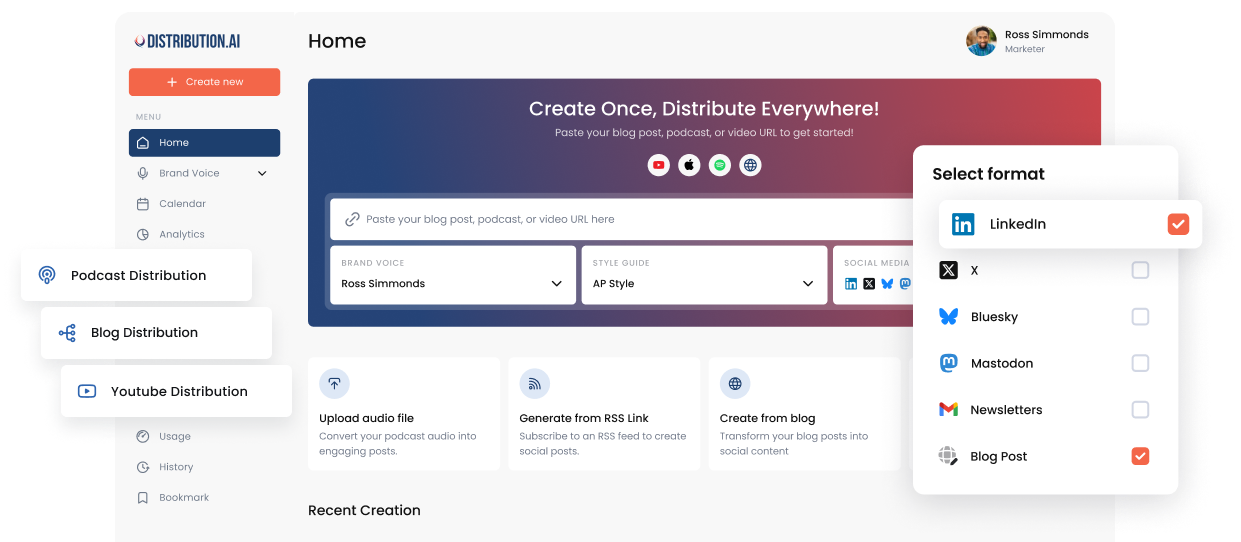
The better setup puts scheduling inside a content distribution platform. The platform turns a source asset into channel-ready posts, queues them into your posting schedule, routes them for approval and reports on results. That’s what Distribution.ai does:
- Autopilot watches your blog, podcast or YouTube channel and creates channel-ready posts the moment something new is published.
- Brand voices and writing styles keep every post on message.
- Recurring posting schedules and approval workflows control when content goes live and who signs off.
- Analytics show which posts drive engagement, filtered by platform and time range.
You can also run the whole loop from an AI assistant. Our guide to connecting Claude to your social media accounts shows how, using the Distribution.ai MCP connector.
How to move from scheduling to distribution this month
You don’t need a reorg. Start with one asset.
- Pick your best-performing article from the last year.
- Run it through the five-part checklist above.
- Generate 10 to 15 channel-native posts and schedule them across six weeks.
- Set a reminder to resurface it in 90 days. Our guide to redistributing old blog posts walks through that pass.
- Compare the results to a piece that only got launch-day posts. Use the framework in How to Measure Content Distribution.
Go deeper
Frequently asked questions
What is the difference between content distribution and social media scheduling?
Social media scheduling is publishing finished posts at set times. Content distribution is the broader strategy of turning an asset into channel-native content and getting it in front of the right audiences across social, email, communities and AI search over months.
Do I still need a social media scheduling tool?
Yes. Scheduling is the final step of distribution. Look for one that sits inside a distribution workflow, so repurposing, approval and measurement happen in the same place.
How many times should I share the same blog post?
There’s no single right number. A practical starting point is a burst of posts across the first few weeks with different angles, then a resurfacing pass every quarter for evergreen pieces.
What is a content distribution platform?
A content distribution platform takes a source asset, such as a blog post, podcast or video, and turns it into channel-ready content, schedules it, manages approvals and reports on results. Distribution.ai is built for this.
How does content distribution affect AI search?
AI assistants build answers from content across the web. The more useful, consistent mentions of your ideas exist on the platforms they draw from, the more likely they are to cite or recommend you. See Foundation’s guide to AI visibility.
Turn every asset into months of distribution
Repurpose, schedule, approve and measure in one place.
No credit card required.
Author

Promote, repurpose & distribute your content with AI
Start 15-Day Free Trial