ChatGPT Vs Content Repurposing Tool: Which One Do You Actually Need?
Compare ChatGPT with a dedicated content repurposing tool across workflow, brand voice, publishing, and scale. Find the right setup for your B2B team.
You’re probably already using ChatGPT to draft emails, blogs, or sales pages.
The question is what happens after the draft.
A single blog post can turn into LinkedIn posts, email sequences, short-form video scripts, social carousels, lead magnets, and sales copy, but getting there takes more than a prompt. It takes a system built specifically for that job.
This article compares ChatGPT with dedicated content repurposing tools across speed, consistency, brand voice, publishing, and scale, so you can choose the right setup for your team.
The short answer
- ChatGPT is best for ideation, summarisation, and text-first drafting.
- Dedicated repurposing tools are better for clipping, formatting, scheduling, and multi-channel publishing.
- Most B2B teams benefit from using both in a hybrid setup.
Is it worth using ChatGPT for Content Repurposing?
ChatGPT is strong at interpreting long-form material and turning it into readable draft assets. To understand how far that strength actually goes in a real workflow, we ran a simple test.
We took an existing article, Social Media Automation 101, and asked two systems to repurpose it. One was ChatGPT. The other was a dedicated repurposing and distribution platform that we will introduce shortly.
ChatGPT response:
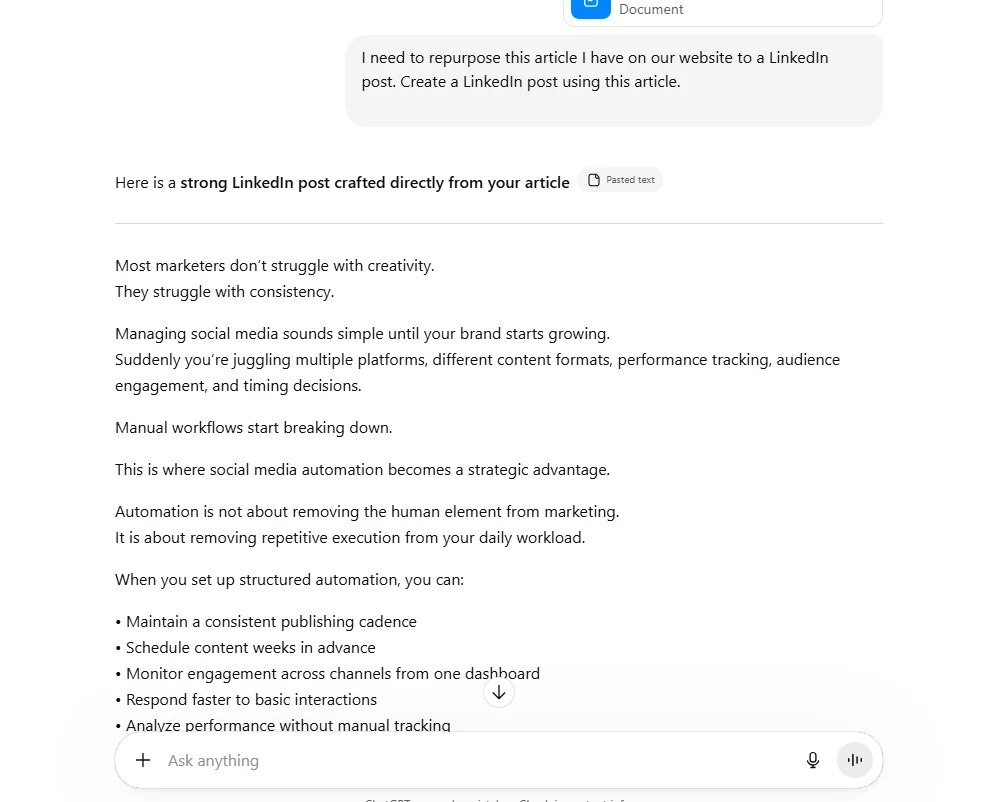
ChatGPT gave us a solid draft that covered the key points from the original article. It was easy to read and worked well for channels like LinkedIn posts or emails.
However, the output still required manual shaping. Platform formatting, content sequencing, publishing timing and distribution planning remained external tasks.
But it had no sense of our brand. It did not ask for guidelines, sample content, or any context about how we communicate.
It spit out a generic content that was usable, but not ours. And once the draft was done, we still had to figure out where to send it, how to format it for each channel, and when to publish. ChatGPT does not do any of that.
That is exactly what Distribution AI is built for.
AI-tool Response: Distribution.ai
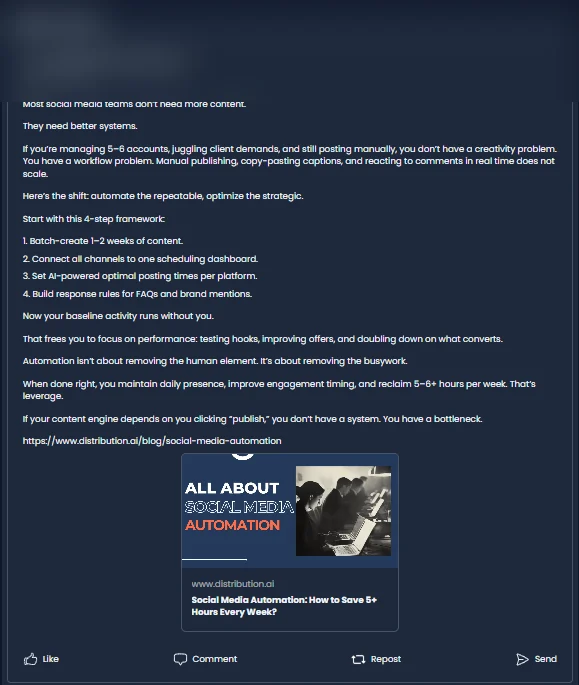
Distribution.ai (Our AI tool) focused more on execution readiness. Instead of one polished draft, it generated multiple content variations aligned to different platforms and posting formats.
Assets were closer to publish-ready. Content structure reflected distribution logic rather than just narrative clarity. This made the output easier to plug into scheduling systems and ongoing campaign workflows.
What This Experiment Reveals About How Content Workflows Actually Work
The experiment was not really about which tool writes better.
It showed where work actually happens when teams start repurposing content seriously. Turning one asset into multiple outputs is not a single action.
It usually moves through a few practical stages:
- Understanding the source — pulling out angles, hooks, and usable draft ideas
- Preparing the assets — adapting formats, creating clips, adjusting visuals, structuring posts
- Getting content live — scheduling, tracking ownership, and maintaining publishing consistency
Most teams only notice this separation once content volume increases. ChatGPT tends to help most in the first stage. It makes drafting and interpretation faster.
Dedicated repurposing tools start to matter later, when the work shifts toward packaging and distribution.
At that point, the real decision shifts to which part of the workflow your team needs to make more predictable.
ChatGPT Vs. Distribution.ai: Side-by-Side Comparison
Once repurposing is viewed as a workflow rather than a single task, the comparison becomes clearer.
ChatGPT tends to create value at the idea and drafting stage, while Distribution.ai create value at the production and distribution stage.
The distinction becomes easier to see side by side:
| Category | ChatGPT | Distribution.ai |
|---|---|---|
| Best For | Ideation, summarisation, drafting, message adaptation | Clipping, packaging, scheduling, publishing, workflow automation |
| Setup Time | Fast to start, slower to standardize | Slower to configure, faster to repeat |
| Learning Curve | Easy for simple prompts, steeper for consistent output | Higher upfront for workflows, easier once set |
| Brand Voice | Strong with examples, files, and custom GPTs | Stronger for repeatable packaging and production consistency |
| Workflow Automation | Limited for native publishing workflows | Built for automated execution |
| Multi-Channel Publishing | Mostly manual | Usually native or workflow-based |
| Video/Audio Repurposing | Weak natively | Usually core to the product |
| Cost Predictability | Can be low at first — labour cost rises with volume | Higher software cost, lower manual cost at scale |
| Team Collaboration | Improving through Projects and workspace features | Better for operational handoffs |
| Scalability | Strong for strategy, weaker for production throughput | Strong for throughput once workflows are configured |
Table: A Side-by-Side View of Where ChatGPT and Distribution.ai Create Value Across the Content Workflow
ChatGPT offers flexibility and speed when shaping content. Distribution.ai offers structure and predictability when moving content into live distribution.
In practice, most growing teams end up using both at different stages of the same pipeline.
Which Option Fits Your Team and Workflow Best?
Your team structure changes the answer.
Best for solo creators
ChatGPT is often enough when your output is mostly text, your publishing volume is moderate, and you can tolerate a manual workflow.
A solo operator can use it to turn one blog post into a week’s worth of content in a few minutes, for example, drafting emails, newsletter draft, some LinkedIn posts, a short script.
But there is a catch. None of it comes out formatted or scheduled. You still do that part manually, which is manageable when you are only running one channel.
To bridge that gap, you can use Distribution.ai. The tool that helps creation and distribution of content across different platforms.
Best for agencies
Agencies work with multiple clients at once. That means they need to write differently for each one, like different tones, different audiences, different goals. ChatGPT is good at that part.
But switching between clients all day gets messy fast.
Distribution.ai keeps the process consistent. It handles how content gets built and sent out, so the team is not figuring that out from scratch every time a new client comes in.
Best for in-house B2B Teams
In-house B2B teams are usually juggling more than anyone else. More channels to post on, more people who need to approve things, and a brand voice that has to stay consistent across all of it.
At that point, ChatGPT alone starts to slow you down. You can use it to think through ideas and draft content, but getting that content out consistently across every channel is a different problem. That is what Distribution.ai handles.
When ChatGPT Alone Is Enough?
ChatGPT is often enough when:
- You mainly need text outputs
- You repurpose content occasionally, not daily
- Your team is small
- You already have a manual publishing process that works
- Budget pressure is higher than time pressure
- Your biggest problem is turning source material into usable drafts
In those cases, ChatGPT gives you flexibility without adding another tool category.
When do you need a dedicated content repurposing tool?
A specialist tool starts to make more sense when:
- You publish across multiple channels every week
- You need clips, captions, resizing, and formatting
- More than one person touches the workflow
- You care about scheduling and operational consistency
- You are repurposing lots of video or audio
- Manual execution has become the bottleneck
That is the point where labour cost usually becomes more painful than software cost.
Where Distribution.ai Fits in This Workflow
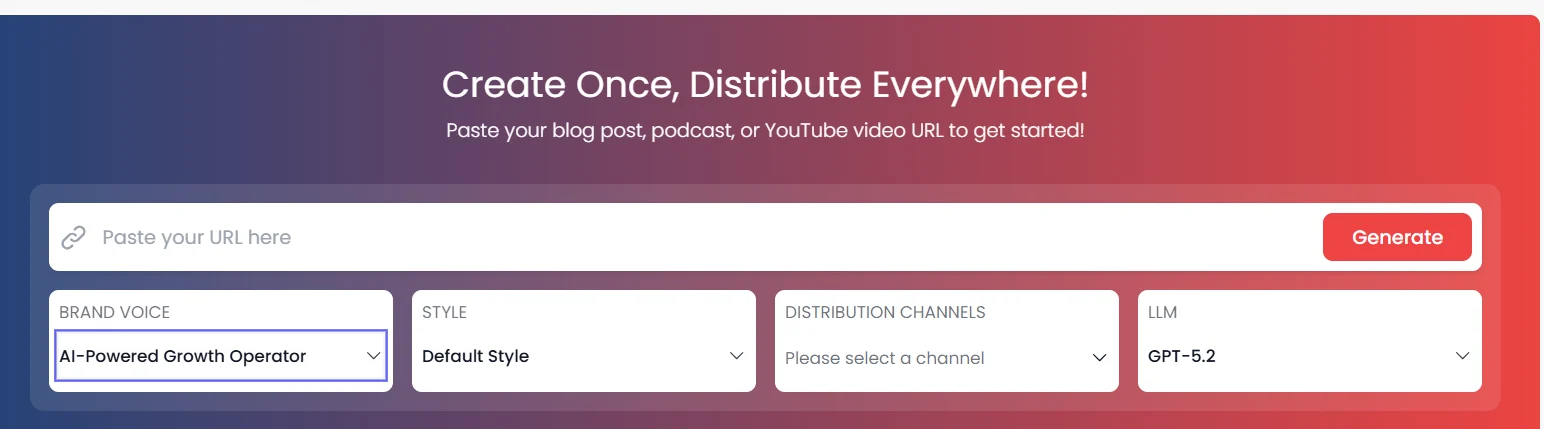
Once you have a piece of content worth sharing, Distribution.ai takes it from there. Here is what that actually looks like inside the tool.
You paste a URL. It does the rest
Go to Blog Distribution, drop in your blog post link, and hit Generate. That is the whole input. Distribution.ai reads the content, figures out what matters, and turns it into posts for whatever channels you select.
LinkedIn, X, Instagram, email campaigns, blog posts, LinkedIn Articles, you pick the channels from a dropdown and it formats each one accordingly.
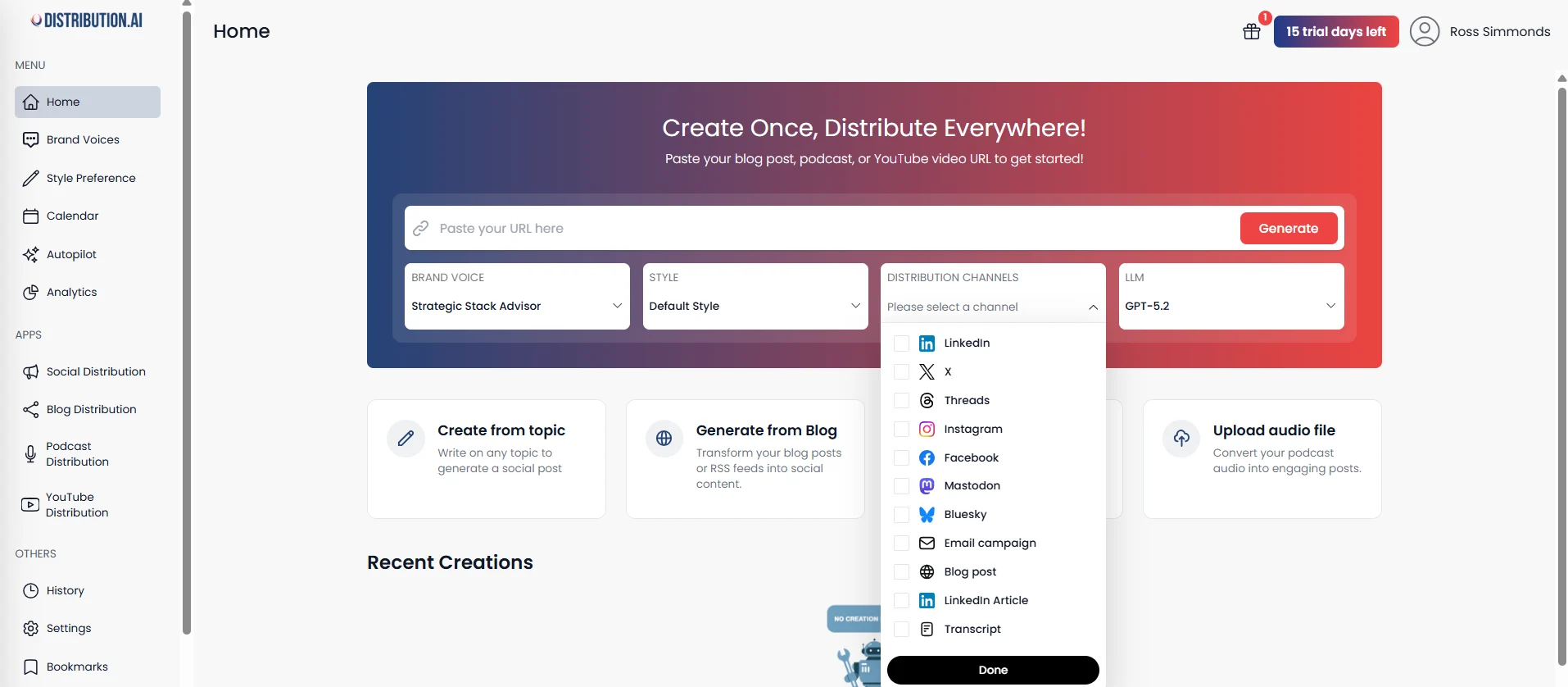
It writes in your voice, not a generic one
Before generating anything, Distribution.ai asks you to set a Brand Voice. If you have brand guidelines, you upload them.
If you do not, it pulls from a sample article and builds your voice profile from that. ChatGPT skips this step entirely. What you get from DAI actually sounds like your brand.
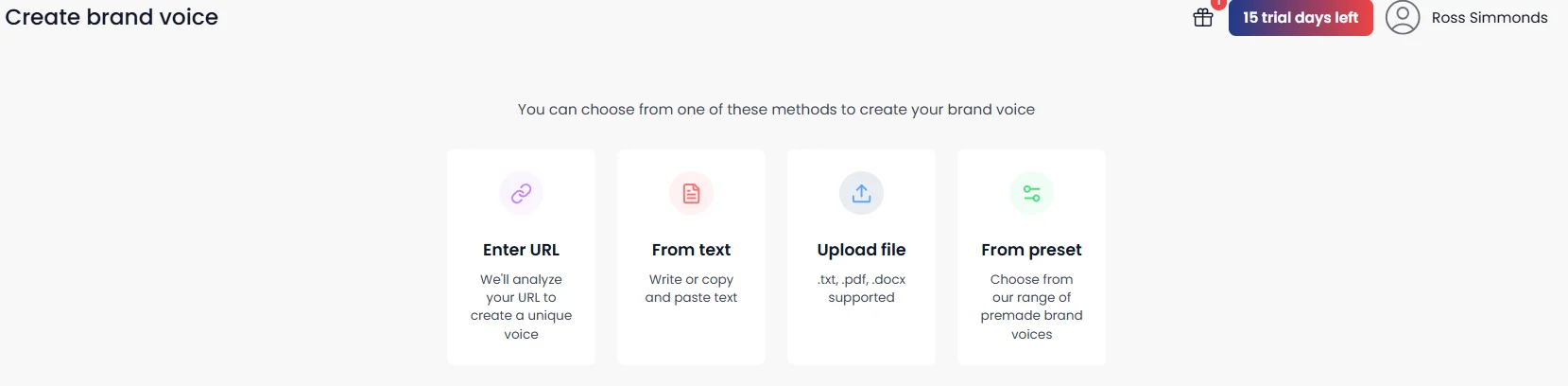
You also set a Style Preference separately. Things like punctuation rules, em-dash formatting, regional spelling, whether to include hashtags, how to handle numbers.
You create it once in the sidebar and it applies every time.
You choose which AI model generates the content
This is where it gets interesting. Distribution.ai does not lock you into one model. You can run your content through GPT-5.2, GPT-5.1, Gemini 2.5 Pro, Gemini 2.5 Flash, and more.
Distribution.ai LLM selector showing GPT and Gemini model options
So you are not replacing ChatGPT here. You are using it inside a system that actually knows what to do with the output.
It covers every content format you work with
The sidebar has four separate distribution modes:
- Social Distribution
- Blog Distribution
- Podcast Distribution
- YouTube Distribution
Each one is built for that specific content type. You are not forcing a blog workflow onto a podcast. Each format gets its own input and its own channel logic.
Scheduling is built in, not bolted on
Distribution.ai Content Calendar scheduling settings with weekday posting times
Once the content is generated, it goes straight into the Content Calendar. You set your posting times per day, pick your timezone, and the queue runs automatically.
And if you want to go fully hands-off, there is Autopilot
Connect your blog RSS feed, your podcast feed, or your YouTube channel. Every time you publish something new, Distribution.ai automatically generates the social posts and queues them up.
The Right Choice Depends on What Part of the Workflow You Need to Fix
- Choose ChatGPT when your biggest bottleneck is ideation, summarisation, or drafting.
- Choose a dedicated content repurposing tool when your biggest bottleneck is clipping, formatting, scheduling, or publishing.
- Choose a hybrid setup when you need both strategic flexibility and operational consistency.
That is the answer most B2B teams end up with. ChatGPT is excellent at helping you create the raw material.
Dedicated repurposing tools are better at turning that material into a repeatable, multi-channel system.
And a platform like Distribution.ai can help connect that work into a more usable distribution workflow, especially when your team wants to move faster without rebuilding the process every time.
If you want to make the right call, do one thing first: audit your workflow from source asset to published outputs and find the exact step where your team slows down. That is where your next tool should earn its place.
Want a better way to turn one strong asset into a full distribution workflow?
See how Distribution.ai helps B2B teams move from content creation to channel-ready execution with less manual work.
Frequently Asked Questions
1. Is ChatGPT a content repurposing tool?
Not in the strict product-category sense. ChatGPT is a general AI workspace that can help with repurposing tasks such as summarising, rewriting, and drafting. It is not positioned as an automated multi-platform execution tool.
2. Can ChatGPT replace repurposing software?
Sometimes, yes — for text-first and lower-volume workflows. Usually, no — when you need automated clipping, resizing, scheduling, and multi-channel publishing.
3. What is the difference between ChatGPT and a content repurposing tool?
ChatGPT helps you interpret and rewrite content. A repurposing tool helps you package, automate, and publish it. One handles strategy and drafting. The other handles production and distribution.
4. Which is better for social media repurposing?
For text posts and hook generation, ChatGPT is strong. For video clips, captions, reformatting, and scheduled posting, dedicated tools are usually better.
5. Which is better for a brand voice?
ChatGPT is stronger for nuanced written voice when you give it good inputs. Dedicated tools are stronger for repeatable production consistency across formats and channels.
6. Do content repurposing tools use AI?
Yes. The category is increasingly hybrid. Specialist tools are using AI inside their own workflow features rather than forcing teams to choose between one or the other.
7. What is the best setup for a B2B marketing team?
For most B2B teams, the best setup is hybrid: Strategy and drafting in ChatGPT, then packaging and distribution in a dedicated repurposing tool or platform like Distribution.ai.
Promote, repurpose & distribute your content with AI
Write 10x faster, engage your audience, & never struggle with the blank page again.
Start 15-Day Free Trial
Frequently Asked Questions
Author

Promote, repurpose & distribute your content with AI
Start 15-Day Free Trial