15 Best AI Image Generators for Content Marketing
Looking for the best AI image generator? We reviewed 15 top AI image generation tools by features, pricing, pros and cons to help you pick the right one.
AI image generators can turn your text prompts into photorealistic images, transform existing images, generate new angles from one or multiple reference images, create infographics, design banners and make granular edits to style, lighting, details and composition.
Your content marketing team can use these tools to accelerate their creative workflow. For instance, social media marketing professionals can use an AI image generator to create aesthetic, on-brand infographics to improve engagement.
In this listicle, we’ve covered 15 top AI image generators you can start using today for various content marketing applications. Some are great at creating flowchart-style diagrams, while other AI image generators excel at illustrations for feature images.
Key Takeaways:
- Leonardo.ai and OpenArt are great for creative teams that create realistic images with consistent characters across a series.
- Ideogram and Gemini Nano Banana Pro are best for marketers designing logos, posters, banners and text-heavy infographics where legible typography matters.
- Canva AI and Picsart are ideal for non-designers who want to edit existing images with AI image generation capabilities built into the editor.
- Adobe Firefly is the safest pick for enterprise teams that produce licensed images commercially.
- BlueWillow and Hotpot AI suit budget-conscious creators looking for a free AI photo generator with the basics covered.
- Midjourney is the best AI image creator for designers chasing best-in-class aesthetic image quality and stylized art.
- Flux Kontext and Janus Pro are built for developers who want API access or open-source AI image models they can run on their own device.
- Getimg.ai and Imagine Art are perfect for power users who want multiple frontier AI models to run the same prompt or multiple prompts concurrently.
- Seedream AI is the right call for high-volume teams generating realistic images at up to 4K.
How We Made This List of Best Image Generators
We started by mapping the kinds of visuals marketing teams actually publish across channels, which include social posts, website graphics, illustrations, AI posters, infographics, flowcharts and diagrams.
From there, we combed through top-ranking editorial resources from authoritative domains to shortlist AI image generation tools capable of producing that range of content.
Platforms that offered more than ChatGPT’s image generation capabilities stood out because they allowed content marketers to do more, like combine images, generate a batch from a single image, help improve their image prompts and offer faster generation speed.
We then visited each tool’s website to learn about the features of the AI technology and pricing.
Finally, we cross-checked user sentiment on review sites like Trustpilot, G2, AppSumo and Capterra to surface the real-world pros and cons behind every shortlist pick.
15 Best AI Image Generators to Elevate Your Content Marketing
From all-in-one design suites that offer powerful free versions to specialized premium AI image models for typography and character consistency, these top AI image generators cover every content marketing use case.
| Tool | Best For | Standout Feature | Pricing (as of July 2026) |
| OpenArt | Creative teams needing consistent characters and custom-trained models | Consistent Character engine and LoRA training | Free plan; paid from $12/month |
| Gemini Nano Banana Pro | Marketers designing logos, posters and text-heavy infographics | Industry-leading in-image text rendering | Free plan; paid from $20/month |
| Imagine Art | Non-designers wanting AI image generation inside a full design editor | Magic Media built into the Canva editor | Free plan; Pro from $12.99/month |
| Adobe Firefly | Beginners and budget creators wanting a free Midjourney-style tool | Free prompt-to-image with multiple variations | Free |
| Hotpot AI | Small teams needing image generation plus quick photo edits | All-in-one editor with REST API and self-hosting | Free tier; credits from $10/month |
| Getimg.ai | Social media marketers wanting AI alongside a full editing suite | AI Playground with 90+ models | Pro from $15/month |
| BlueWillow | Enterprise teams needing commercially safe images in Creative Cloud | IP-indemnified outputs and Photoshop integration | Free tier; paid from $9.99/month |
| Canva AI | Power users wanting multiple frontier models in one workspace | Multi-model access (FLUX.2, Seedream, Nano Banana, GPT Image) | Free credits; paid from $10/month |
| Janus Pro | Marketers building factual infographics and multilingual visuals | 4K output with Google Search grounding | Bundled with Google AI plans |
| Picsart | Developers needing API access for character consistency and local edits | In-context editing with text + reference images | $0.04–$0.08 per image |
| Midjourney | Developers and researchers wanting open-source AI image models | MIT-licensed unified understanding + generation | Free and open-source |
| Seedream AI | Creators producing consistent characters in images and videos | 100+ premium image and video models in one studio | Paid from $14/month |
| Flux Kontext | High-volume creators needing 4K outputs and unified edit + generation | Up to 4K resolution with multi-reference input | Paid from $19.90/month |
| Leonardo.ai | Creative pros chasing best-in-class aesthetic quality | Stylized, polished outputs from simple prompts | Paid from $10/month |
| Ideogram | Mobile-first creators wanting frontier models on web and mobile | Frontier image and video models (Flux, Kling, Veo, Nano Banana) in one app | Free tier; paid from $13/month |
A side-by-side look at the top 15 AI image generation tools—what each does best, its standout feature, and starting price.
1. Leonardo.ai
Leonardo.ai offers multiple general and fine-tuned AI image models for image generation, with tools to maintain character consistency and custom model training for finer creative control.
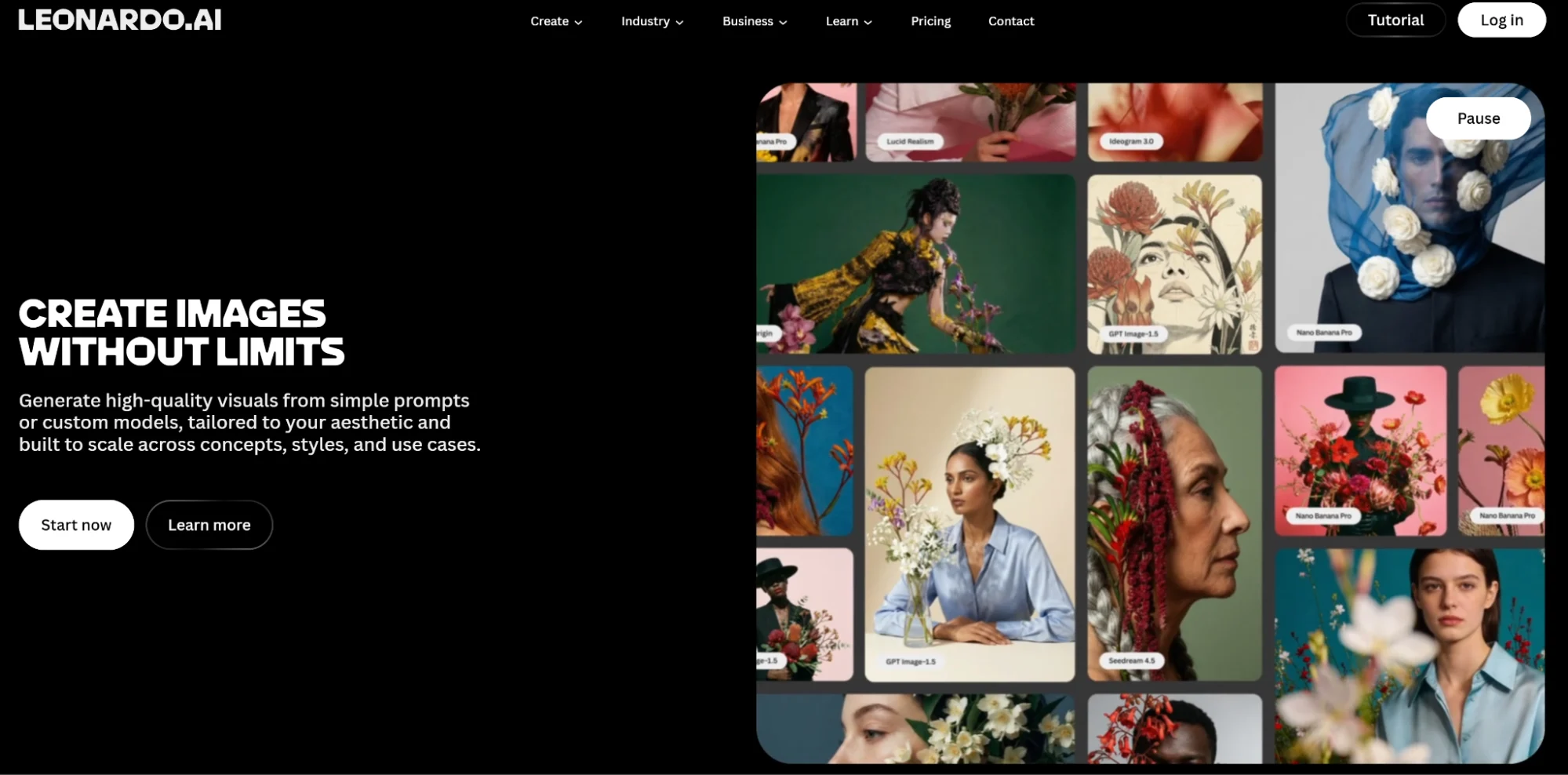
Leonardo.ai is Best for: Creative teams that need to generate consistent visuals across a series of images.
Leonardo.ai’s Features
- Multiple proprietary models (Phoenix, Lucid Origin, Lucid Realism)
- Custom model and LoRA training, plus a Consistent Character engine
- Image and video generation, with unlimited relaxed generations on premium plans
- ControlNet-style posing and edge tools, plus negative prompts
- API access on higher tiers
Leonardo.ai’s Pros
- A wide range of creative styles, presets, model options and customization.
- Clean, intuitive interface
- Fast, high-quality image generation at reasonable prices compared to other image generators
- Strong, responsive customer support
Leonardo.ai’s Cons
- Tokens can be unexpectedly expensive and burn faster on certain generations
- Users have reported subscription cancellation and refund difficulties, including one enterprise user being charged repeatedly after a confirmed cancellation request
Leonardo.ai’s Pricing
- Free plan: 150 tokens per day
- Essential: $12/month for individuals
- Team Starter: $72/month for 75,000 tokens (minimum 3 seats)
- Team Growth: $144/month for 180,000 tokens (minimum 3 seats)
- Pay-as-you-go API model with no monthly fee
2. Ideogram
Ideogram is an AI image generator known for industry-leading in-image text rendering, making it a go-to for logos, posters, banners, infographics and marketing materials. It also includes editing tools like Magic Prompt and batch generation to streamline your workflow further.
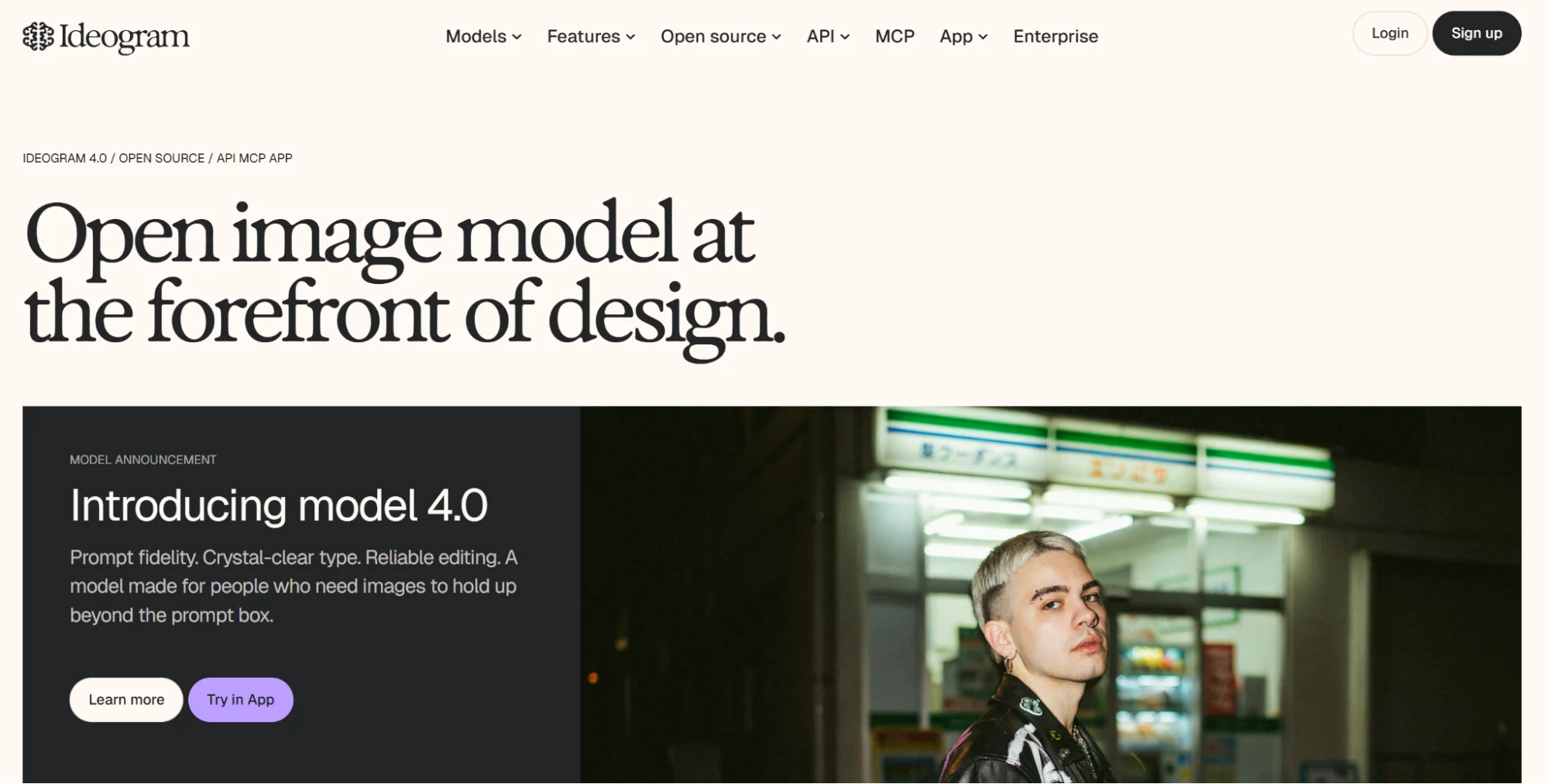
Ideogram is Best for: Marketers and designers who need a tool that supports text-to-image for text-heavy images.
Ideogram’s Features
- Best-in-class legible text rendering inside images
- Magic Prompt for prompt enhancement
- Batch generation (up to 500 prompts via CSV on Pro and Team plans)
- Editing tools: remix, reframe, replace background, upscale and layerize
- API access (priced separately)
Ideogram’s Pros
- One of the best AI image generators for text and typography rendering inside images
- Easy to use, with versatile styles that work even for text-heavy infographics
- A helpful Magic Prompt feature that ensures good prompt adherence
- Responsive customer support that fixes reported issues proactively
Ideogram’s Cons
- Issues with refund requests, even when the platform doesn’t work after payment
- The number of free tokens can be deceptive, since the platform limits the number of actual generations
Ideogram’s Pricing
- Free plan: 10 slow credits per week with public images
- Paid plans start at $20/month (billed monthly) for 1,000 priority credits/month
- Pro: $60/month (billed monthly) for 3,500 priority credits/month
3. Canva AI Image
Canva’s AI image generation tools (Magic Media and Dream Lab) create images from text prompts directly inside the Canva design editor. It can be a great option for marketers familiar with Canva’s designer and image editing suite.
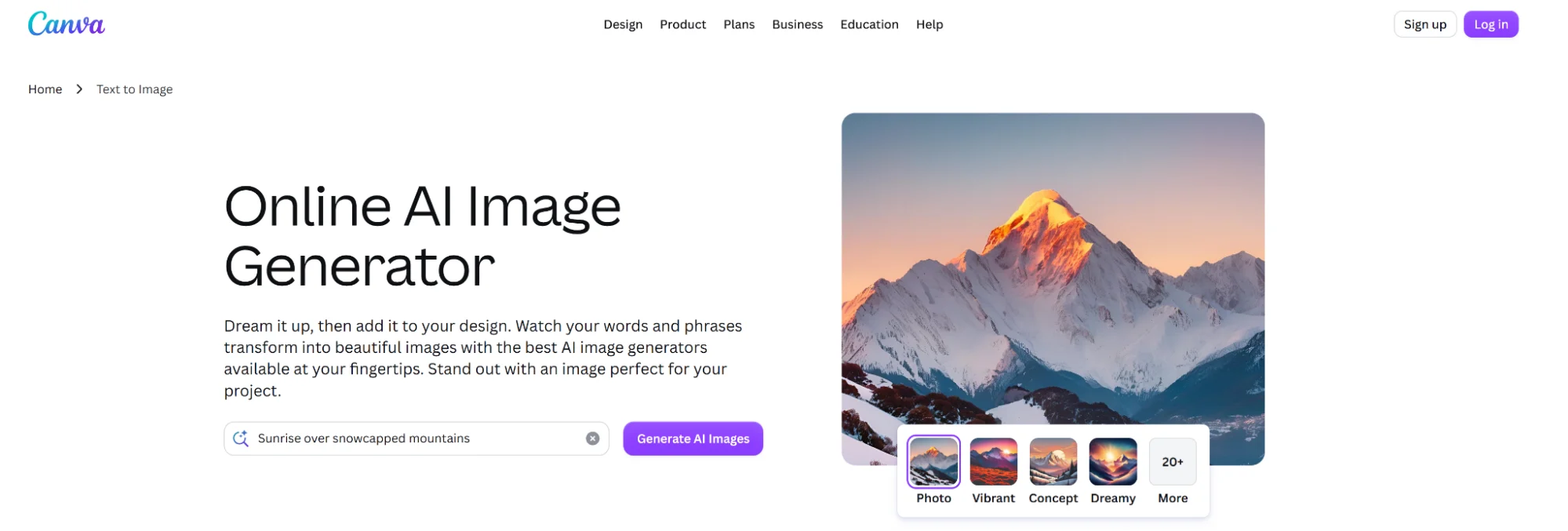
Canva AI is Best for: Non-designers and marketing generalists who want to generate images and a design tool.
Canva AI’s Features
- Text-to-image generation via Dream Lab (built on Leonardo’s Phoenix architecture)
- Multiple artistic styles and style transfer across matching images
- Integrated into the Canva editor with templates and editing tools
- Conversational Canva AI 2.0 design
- Commercial usage rights on Free and Pro plans
Canva AI’s Pros
- Can be used to produce graphics and visuals in different styles
- Widely known for exceptional ease of use and a massive template library
- An all-in-one suite (photo and video editing, AI text and image tools, background remover)
- Strong real-time collaboration capabilities for distributed teams
Canva AI’s Cons
- One user reported being charged for every iteration of their design work
- Advanced design control is limited compared to other tools, and the platform’s layout changes can be confusing
- Doesn’t allow users to use their own API key easily; it has a technically-heavy workaround
Canva AI’s Pricing
- Free plan: limited AI use (around 50 Magic Media generations/month)
- Canva Pro: $12.99/month (billed monthly), includes 2,000 monthly AI credits shared across features
- Canva Business: $25/person/month (billed monthly)
- Optional AI Pass add-on: $100/month/user for more AI usage
4. BlueWillow
BlueWillow is a free, beginner-friendly AI art generator that turns text prompts into images, such as logos, characters, illustrations and photo-realistic artwork. You can access the free platform’s AI Studio after entering your email.
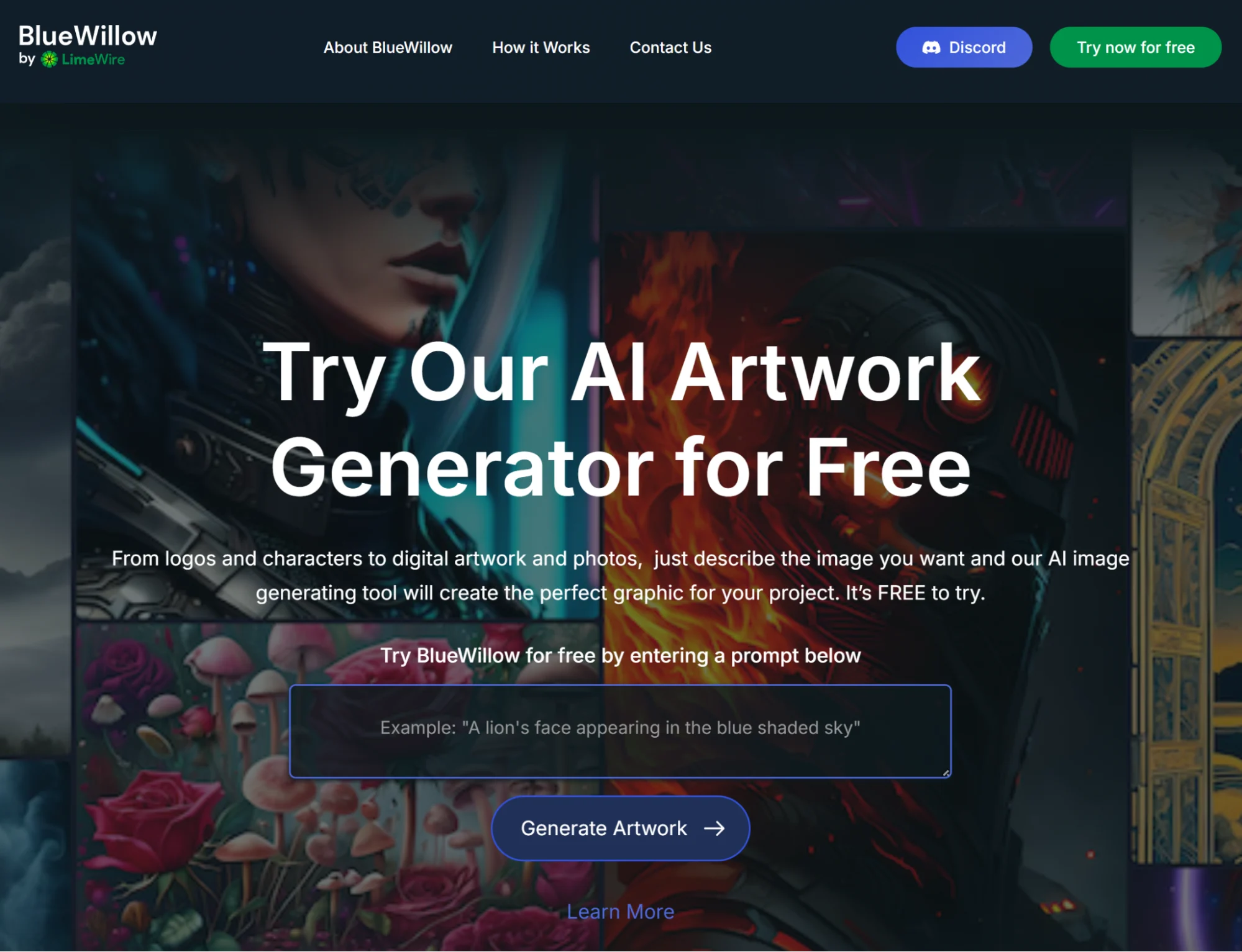
BlueWillow is Best for: Beginners and budget-conscious creators who want a free AI image generator.
BlueWillow’s Features
- Text-to-image generation from simple prompts
- Generates multiple image options per prompt
- Refine and regenerate options
- Handles logos, characters and photorealistic styles
- Discord community for sharing and updates
BlueWillow’s Pros
- A budget-friendly alternative to Discord-based tools in the AI industry, like Midjourney
- A simple prompt-to-image process that supports a variety of styles
- Good enough for social-media visuals, banners, illustrations and logos, considering its price
BlueWillow’s Cons
- Image generation can take longer than other tools, and outputs can be irregular at times.
- Discord-only interaction can feel limiting for business users
BlueWillow’s Pricing
- Free to try (per official website)
5. Hotpot
Hotpot combines AI image generation, photo editing (background removal, upscaling, colorization and restoration), AI headshots and copywriting tools.
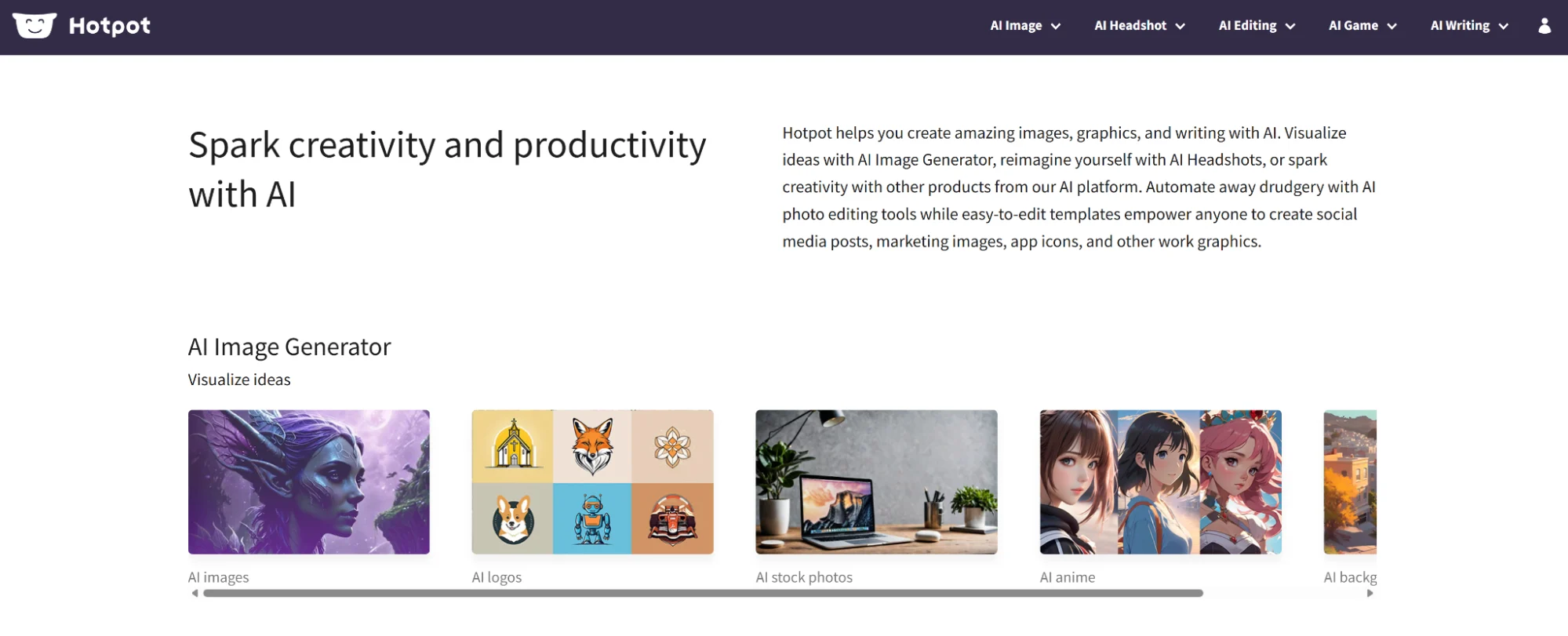
Hotpot is Best for: Small teams that need quick image creation and photo edits.
Hotpot’s Features
- AI Art Generator (text-to-image) that can generate consistent characters
- Photo editing: background remover, upscaler, colorizer, restorer and object remover
- AI headshots and avatars to polish existing images without any visible watermark
- Sparkwriter AI copywriting
- REST API and self-hosted or AWS deployment options
Hotpot’s Pros
- An easy-to-use platform with the essentials covered, which speeds up adoption
- Supports multiple image dimensions across styles
- Offers robust API access so you can plug the generative models into your own AI systems
Hotpot’s Cons
- Credit-based pricing can feel high for what is otherwise a minimalistic solution
- Users have reported technical bugs and refund/cancellation issues
Hotpot’s Pricing
The image generator offers a free tier, but the output is watermarked.
- Free tier available (output is watermarked)
- Credits available as one-time, monthly, or yearly packs (1,000–20,000 credits)
- 1,000 credits pricing example: $12 (one-time), $10 (monthly), or $100 (annually)
6. Picsart AI Image Generator
Picsart pairs AI image and video generation with a full photo and video editing suite, including an AI Playground that aggregates 90+ third-party AI models, such as Stability AI and Flux.
Content teams can use Picsart to mix and match models to create visuals for different use cases, minimizing overall costs without sacrificing quality.
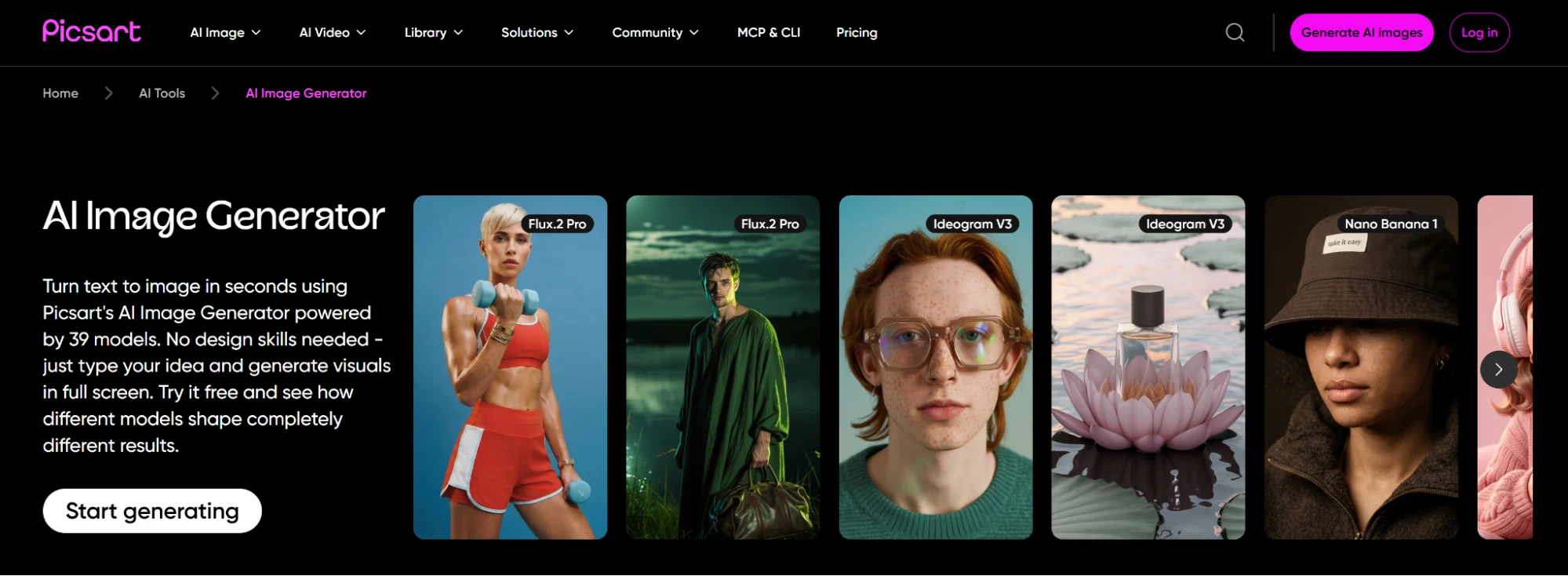
Picsart AI Image Generator is Best for: Social media marketers and mobile-first creators who want AI image generation with editing tools.
Picsart AI Image Generator’s Features
- AI image generation, AI Replace, AI Expand, AI backgrounds, stickers and logos
- AI Playground with 90+ models (VEO, Flux Kontext, Ideogram and more)
- A full photo and video editing suite
- Background remover, upscaler, enhancer and batch processing
- Brand Kit and team collaboration on higher tiers
Picsart AI Image Generator’s Pros
- A beginner-friendly UI paired with powerful AI tools like background remover and object selection
- A huge variety of filters, stickers, effects, pictures and templates that support many marketing use cases
- Users can choose from multiple models to optimize costs
- Offers several key editing features at no cost, making it quite cost-effective
Picsart AI Image Generator’s Cons
- The platform shows ads, which can be disruptive during deep work.
- The image enhancer often malfunctions and sometimes does the opposite of what you’d expect.
Picsart AI Image Generator’s Pricing
- Pro: $15/month (billed monthly) for 500 AI credits
- Ultra: customizable by credit volume; $45/month (billed monthly) includes 12,500 AI credits
7. Adobe Firefly
Adobe Firefly is Adobe’s generative AI platform for creating and editing images, video and audio. It’s designed to be commercially safe because it is trained on licensed and Adobe Stock content and is integrated across Creative Cloud.
Adobe Firefly is Best for: Enterprise teams and agencies that already use Adobe and need commercially safe AI-generated content for client work.
Adobe Firefly’s Features
- Generate videos and images from text and image inputs
- Commercially safe outputs with IP indemnification and content credentials for enterprises
- Access to partner models (Google, OpenAI, Black Forest Labs, Ideogram and others)
- Generative fill and text effects
- Integration with other Adobe tools like Photoshop and Express
Adobe Firefly’s Pros
- Easier adoption for teams using Photoshop, Express, Illustrator and the broader Adobe ecosystem
- Users praise the tool for its intuitive interface and fast performance
- The Firefly image model is trained on licensed AI training data, which keeps it commercially safe for client work
Adobe Firefly’s Cons
- Limited customization and granular editing capabilities
- Text-rendering capabilities fall short compared to tools like Ideogram
Adobe Firefly’s Pricing
- Free tier: limited AI credits and slow generation
- Firefly Standard: $9.99/month (2,000 credits)
- Firefly Pro: $29.99/month (4,000 credits)
- Firefly Pro Plus: $49.99/month (10,000 credits)
- Firefly Premium: $199.99/month (50,000 credits)
- For businesses: Standard not available; Pro, Pro Plus and Premium keep same monthly pricing/credits but priced per user
8. Getimg.ai
Getimg.ai is an all-in-one AI creative platform for generating and editing images, video, music and speech. It hosts multiple top-tier AI models (FLUX.2, Nano Banana 2, Seedream and GPT Image) in a single workspace.
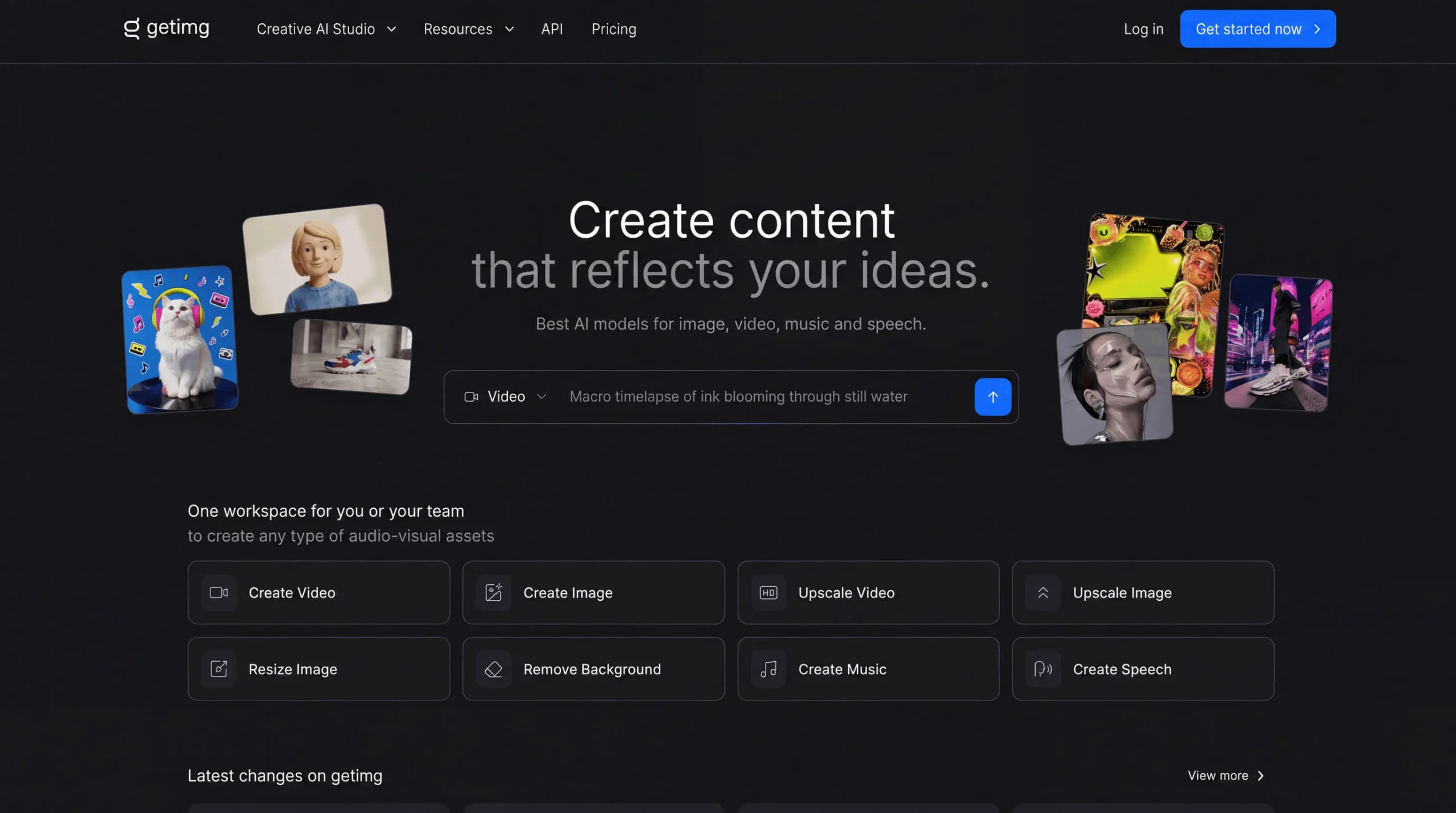
Getimg.ai is Best for: Power users and creative agencies that want to compare and combine multiple latest models.
Getimg.ai’s Features
- Multi-model text-to-image (FLUX.2, Seedream, Nano Banana, GPT Image and Qwen)
- Image editing capabilities, including inpainting, outpainting, background swap and upscaling up to 16K depending on the model
- Image-to-video plus AI music and speech generation
- Create reusable references (Elements) for products, people, styles and color palette for consistency
- Resize images and generate new extended areas of a picture based on its existing content with Smart Resize and AI Outpainting
Getimg.ai’s Pros
- Lets users run multiple best AI image generators concurrently
- Offers text-to-image and image-to-image capabilities with editing and upscaling in a single interface
- Includes additional generative features for video and music
Getimg.ai’s Cons
- Content filters censor even non-NSFW, clothed images unexpectedly
- A platform redesign reportedly removed support for paid custom LoRA models and raised credit costs
Getimg.ai’s Pricing
- Entry: $8/month (billed annually) or $10/month (billed monthly) (3000 credits)
- Core: $25/seat/month (15,000 credits)
- Plus: $55/seat/month (35,000 credits)
- Ultra: $150/seat/month (100,000 credits)
9. Nano Banana 2
Nano Banana 2 (Gemini 3 Pro Image) is Google DeepMind’s state-of-the-art image generation and editing model, built on Gemini 3 Pro. It generates images by relying on reasoning and world knowledge to ensure accurate output.
Nano Banana 2 is Best for: Marketers and content teams creating data-rich infographics and multilingual visuals.
Nano Banana 2’s Features
- Best-in-class legible text rendering, including multilingual text and translation
- Up to 4K resolution across multiple aspect ratios
- Google Search grounding for factual, data-rich visuals like infographics
- SynthID watermarking on every output for safety
Nano Banana 2’s Pros
- Industry-leading legible in-image text rendering across multiple languages
- High-fidelity output up to 4K, with strong reasoning and world knowledge for infographics and accurate scenes
- Fast, conversational editing with no Discord-style learning curve
Nano Banana 2’s Cons
- Free-tier users hit “503 Model Overloaded” errors at peak hours and get capped at 1K quality.
- No third-party user-review platform presence to verify long-term value
Nano Banana 2’s Pricing
- No specific standalone pricing; available in the Gemini app
- Free-tier users get limited quotas before reverting to standard Nano Banana model
- Google AI Plus, Pro and Ultra subscribers get higher quotas
10. Flux Kontext by Black Forest Labs
FLUX.1 Kontext, from Black Forest Labs, is a suite of generative flow-matching AI models for in-context image generation and editing. You can prompt with text and reference photos to generate images that require little polishing.
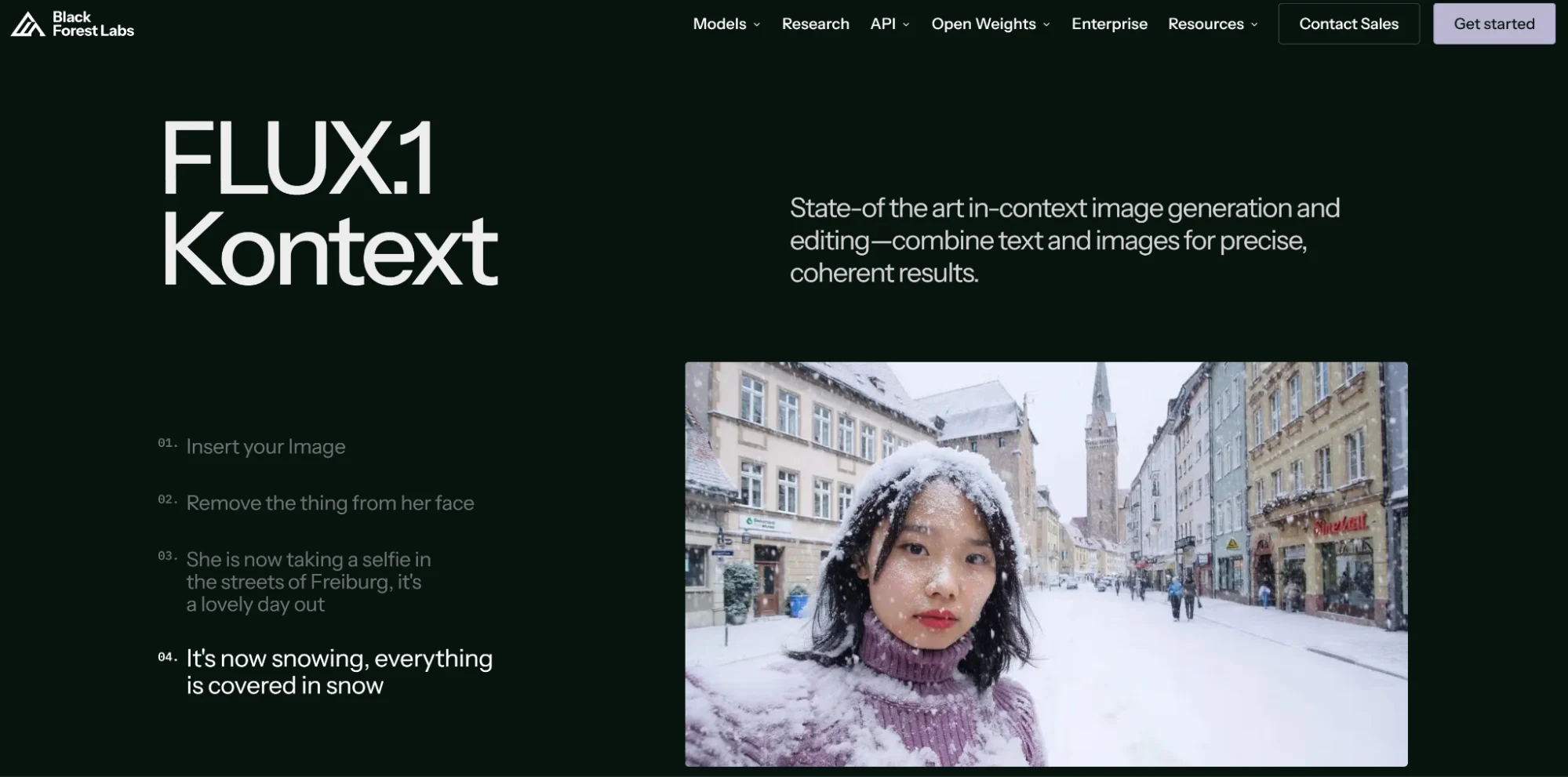
Flux Kontext is Best for: Developers and product teams that need API-driven character consistency and multi-turn edits.
Flux Kontext’s Features
- In-context generation and editing from combined text and image inputs
- Strong character uniformity across scenes and multi-turn edits through style reference and transfer
- Local editing of specific regions without affecting the rest of the image
- The inference speeds of these models are up to 8x faster than current leading models (e.g., GPT-Image), with interactive speeds of 3–5 seconds at 1MP
Flux Kontext’s Pros
- State-of-the-art character consistency across scenes
- Extremely fast iterative editing and precise localized edits via text instructions
- The open [dev] model is available for research and on-brand fine-tuning
Flux Kontext’s Cons
- Setting up the APIs to use the platform can be too technical for business users
- No third-party user-review aggregator presence to confirm overall user sentiment
Flux Kontext’s Pricing
- Available via BFL API on a pay-as-you-go, per-image basis
- FLUX.1 Kontext [max]: $0.08/image
- FLUX.1 Kontext [pro]: $0.04/image
11. Janus Pro
Janus-Pro is DeepSeek’s open-source unified multimodal model that handles both image understanding and text-to-image generation. It runs on a decoupled visual encoding framework and a single transformer, keeping the tool cost-effective while maintaining decent quality.
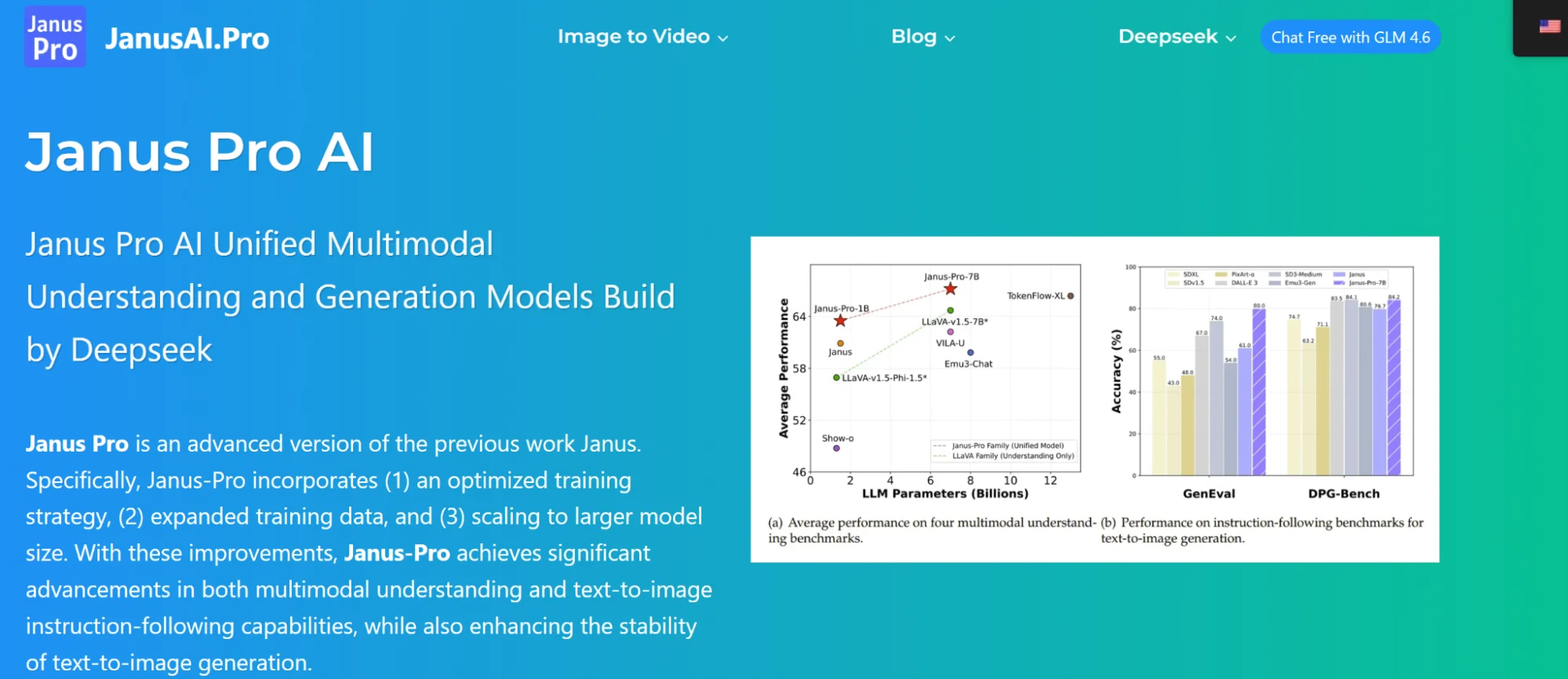
Janus Pro is Best for: Developers and teams that want a fully open-source AI image generator they can run on their own device.
Janus Pro’s Features
- Unified multimodal understanding and image generation
- Decoupled visual encoding with a unified transformer architecture
- Available in 1B and 7B parameter sizes
- The 7B model runs on consumer-grade hardware; the 1B model can run in-browser via WebGPU
- Janus-Pro-7B scores 0.80 on GenEva, surpassing DALL-E 3 (0.67) and Stable Diffusion 3 Medium (0.74)
Janus Pro’s Pros
- Fully open-source and free under an MIT license, allowing commercial use.
- Unified understanding and generation in a single model with decoupled visual encoding.
- The 1B variant runs in the browser via WebGPU.
Janus Pro’s Cons
- A very low 384×384 native resolution, which can be limiting
- Real-world image quality lags far behind DALL-E 3 and Stable Diffusion despite the benchmarks
- Struggles with humans and faces, producing artifacts and inconsistencies
Janus Pro’s Pricing
- Free and open-source
- MIT-licensed code (model use subject to DeepSeek Model License)
- Weights freely available on GitHub and Hugging Face
12. OpenArt
OpenArt is an all-in-one AI creator studio for images, videos, characters and audio. It integrates 100+ premium AI models (Flux, Veo, Kling, Nano Banana Pro and Seedream) with editing capabilities.
OpenArt is Best for: Creators producing short-form video or images for character-driven storytelling.
OpenArt’s Features
- Access to 100+ premium image, video and audio models.
- Consistent characters, personalized model training and One-Click Story.
- A powerful image editing suite (inpainting, outpainting).
- Parallel image generations (8–32, depending on tier).
- Commercial use rights on the Advanced plan and above.
OpenArt’s Pros
- Produces photorealistic images and videos while maintaining tone and style
- All-in-one access to many image and video AI models for different kinds of creative workflows
- Customer support is frequently praised as fast and helpful
OpenArt’s Cons
- Some users were charged after cancellation and weren’t refunded
- Image failures were reported, including gender mistakes and poor handling of darker skin tones
OpenArt’s Pricing
- Essential: $14/month (4,000 credits)
- Advanced: $29/month (12,000 credits)
- Infinite: $56/month (24,000 credits)
- Wonder: $240/month (106,000 credits)
- Add-on credit pack: $15/month on Advanced plan and higher (5,000 credits that roll over)
13. Seedream AI
Seedream 4.5 is ByteDance’s next-generation image creation model that unifies text-to-image generation and image editing capabilities within one platform. The model can produce 4K images for your content marketing campaigns.
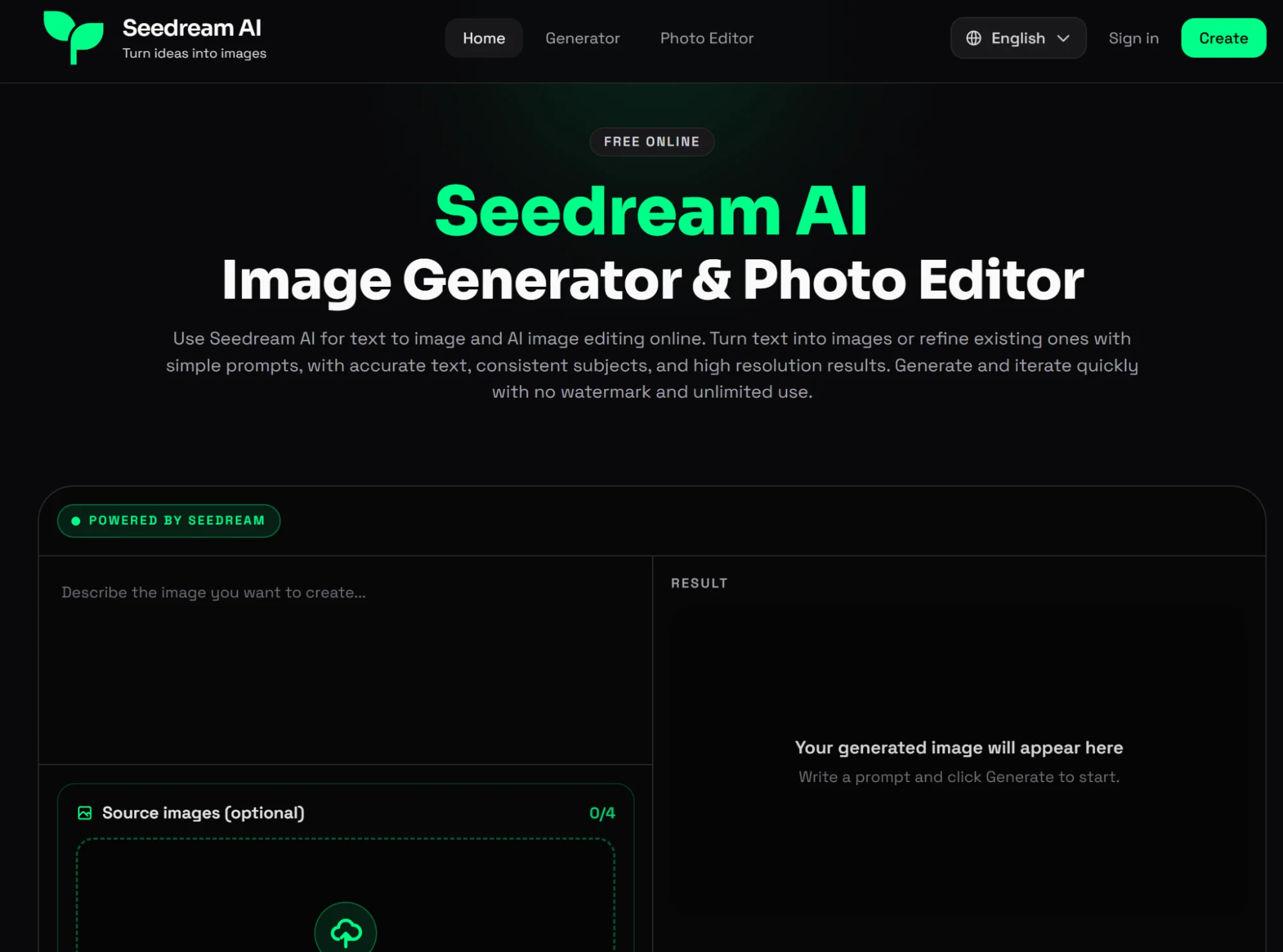
Seedream AI is Best for: High-volume creators and content teams that need 4K outputs plus editing at a low per-image cost.
Seedream AI’s Features
- Unified generation and editing in one AI model
- The latest model’s reasoning speed is more than 10 times faster than that of Seedream 3.0
- Multi-reference input and batch generation of multiple consistent images (up to 9 outputs at once)
- Natural-language editing (object removal/replacement and text edits that preserve style)
- 30+ artistic styles and native structure control (sketch/pose guidance)
Seedream AI’s Pros
- Strong prompt adherence and high-quality aesthetics, with output up to 4K.
- A unified generate-plus-edit workflow with precise text and element edits.
- Very affordable per-image pricing (from $0.03/image) for high-volume batches.
Seedream AI’s Cons
- No third-party reviews exist to verify user sentiment
- Photorealism, texture and human proportions lag behind Nano Banana Pro
- Text rendering is still inconsistent on longer strings and non-Latin scripts
Seedream AI’s Pricing
- Basic: $19.90/month (200 credits/month)
- Pro: $39.90/month (500 credits/month)
- Max: $69.90/month (1,050 credits/month)
- Pro Max: $99.90/month (2,100 credits/month)
14. Midjourney
Midjourney is a subscription-based AI image (and video) generator from an independent research lab, known for highly aesthetic, stylized outputs, accessed via web and Discord.
Midjourney is Best for: Creative professionals and brand designers who want the best-in-class quality and stylized art for moodboards and campaigns.
Midjourney’s Features
- High-quality, stylized text-to-image generation
- Fast and Relax GPU modes (unlimited Relax on Standard and above)
- Stealth/private mode on Pro and Mega
- Image and video generation from premium models in one place
- Multiple concurrent jobs, scaling by tier
Midjourney’s Pros
- Best-in-class aesthetic quality, lighting, textures and character consistency.
- Produces polished, designed-looking images quickly from simple prompts.
- Strong prompt adherence and stylistic range, ideal for concept art and moodboards.
Midjourney’s Cons
- Inconsistent results (hands and anatomy) plus expensive iterative retries
- One subscriber reported not getting fast GPU time until the following month
- Another user had their account suspended under the pretense of bot activity
Midjourney’s Pricing
- No free tier or credits
- Basic: $10/month (billed monthly)
- Standard: $30/month
- Pro: $60/month
- Mega: $120/month
- Plans differ in Fast GPU hours, concurrency and privacy
15. Imagine Art
ImagineArt (by Vyro AI) is an all-in-one generative AI creative suite for images, videos and voice from text prompts. It includes editing tools, a background remover, an upscaler and custom models, which can be accessed via the web and mobile.
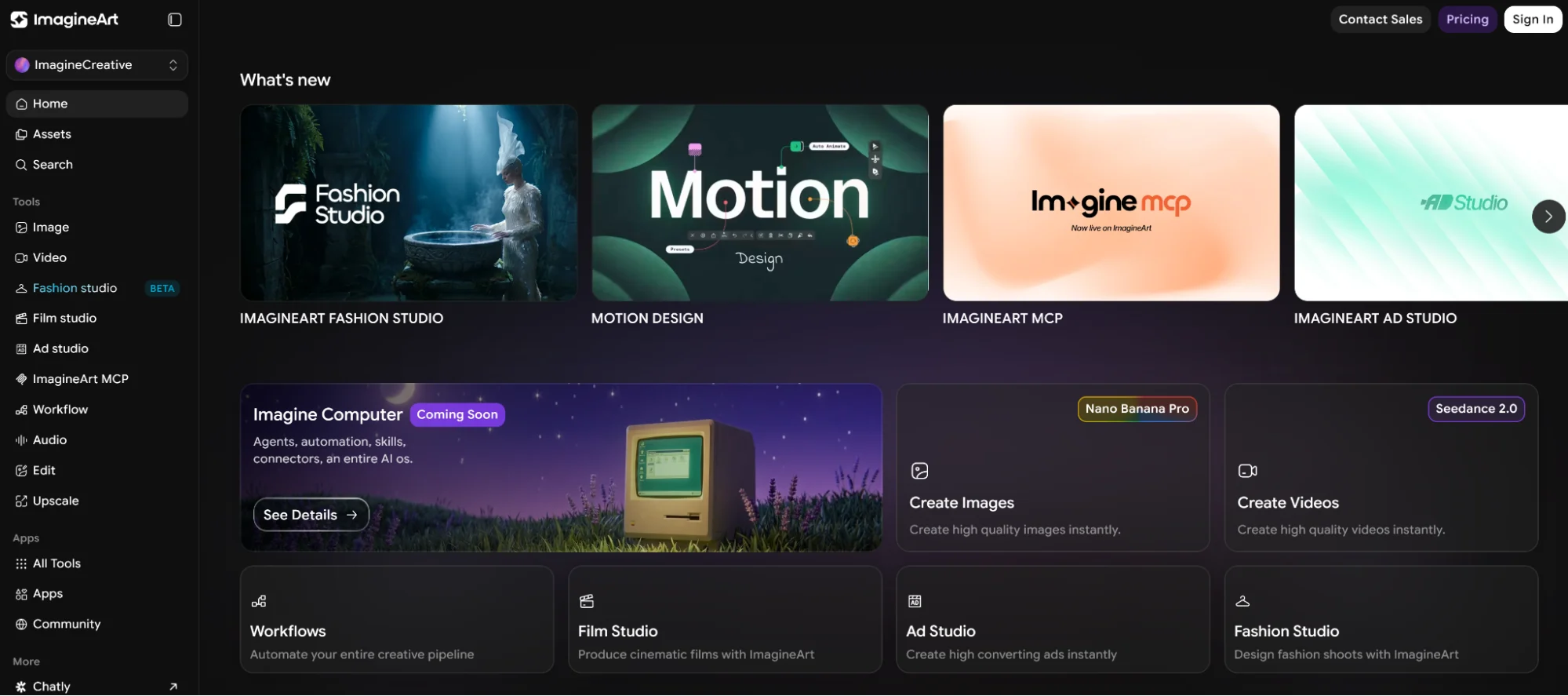
Imagine Art is Best for: Mobile-first creators and small teams that want access to many frontier AI image and video models in one app.
Imagine Art’s Features
- Text-to-image generation (Imagine v6 engine) plus multiple AI models
- Personalize Character and reference-based generation
- Video and voice generation models are available in the same interface
- Editing tools, background remover, resolution enhancer and upscaler
- Web, Android and iOS apps for improved accessibility
Imagine Art’s Pros
- Access to many frontier image and video models (Flux, Kling, Seedance, Veo and Nano Banana) in one interface
- Affordable, with good quality and variety relative to peers like Leonardo
- An intuitive, frequently updated interface with new AI models added quickly
Imagine Art’s Cons
- Issues with refunds, even when paid users cancel on time and haven’t used any AI credits
- The platform struggles with prompt adherence
Imagine Art’s Pricing
- Free tier: 100 credits/day, refreshed daily
- Basic: $13/month (3,000 credits)
- Standard: $30/month (8,000 credits)
- Ultimate: $50/month (16,000 credits)
- Creator: $250/month (100,000 credits)
- Subscription credits don’t roll over, but topped-up credits last forever
Create Content for the Images with Distribution.ai
Even the best AI-generated images need context to do their job.
A standout infographic or photorealistic scene resonates better with your audience when paired with copy that educates your audience and guides them toward the next step. The caption tells them whether they need to sign up for your tool or click on a link to read your latest article.
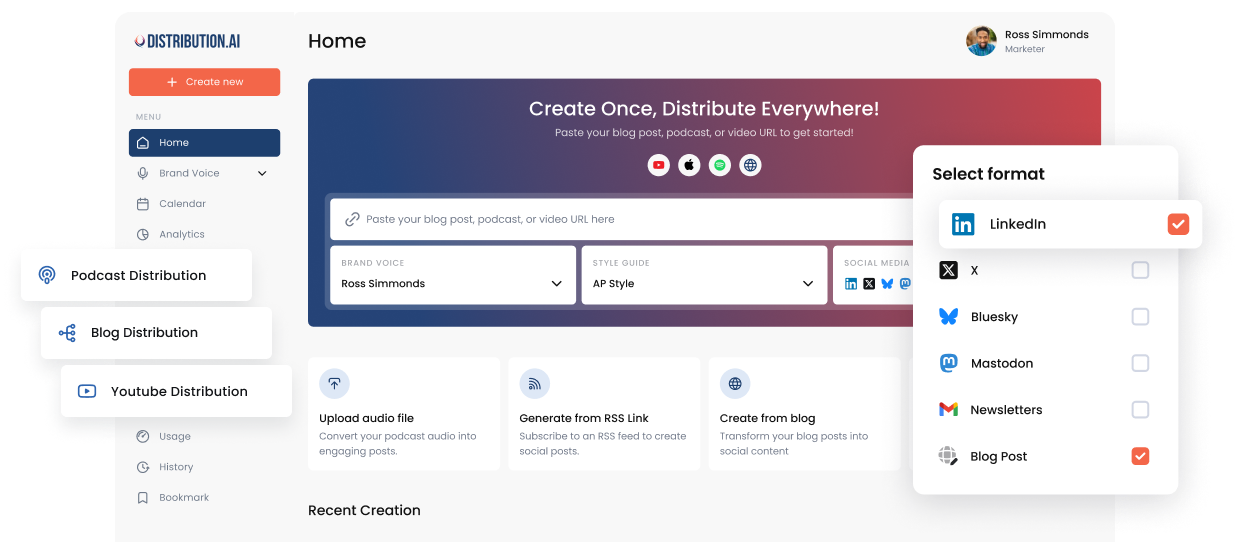
Distribution.ai helps content marketing teams produce such bite-sized posts and snippets quickly by repurposing your existing long-form content.
After signing up, set up your brand’s tone and style guidelines once and paste a link to an existing content piece, such as a blog article or a YouTube video.
In under a minute, the platform will produce multiple content pieces, such as LinkedIn posts, X threads, Instagram captions and Facebook captions that enhance your AI-generated images.
Ready to turn your images into a full content marketing campaign?
Promote, repurpose & distribute your content with AI
Write 10x faster, engage your audience, & never struggle with the blank page again.
Start 15-Day Free Trial
Frequently Asked Questions
Author

Promote, repurpose & distribute your content with AI
Start 15-Day Free Trial