How to Get Your Podcast Cited in AI Answers: 7 Strategies With Real Examples
There are over five million podcasts, and AI engines cite roughly 30 of them. The gap has nothing to do with production quality or audience size. If you want to get your podcast cited in AI responses, it comes down to whether AI tools can find, read, and quote your episodes. To get your podcast […]

There are over five million podcasts, and AI engines cite roughly 30 of them. The gap has nothing to do with production quality or audience size. If you want to get your podcast cited in AI responses, it comes down to whether AI tools can find, read, and quote your episodes.
To get your podcast cited in AI answers, publish the podcast transcript on your own site and add structured data so AI tools can extract clean answers. There are other key elements, such as schema and cross-platform distribution, that can further boost your chances of being cited in AI-generated answers.
Read on to discover actionable strategies with real-life examples of podcasts that earn citations across LLMs (Large Language Models).
Key Takeaways
- AI tools cite text. Every strategy in this guide exists to put your podcast content on a crawlable page in a readable format.
- The transcript is the single highest-impact action. Without it, none of the other strategies matter.
- On-page work makes you citable. Off-page distribution makes you cited. Both are required.
- Schema markup, specifically FAQPage, PodcastEpisode, and AudioObject, tells AI crawlers what your page is and makes each Q&A pair directly extractable.
- Getting cited consistently requires a repeatable workflow: one transcript, one episode page, and one round of distribution per episode, every time you publish.
Why AI Isn’t Citing Your Podcast
AI answer engines cite what they can read and verify. If your podcast isn’t showing up in ChatGPT, Perplexity, or Google AI Overviews, it’s because AI can’t crawl it.
Here are a few reasons why your podcast isn’t appearing in AI citations.
AI can’t listen to your episode
Answer engines like ChatGPT and Google AI Overviews crawl text and decide what to quote from it. If your only asset is an audio file behind a player, there’s nothing for an AI crawler to read. As a result, there’s nothing for AI to cite.
Your podcast is optimized for SEO, not AEO
While SEO (Search Engine Optimization) needs crawlability and backlink signals, AEO (Answer Engine Optimization) requires named entities and clarity in structure. Traditional SEO gets your episode ranked in search results. AEO gets you AI citations. They need different setups. SEO rewards keywords and internal links, and AEO requires a structured page that can be read, quoted, and trusted by an AI tool.
AI tools don’t index hosting platforms
Apple Podcasts, Spotify, and YouTube host your audio, but they’re not where AI sees citable text. These platforms don’t give crawlers reliable access to your episode content, so they rarely show up as citations in AI answers. Most podcast platforms block or restrict crawler access because there’s no static, readable text on the page for AI tools to retrieve.
7 Strategies to Get Your Podcast Cited in AI Answers
To get your podcast cited by AI tools, publish the full episode transcript as text on your own site, structure the page so AI tools can extract clean answers, add the right schema, and distribute each episode across the web to build brand mentions AI models trust.
Below are seven strategies to help you get your podcast cited in AI answers.
1. Publish the full transcript on your episode page
The transcript is the single most important thing you can do. When AI engines crawl the words, they know that your show exists.
Publish the full transcript directly on the episode page as readable HTML. The text needs to sit on the page where AI crawlers can reach it. Fix speaker labels, clean up filler words, and correct any misheard names or industry terms before publishing. A transcript with errors in key terms signals low quality to AI tools and can work against you.
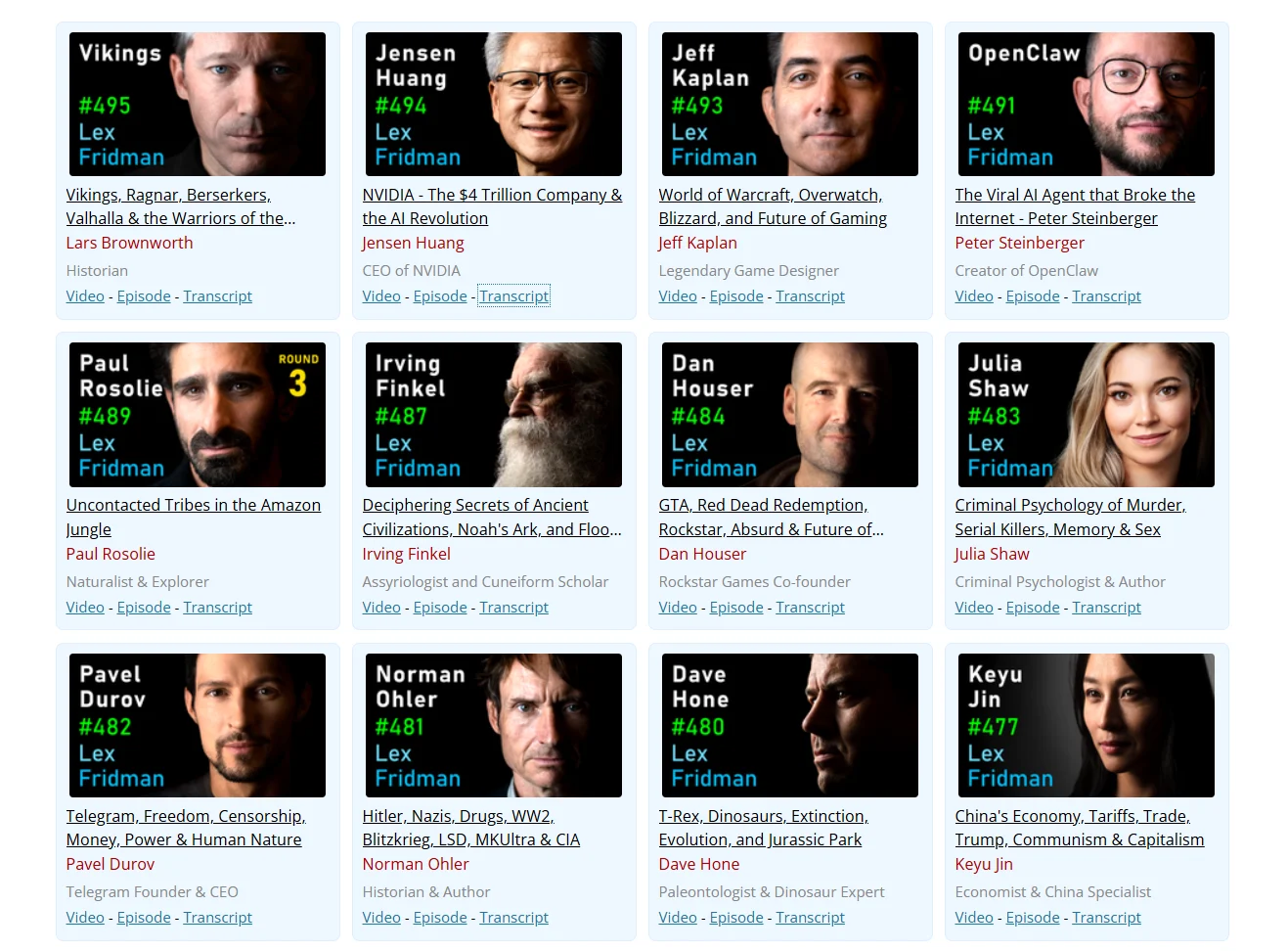
The Lex Fridman Podcast gives every episode its own dedicated transcript page, separate from the episode and video pages. Each transcript page has:
- A descriptive, entity-rich title (the guest’s full name and their role)
- Clickable timestamps
- Speaker labels throughout, and
- A chapter navigation that breaks the conversation into named topics
This structure gives AI tools a static, crawlable page where every claim is attributed to a named person, every topic has a clear anchor, and any passage can be lifted and cited on its own without the surrounding context.
2. Put the answer at the top
AI tools pull the first clear, self-contained answer they find on a page. This answer needs to be near the top of the page in plain text, before the guest intro, the backstory, or the episode overview. Consider it a direct answer block: one or two sentences that state the conclusion, followed by the details. If you bury the insight, your chances of getting cited reduce.
Say, someone asks ChatGPT, “How to build a $100M SaaS business without venture funding.” An episode page that opens with a direct 2-3 sentence answer gets cited. For example, “Mark built his ERP software to a $100M+ valuation before raising a single dollar. The playbook: $500 a month in Facebook ads aimed at a hyper-specific audience, a tight relationship with the implementer community, and 24/7 support that the market leader couldn’t match.” But if your page opens with a guest bio and three vague lines about what they discussed, there’s nothing useful for AI to quote.
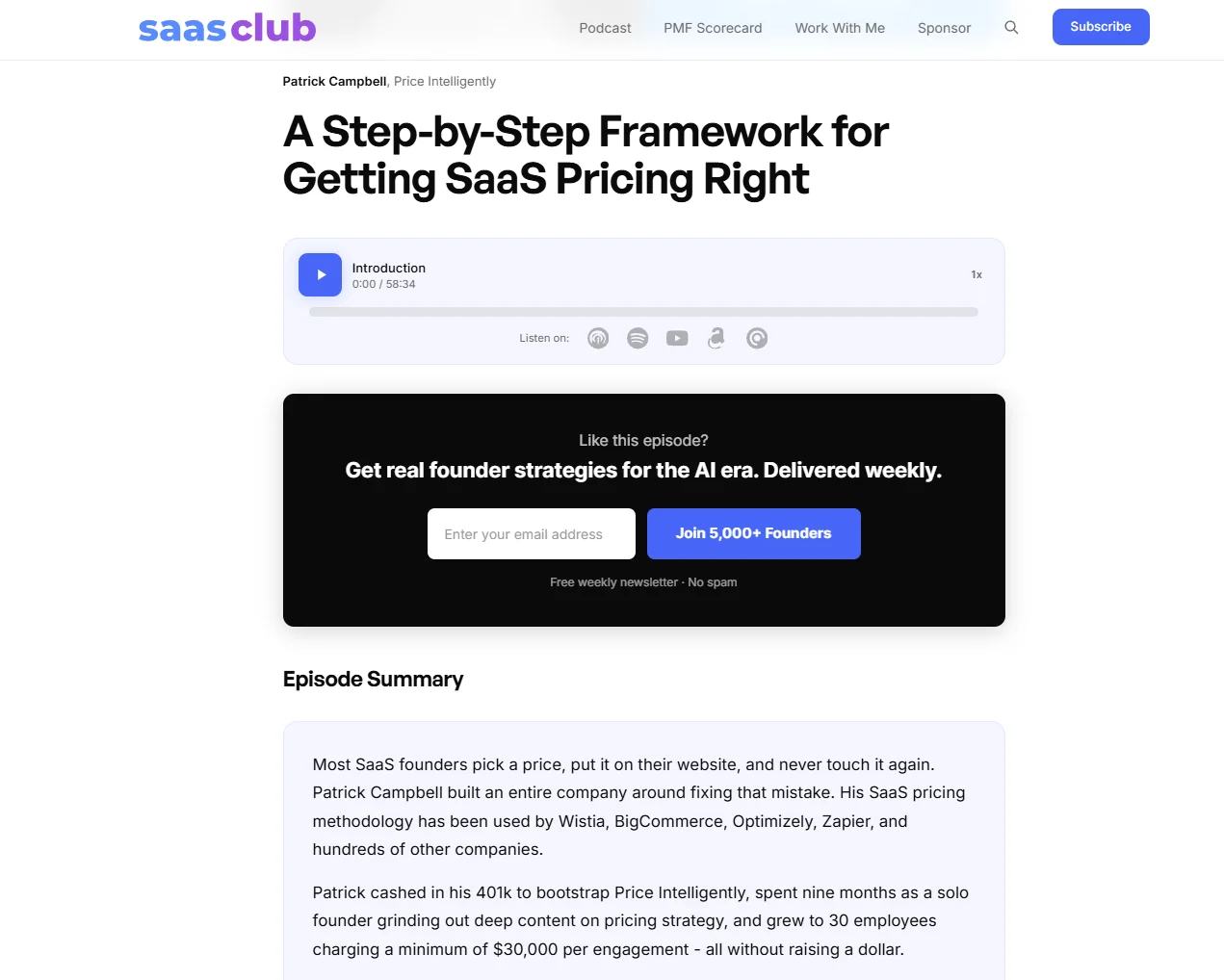
Take a look at The SaaS Podcast episode page.
When asked about SaaS pricing strategy, ChatGPT cites this page because it’s designed to answer the question before the reader even reaches the transcript. It includes:
- An episode summary stating the core problem.
- A Key Insight block delivers the conclusion in one sentence.
- A dedicated Q&A section answers eight follow-up questions in full.
- The chapters with timestamps, key ideas, and lessons in bulleted lists.
Every section on the page gives AI tools a separate passage to lift and cite independently.
3. Write show notes that go beyond a summary
A 600 to 1,200-word show notes section organized around specific entities, factual claims, and frameworks is what AI models read first. Name the guest and their company, name the frameworks discussed, and include specific numbers or claims from the conversation.
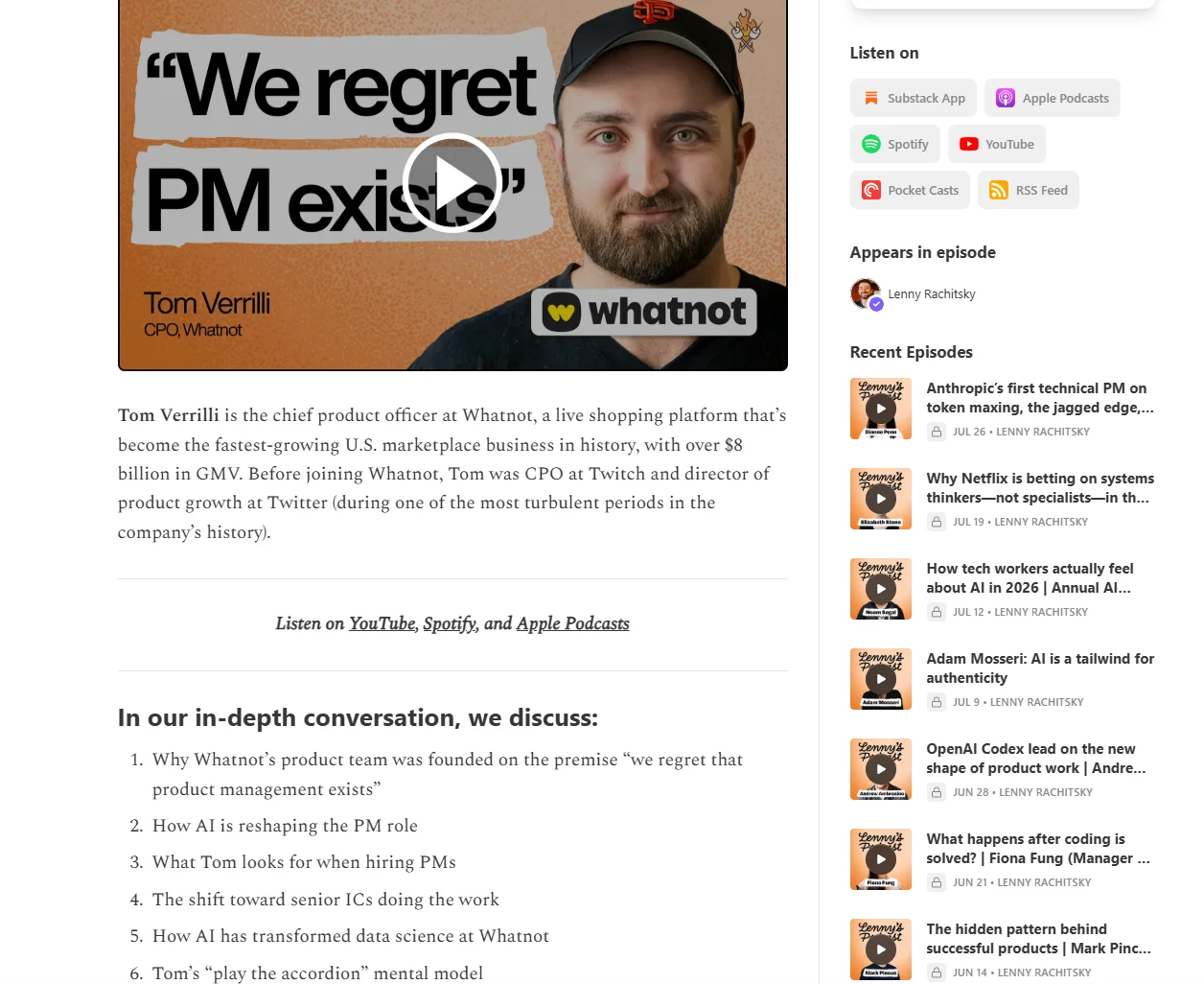
Lenny’s Podcast does this well. Each episode page opens with a guest bio that names the person, their current company, specific metrics, and previous roles. The “In our in-depth conversation” section lists the exact topics covered as a numbered extract. The resources section names every company, person, and framework mentioned.
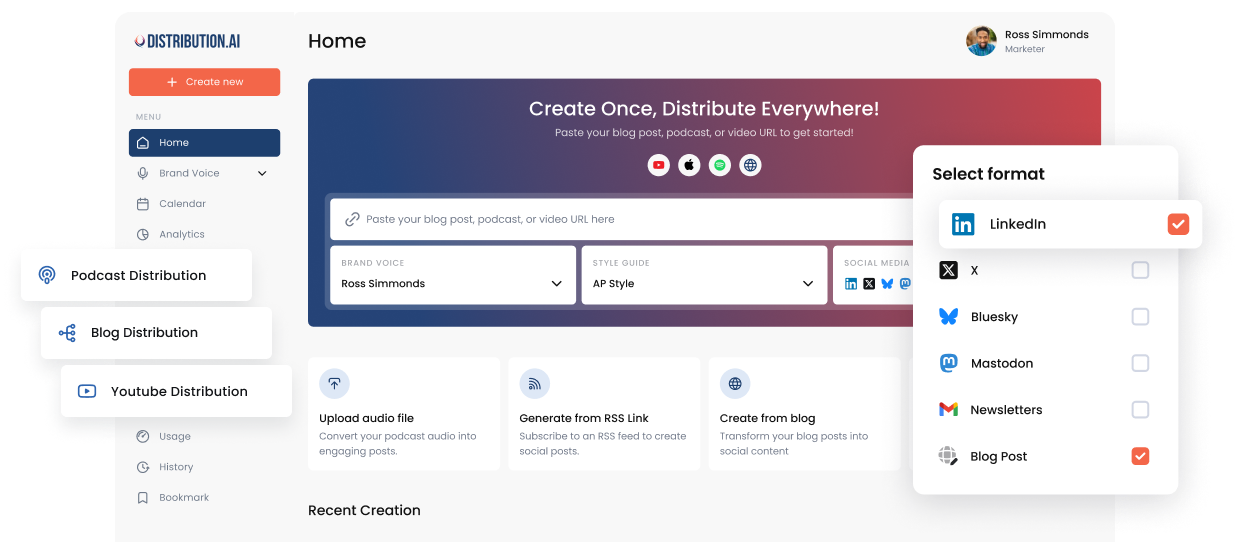
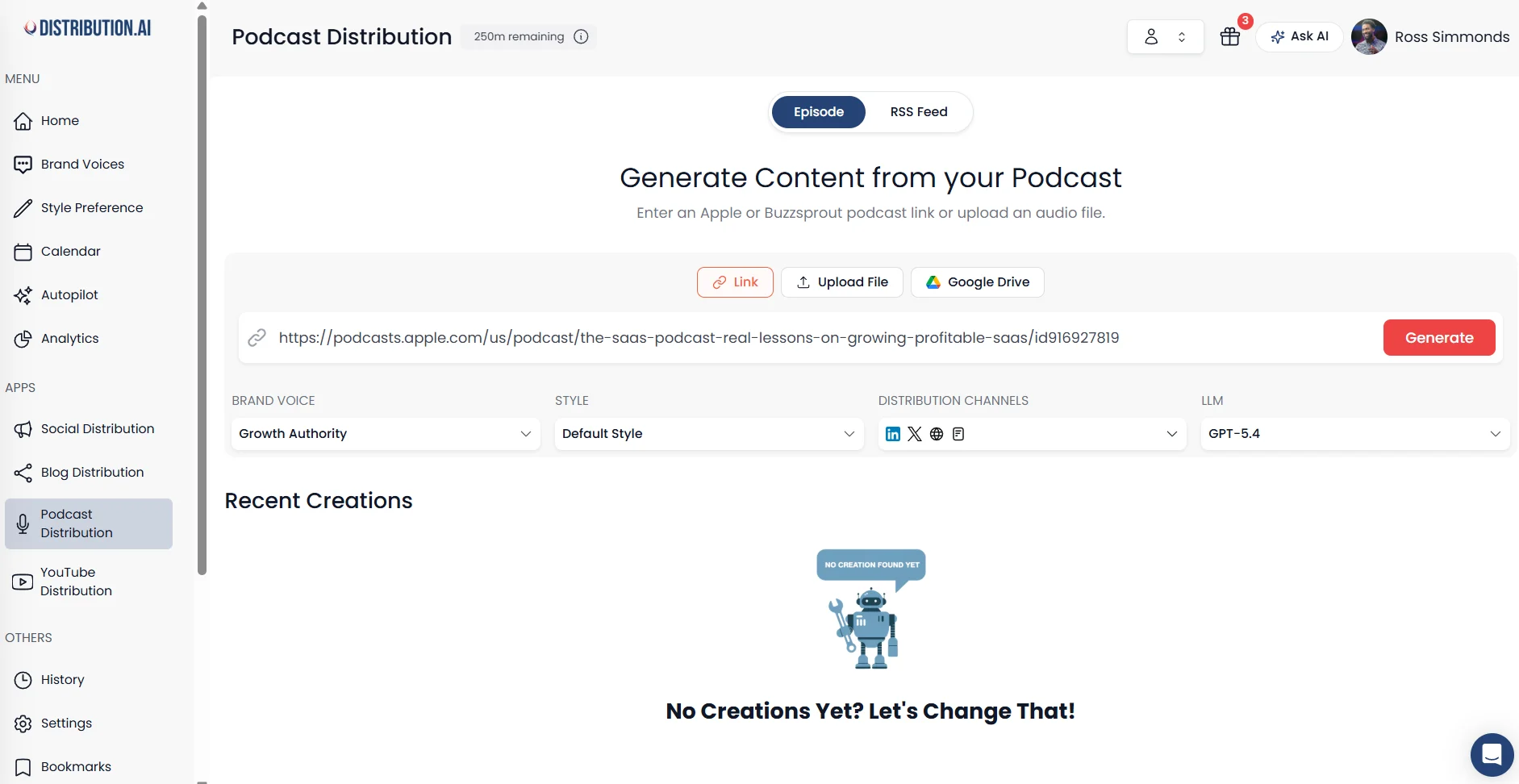
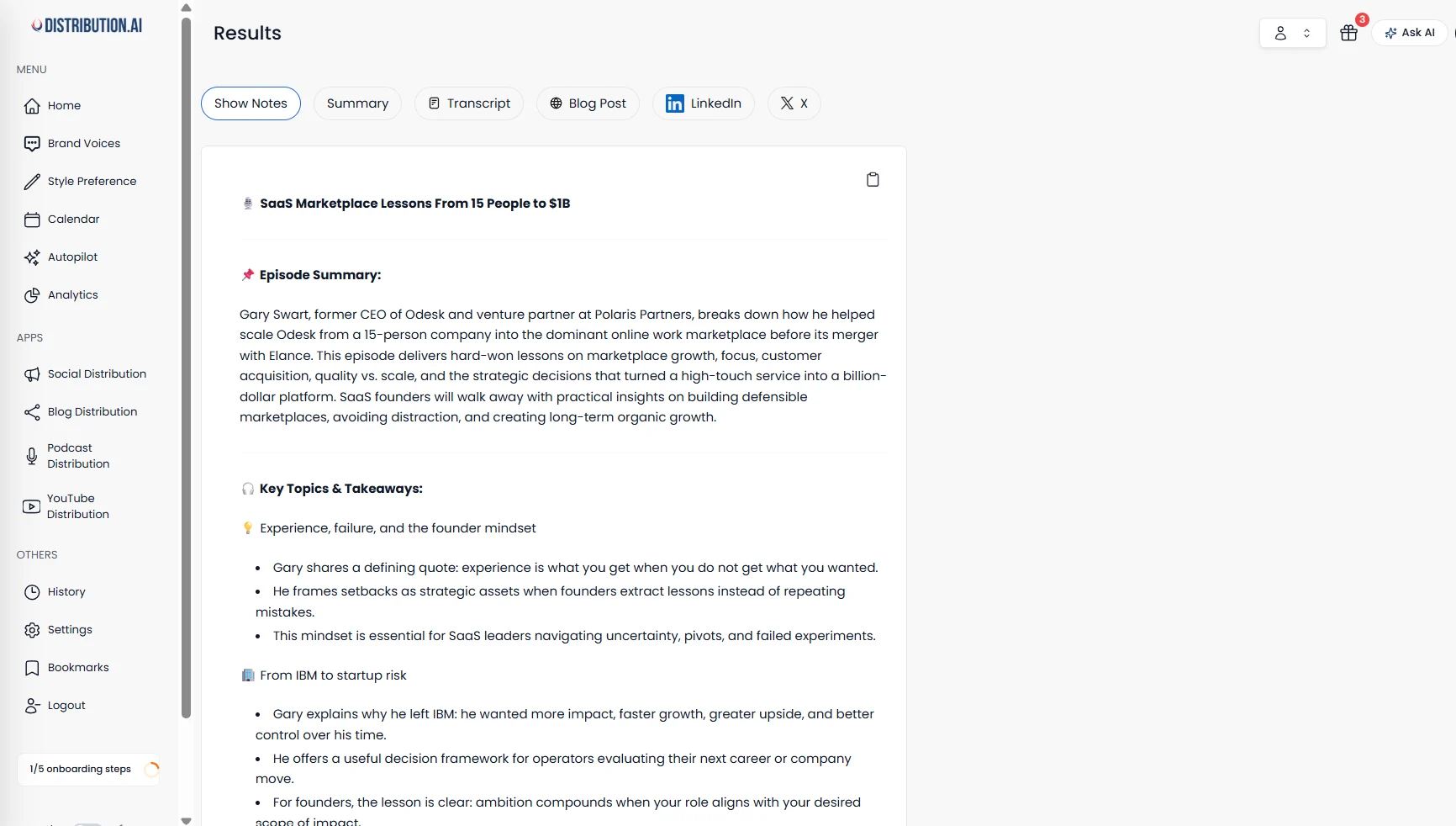
Tip: If writing structured show notes for every new episode consumes a lot of your time, use Distribution.ai to automate the process. Simply paste your podcast link, and it generates show notes, a summary, transcript, blog post, and platform-specific social content in one go, all in your brand voice.
4. Add FAQPage, PodcastEpisode, and AudioObject schema
Schema markup tells AI crawlers exactly what your page contains. Three types matter the most for podcasts.
- FAQPage schema marks up 5 to 7 questions the episode answers, each with a self-contained 40 to 60-word answer written to stand alone as a quoted passage. FAQPage JSON-LD is the structured data for getting cited by LLMs. It marks each Q&A pair as a discrete entity that AI engines can extract directly.
- PodcastEpisode schema classifies the page correctly, so it routes through the podcast citation pipeline. It tells AI crawlers that the page is a podcast episode, the series it belongs to, and who published it.
- AudioObject schema identifies the media type. It classifies the audio file itself, its duration, format, and encoding, so crawlers treat it as media content, not a text page with an attachment.
To add all three, you can use schema markup generators such as Rank Ranger or TechnicalSEO.com. You can also ask ChatGPT or Claude to generate the JSON-LD for each type. Paste the output into your episode page header, then run it through Google’s Rich Results Test to confirm it’s reading correctly before you publish.
5. Use descriptive, entity-rich episode titles
Episode titles tell AI tools what a page is about before they read the content. A vague title has no named entity to match against a query. A specific one, with a guest name, a company, a framework, or a result, becomes a citation anchor.
Say your podcast covers SaaS growth. Here are two episode title examples.
- A Conversation On Reducing Churn in SaaS: This title covers the topic but has no specific information. There’s no entity like a company or guest name for an AI tool to extract. Hence, the chances of citing this podcast are less.
- How Intercom Cut Churn by 30% Using a Three-Touch Onboarding Sequence | Des Traynor, Co-founder: This episode title names the company, the guest, the role, the method, and a specific result for LLMs to cite. They can match the title against queries about onboarding strategy, SaaS churn, or Intercom.
Apply the same logic to chapter headings inside the transcript. Each descriptive heading gives AI tools specific entry points to quote from.
6. Repurpose each episode into content that gets you mentioned across the web
Brands are 6.5 times more likely to be cited by AI systems through third-party sources than through their own domains. Every LinkedIn post, X thread, or newsletter that references your episode is another mention on another domain, which builds credibility.
Semrush’s 2026 AI Visibility Index, which analyzed 126 million U.S. AI search prompts, found that the platforms’ AI tools draw from most consistently include Reddit, Wikipedia, YouTube, and LinkedIn. If your episode is not showing up as content on these platforms, you miss the chance of being cited in AI answers.
So, for every episode you publish, create platform-specific content that references it. For example, a LinkedIn post breaking down the key insight, an X thread on the main argument, a newsletter mention with a link to your episode page. Each one is a brand mention on a new domain, building your cross-platform presence over time.
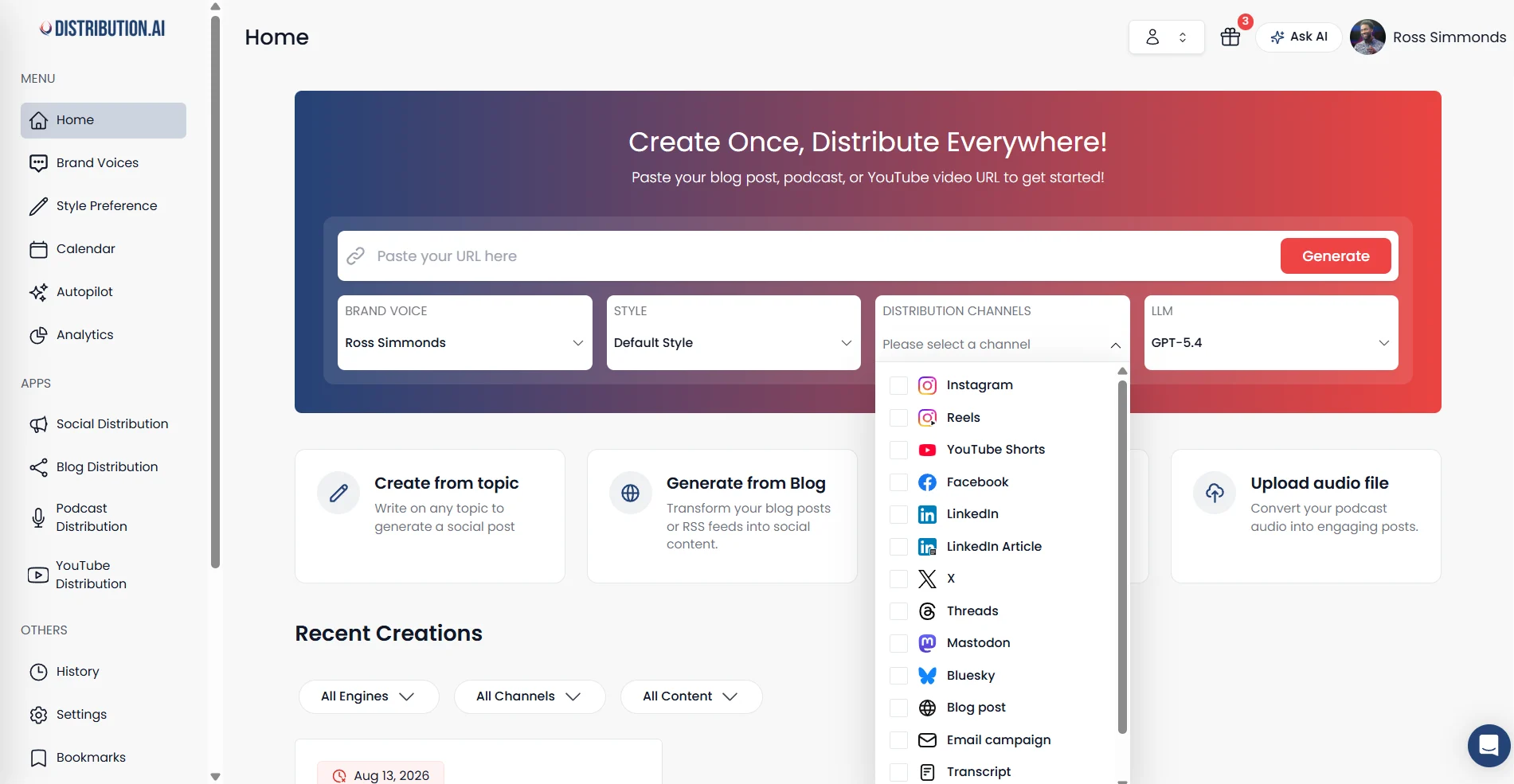
To save hours on creating content for each platform, consider Distribution.ai. The platform’s AI podcast repurposing tool automatically turns each episode into platform-specific posts for LinkedIn, YouTube, X, Instagram, Facebook, and more, each written in your brand’s tone to ensure consistency. You can even copy-paste your podcast’s YouTube link to auto-generate Reels for Instagram and YouTube Shorts. Sign up for a free trial.
Learn more about how to repurpose podcast content for maximum reach.
7. Guest on other podcasts in your category
Podcast guesting is now a citation share strategy. Every appearance on a well-cited show creates a transcript on a third-party domain with your name, your expertise, and your podcast woven through it. AI tools can pull from that page months or years after the recording date.
The more your name appears on other domains, the more surfaces AI tools have to cite you from. So, next time you land a guest spot, send the host a prepared assets pack that includes:
- Your episode title suggestion
- Three to five key claims from the conversation
- Named entities like company name, specific framework to include in show notes
- A link back to your own episode page
Most guest appearances go uncited because the host’s episode page ships with a one-line description. A good assets pack fixes that without putting any extra workload on the host.
Ready to Get Your Podcast Cited?
The seven strategies above work together. While podcast transcripts make you readable, the structure and schema make you quotable. Guest appearances and content distribution across domains build the AI visibility that gets you cited consistently. And none of it requires a bigger budget or a larger audience. It just requires the right setup.
Pick one episode, apply the full checklist, and run through LLMs two weeks later to see if it appears in Perplexity or ChatGPT search. That’s your baseline. You can then build from there to boost your podcast appearances.
As you scale, try automating show notes production, social media posts generation, and content distribution. Distribution.ai can repurpose your podcast content and automatically generate transcripts, show notes, and social media content specific to each platform in your brand’s voice.
Frequently Asked Questions
How long does it take for a podcast to start getting cited in AI answers?
Initial impact can appear within weeks of publishing a proper transcript, but meaningful AI visibility gains typically take 2 to 3 months. Publishing consistently at weekly cadence compounds your citation surface faster than monthly publishing.
Does episode length affect AI citations?
Longer episodes produce longer transcripts, which give AI tools more quotable passages and named entities to extract. Short episodes leave almost nothing specific enough to cite. Aim for depth over brevity when the topic warrants it.
Can a small podcast get cited over a larger one?
Yes. Audience size does not determine AI citations. A small podcast with a well-defined transcript, clean episode pages, and schema markup can outperform a larger show with no crawlable text on its episode pages.
Should I add transcripts to old episodes or only new ones?
Both, but prioritize strategically. Identify the old episodes that answer questions your audience actively searches for and upgrade those first with transcripts, structured show notes, and schema. Start with the top 20% before tackling the full back catalog.
Does getting cited in AI answers actually bring in listeners or leads?
A citation in ChatGPT or Perplexity puts your podcast in front of someone actively researching a topic you cover. The metrics to track are branded search lift and direct referral traffic from LLMs.
Promote, repurpose & distribute your content with AI
Write 10x faster, engage your audience, & never struggle with the blank page again.
Start 15-Day Free Trial
Frequently Asked Questions
Author

Promote, repurpose & distribute your content with AI
Start 15-Day Free Trial