How Restaurants Can Use AI for Marketing in 2026
Learn how AI marketing for restaurants boosts growth with automation, smarter targeting, and AI-driven tools to increase sales and customer engagement.
Running a restaurant business successfully means you need to do a hundred different complex things at once. Everything from perfecting recipes to keeping customers happy happens in parallel, and no two days are the same.
Due to this fast-paced nature of the restaurant industry, marketing can slip down the priority list.
After all, who has the time to post consistently on social media when you have pending tasks like training employees or managing customers during rush hour?
And that’s a key problem because in 2026, you need marketing. Your future loyal customers are scrolling through Instagram and X to find the next best spot for a friendly brunch or a date night.
If your restaurant shows up organically on their feeds, you increase the chances of turning that attention into a measurable action, such as a reservation, a walk-in visit or an online order.
This is because discovery on platforms like Instagram or X typically happens at the top of the funnel, where potential diners are still deciding where to go.
The good news is that you can market your restaurant easily using artificial intelligence in the right ways.
In this article, let’s look at the advantages of using AI for restaurant marketing and how you can do that effectively while maintaining your brand’s unique identity.
Why Restaurants Should Use AI for Marketing
Traditional marketing workflows simply aren’t fast or flexible enough to keep up with how restaurants operate in the food industry today. Here are four key reasons why you need AI marketing for restaurants:
1. Frequent Promotions and Menu Changes
Restaurants are constantly running something new, such as a weekday happy hour, a seasonal tasting menu, a limited-time dessert or a holiday offer.
Your menu items often change depending on what’s in season, what’s selling and what your chef is excited about that week. Every one of those changes needs to be communicated across your website, Google Business Profile, Instagram, email list and delivery apps.
Doing that manually almost always leads to mismatched prices, outdated photos, delays or a promotion that’s still live three weeks after it ended. Your customers find these out when they are actually at your location, which can cause churn, even for quick-service restaurant chains.
2. Repetitive Customer-Facing Tasks
If you’ve ever watched a host answer phone calls during a Friday dinner rush, you know the drill.
“What time do you close?”
“Do you take walk-ins?”
“Is the patio open tonight?”
The same questions, over and over. Every phone call or DM pulls staff away from serving guests, and the usual fix is hiring more people, which can take days while costing you more and increasing operational complexity.
These are exactly the kinds of mundane tasks that restaurant AI marketing tools can handle well, without sacrificing the quality of the answer or the guest experience.
3. Pressure to Post Consistently Across Channels
A strong social media presence is how many restaurants win new customers today.
People scroll Instagram and TikTok looking for their next meal, and if your content looks stale or inconsistent, they’ll keep scrolling. Moreover, if your content isn’t engaging enough, the algorithm will limit its reach!
Restaurants typically produce a mix of content, such as dish photos, behind-the-scenes videos, staff introductions, event announcements, short-form reels and Stories.
The tricky part for you is staying on-brand while adapting each piece for different platforms. A caption that works on Instagram may flop on X/Twitter, and inconsistencies in tone or visuals can quietly erode your brand’s image.

A content creation AI platform can be trained on your restaurant's tone and style guidelines to produce standardized posts for all social media platforms.
4. Need for Personalized Outreach Efforts
Your past customers and warm leads (the ones who’ve DM’d you with buying intent or signed up for your email newsletter) are your most valuable audience.
And the last thing you want to do is send them a generic “cheap meals, good quality” message, especially if you want to strengthen customer loyalty.
Reaching them well means segmenting your list and writing personalized emails and SMS messages for each group: first-time guests, regulars, birthday clubs and folks who haven’t visited in a while.
However, it’s not feasible to do it manually, considering how quickly you have to move every day.
AI models can go through past orders and guest data and analyze DM conversations to draft messages that actually feel relevant to each person, which increases your chances of being heard.
AI Marketing for Restaurants: 4 Applications
Here are four practical places you can put AI to work in your marketing today, without a huge budget or a tech team.
1. Social Media Content Creation
As we discussed earlier, creating content for different social media channels in a restaurant setting can be exhausting.
AI technology can help you with it by taking your key pointers and converting them into complete, engaging social media posts that are tailored for each platform.
For instance, let’s say you are running a promotional offer for an upcoming event in your locality. You can share the relevant details, like the new menu items and dish-specific discounts with AI systems, to generate platform-native posts for multiple channels.
Distribution.ai does just that.
You simply need to feed it an existing content piece or a detailed PDF containing all the relevant information, and the platform will produce multiple posts in under a minute.
The content pieces will be tailored and highlight what kind of customer experiences your guests can look forward to because you have already provided the core points.
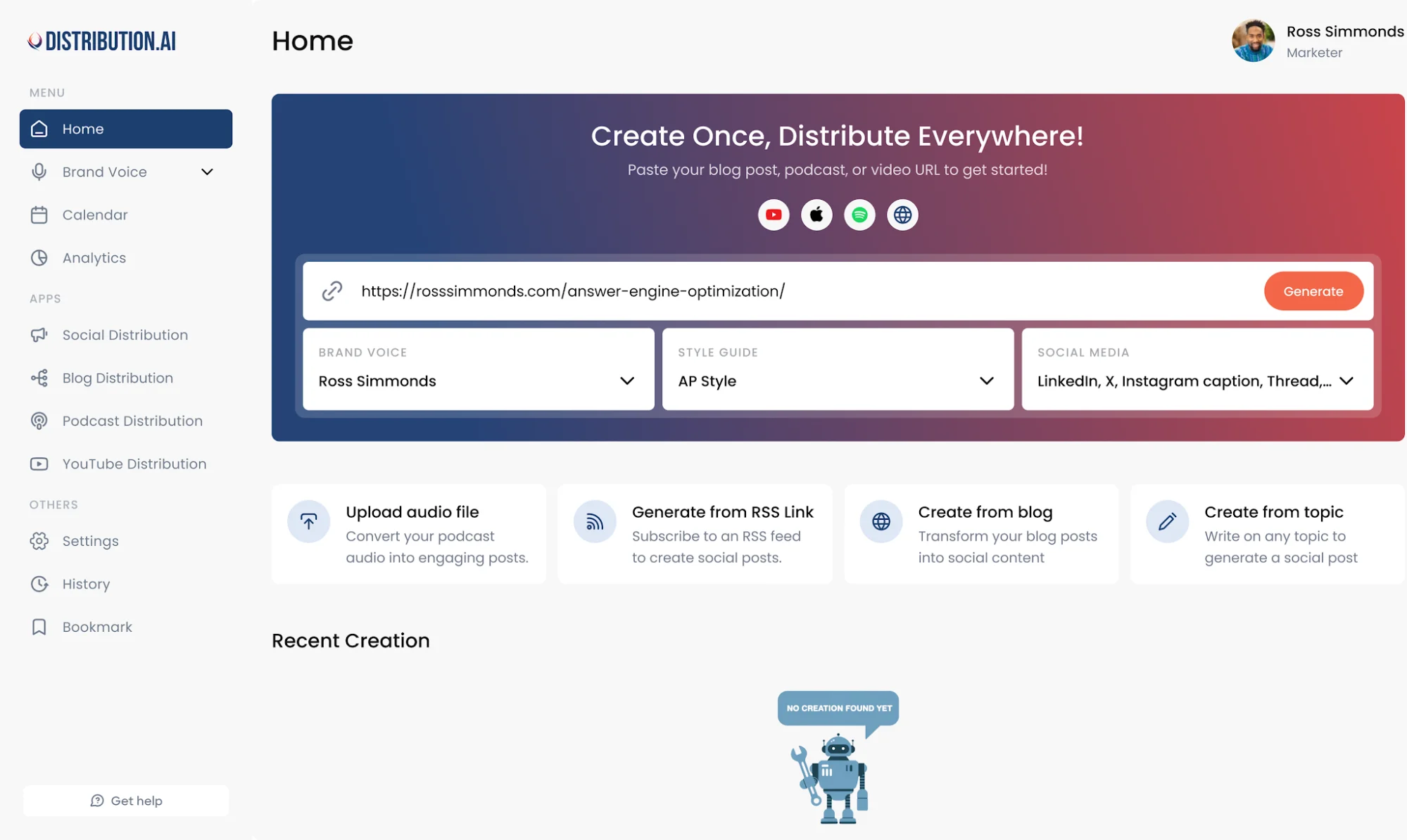
Then, you can refine the AI-generated drafts and schedule them to go live whenever you want.
This allows you to plan marketing campaigns ahead of time and prepare your team better to handle more customers while maintaining the dining experience.
You can practically create a week’s content in under an hour!
2. Review and Reputation Management
Your restaurant’s online reputation is basically your storefront. A string of three-star reviews can cost you more walk-ins than a rainy weekend.
Hence, it’s essential for you to stay active on review sites and promptly address your customers’ grievances as they come up.
But replying thoughtfully to every Google, Yelp, X and TripAdvisor review, while also tracking what people are generally saying about your restaurant on different pages and forums, is a full-time job on its own.
AI in restaurants can help by drafting personalized responses to reviews in seconds and flagging negative conversation themes around your brand so a human can step in quickly.
These platforms use natural language processing to spot recurring themes in feedback (slow service on Sundays, love for your bartender, confusion about the new menu and potential food waste).
You can consider tools like MARA AI, Birdeye, Mention and ReviewTrackers as good starting points for restaurants that want to get ahead of their reputation without drowning in notifications.
3. Automating Outreach Campaigns and Support
If you’re already collecting customer data through reservations, online ordering, drive-thrus or a loyalty program, and you’ve got people sliding into your DMs asking about private events, you need this.
AI systems can dig into past orders to build targeted campaigns that nudge the right person at the right time.
For example, a guest who hasn’t visited in 60 days gets a “we miss you” SMS with their favorite dish. Similarly, a first-time website visitor gets a gentle email with your bestsellers.
Klaviyo and Toast’s built-in marketing suites are all reasonably priced options that use machine learning to automate this kind of outreach. You need to connect your databases and the AI will help you create an automation that personalizes outreach.
4. Local Search and Visibility Optimization
When someone types “best ramen near me” into their phone, you want to show up (provided you serve ramen).
For this, your digital profiles, such as your website, your Google Business Profile, your social accounts, need to be optimized for those relevant terms so search engines, AI research tools and voice assistants surface you first.
AI platforms can audit your digital presence and flag exactly what’s dragging you down.
You can upload a range of inputs to a multimodal AI chatbot, like ChatGPT and Claude, such as a photo that’s six months old, a menu link that’s broken, keywords your competitors are ranking for that you’re not, or a Google Business Profile that’s missing popular categories.
These tools will instantly analyze your input and provide you with a series of steps you can follow to fix the issues and increase your organic visibility.
How Restaurants Can Use AI Without Losing Their Brand Voice
If you use AI tools like everyone else, your restaurant will appear like everybody else.
1. Define Your Brand’s Content Guidelines
This is a one-time setup that pays off every single time you use AI afterward.
Your content guidelines should cover your tone (warm and witty? polished and classic?), the words you always use and the ones you never say, your sentence rhythm, your point of view, the kinds of emojis you use and any visual rules for photos and graphics.
To figure these out, pull together your five best-performing posts, a few customer reviews that nail how people describe you and your menu copy. The patterns in there are your voice.
Then, you need to convert it into a set of bullets and create your own restaurant’s persona. You can add it to Distribution.ai and simply select it anytime you are writing content for your future customers:
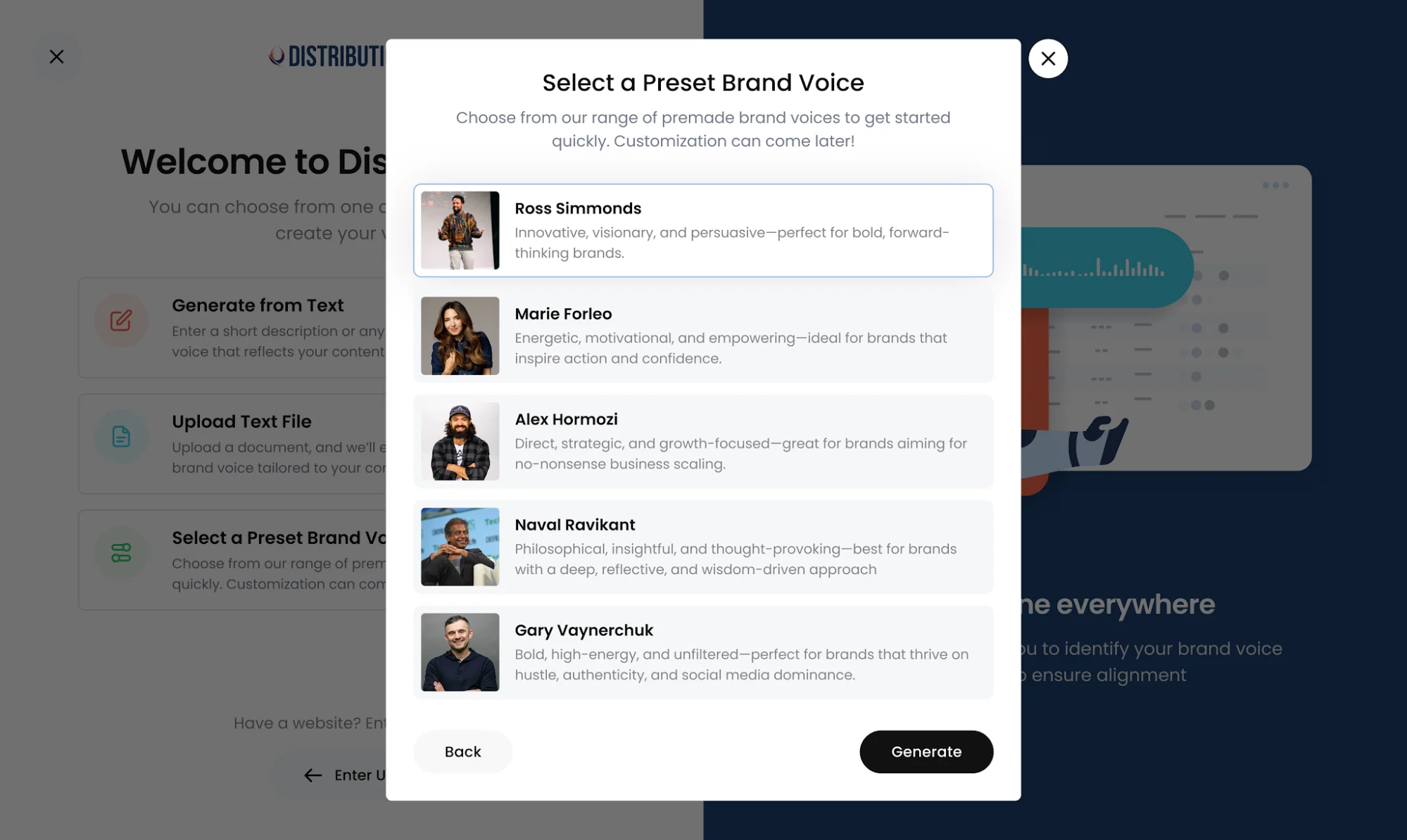
You can also create multiple personas for different kinds of content, such as informative or promotional, to evoke the right emotions among your audience on every occasion.
2. Include a Human Editing Layer
Anything AI writes should be reviewed by a human before it goes live.
Your marketing team should check for tone, brand alignment, factual accuracy (AI hallucinates prices and dish names all the time) and the small emotional beats that make content feel human.
Here’s a quick checklist to implement this in practice:
- Does this sound like us, or like a generic restaurant chain?
- Are the menu items, prices, hours, and event details actually correct?
- Is there a moment of personality like a joke, a specific detail, a staff name?
- Would I be embarrassed to send this to a regular?
- Does the call-to-action actually make sense for this platform?
3. Use Real Customer Data in Content
“Real customer data” means the things your guests actually do and say: a regular who’s ordered the short rib 14 times, a review that called your patio “the best date-night spot in the neighborhood,” the dish that sold out three Saturdays in a row.
You can use these in your marketing while protecting privacy by keeping it anonymous or asking for permission. These details give your restaurant a competitive edge because they’re uniquely yours.
A simple example: instead of “Our carbonara is a guest favorite!” try “Our carbonara has been ordered 847 times this month, and Tuesday regulars swear it’s better than the one they had in Rome.”
Common Mistakes Restaurants Make With AI Marketing
You need to be cautious when implementing AI-enabled processes into your restaurant marketing workflows to get the most out of them.
1. Trying to Automate Everything at Once
It can be tempting to adopt multiple AI platforms at a time to accelerate and scale multiple aspects of your restaurant business.
However, this will do more harm than good. Automating anything requires a careful, structured approach where any change is carefully monitored because restaurants operate fast, and any oversight can be too costly.
Then, after you have validated the AI tool for your use cases, you can move towards organization-wide implementation.
A good rule of thumb is to pick one area, such as social media content creation, and then automate it completely. This will keep your restaurant operations sustainable in the long run while preventing any kind of burnout from managing too many tools and workflow changes along the way.
2. Tracking Vanity Metrics
Vanity metrics look great on paper and change nothing about your revenue.
It’s easy to fall into that trap if you are tracking follower count without engagement, impressions without click-throughs, email opens without visits and website traffic without booking reservations.
When adopting AI into your restaurant marketing workflows, it’s crucial to monitor the KPIs that truly matter to your business. This includes engagement, clicks and conversions of your social media content.
Monitoring the right numbers is essential for iterating your marketing strategies for upcoming campaigns.
Distribution.ai facilitates this by tracking your content’s performance across all social channels in a unified dashboard.
This will tell you what format and message are performing better than the others, enabling you to focus your efforts appropriately.
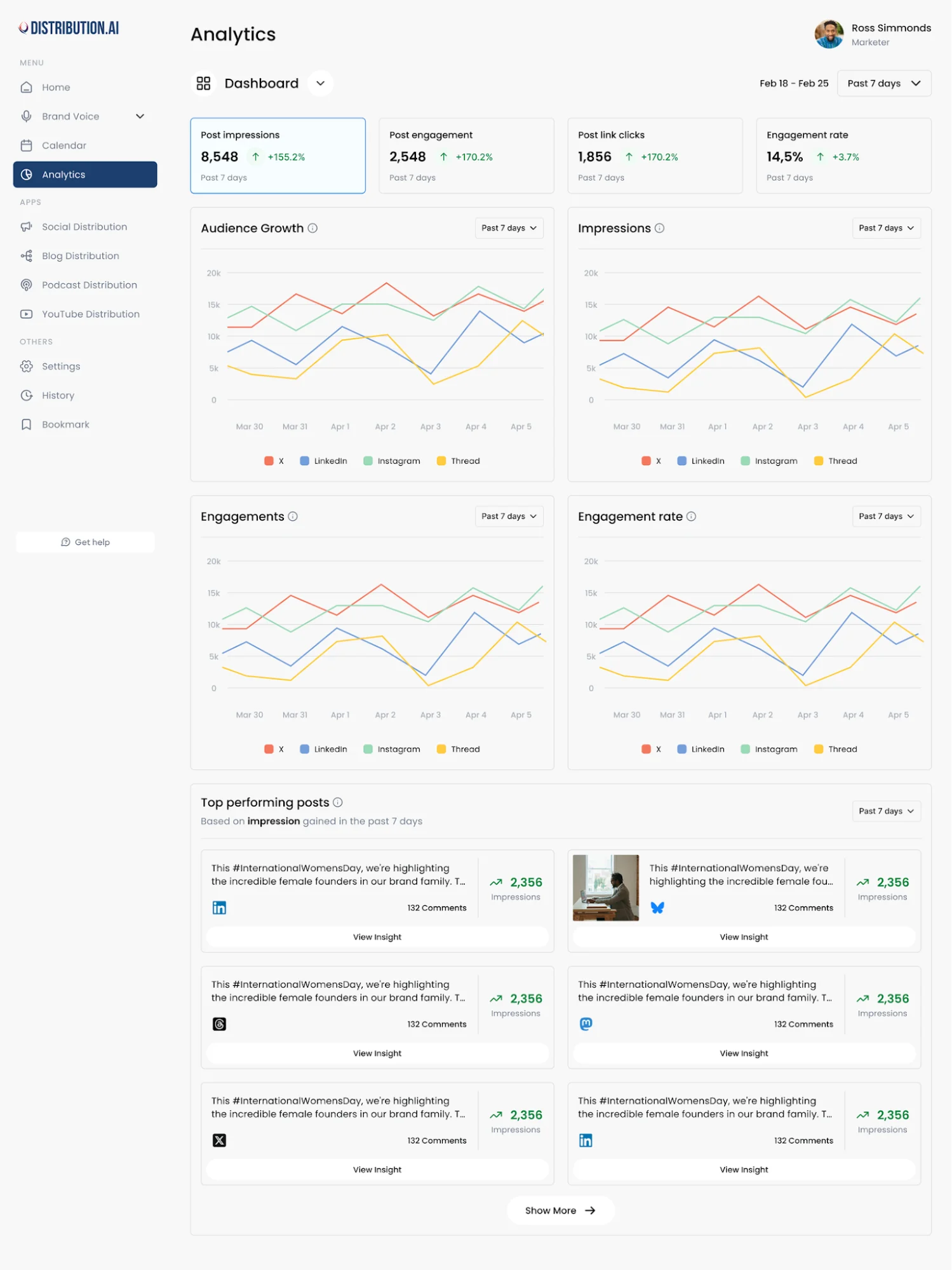
Identify the essential metrics for each process that has undergone AI automation and track them closely.
And this goes beyond marketing. You must look at supporting processes like supply chain, inventory management, online ordering frequency and food preparation procedures.
The broader objective is to ensure that the newly adopted machine learning algorithms and AI models are driving revenue measurably.
3. Using AI for Creative and Strategic Tasks
You know what your Tuesday regulars love, why your neighborhood is the way it is, how your weekend specials should be planned and which upcoming events are worth promoting hard.
AI doesn’t. It can only suggest ideas, but it can’t tell you what will actually land for your specific restaurant experience.
A better split is to use AI as an ideation partner for creative and strategic tasks, such as brainstorming campaign angles, drafting first versions and riffing on headlines, and then lean on it heavily for repetitive work like scheduling and reformatting.
4. Not Iterating Their Approach
AI-driven restaurant marketing workflows need constant attention.
The tools themselves get better every few months, your audience’s behavior shifts, platforms change their algorithms and your menu evolves.
Revisiting every aspect of your workflow will help you tighten your prompts and brand guidelines to get better content out of your AI tools. The goal is to make small tweaks to incrementally improve your process rather than making giant overhauls.
Streamline Restaurant Marketing with Distribution.ai
You need a steady flow of content that represents your restaurant accurately in tone and style to make marketing easy.
And that’s exactly what Distribution.ai is built to do.
You can start with one piece of content or a few well-explained pointers, and the tool will transform the input into multiple bite-sized pieces for various social media channels in under a minute.
Then, you can instantly schedule it for Instagram, X, Facebook or Bluesky, and reach your audience on their preferred platforms.
Ready to market your restaurant effectively with AI?
Frequently Asked Questions
1. How Can AI Help Restaurant Marketing?
AI helps restaurants write social media posts, reply to reviews, personalize emails and SMS messages, optimize their Google Business Profile and analyze guest data to run targeted campaigns. It handles the repetitive work so owners can focus on preparing the best food and offering great customer service.
2. What Are The Best AI Marketing Tools For Restaurants?
Some of the best AI marketing tools for restaurants include Distribution.ai for social media content creation, MARA or Birdeye for reviews, Klaviyo and Popmenu for email and SMS and Semrush or BrightLocal for local SEO.
3. Can AI Increase Restaurant Reservations And Sales?
Yes. AI-powered tools can analyze historical data and customer preferences to send targeted campaigns that drive repeat customers and boost visit frequency. This can re-engage your past customers to nudge them toward making another reservation.
4. What Should A Restaurant Automate First?
Start with whatever costs you the most time at the moment. For most restaurants, that’s social media posts and responding to reviews because both are repetitive and high-volume. Once those are running smoothly, layer in email automation, then SMS outreach to past customers.
5. Is AI Marketing Affordable For Small Restaurants?
Absolutely. Many AI marketing tools for restaurants, such as Distribution.ai, start under $50 a month, and some have free tiers. For small restaurant owners, the real savings come from the hours you get back that you can now spend serving customers.
6. Will AI Replace Restaurant Marketers Or Owners?
No. AI handles mundane tasks like drafting and scheduling for restaurant operators, but it can’t replace the judgment and relationships that restaurant owners and marketers bring. The restaurants that win with AI are the ones leveraging AI to move faster while keeping the human touch in every guest interaction.
7. How Do Restaurants Use AI Without Sounding Robotic?
Restaurants have to set clear brand guidelines, feed the AI real examples of your voice and always run output through a human editor before publishing. Adding specific details, such as staff names, regulars’ favorites and real customer quotes, keeps AI-written content grounded and authentic.
8. Does AI Help With Local SEO For Restaurants?
Yes. AI tools can audit your Google Business Profile, website, social media accounts and listings to find gaps, suggest keywords, optimize for voice search and keep your information consistent across platforms. This visibility directly affects how often nearby website visitors and hungry locals find you first.
Promote, repurpose & distribute your content with AI
Write 10x faster, engage your audience, & never struggle with the blank page again.
Start 15-Day Free Trial
Frequently Asked Questions
Author

Promote, repurpose & distribute your content with AI
Start 15-Day Free Trial