AI Content Repurposing in 2026: A Comprehensive Guide
Learn how to scale content with AI content repurposing in 2026. Discover strategies, tools and workflows to maximize reach and ROI efficiently.

You already know the significance of content repurposing. One asset, such as blog content, can be used to generate multiple bite-sized pieces for social media, expanding your brand’s visibility without creating new pieces.
The value of such a workflow is obvious, and most, if not all, marketers and marketing teams know that.
However, the real challenge lies in how to do it well, especially now that AI has entered almost every content production process, including repurposing workflows.
Even with AI, content teams face numerous challenges, such as tool sprawl, poor quality of content, inconsistent tone/style and improper performance monitoring.
In this guide, we will explore why you need an AI-powered content repurposing workflow and how you can run it effectively.
Why You Need an AI Content Repurposing Workflow
AI content repurposing tools automate many tasks within your workflow, freeing you up for more strategic marketing initiatives, like planning better long-form assets for the future.
1. Maximize Content ROI Quickly
Every long-form asset you create, such as a blog post, a podcast episode, a how-to guide or a research report, contains dozens of ideas worth sharing.
AI models can quickly go through those assets and extract the nuggets of information that can be converted into standalone social media posts or newsletters.
2. Scale Without Hiring More Marketers
Hiring more marketers or writers may seem like a logical step, but it has a lot of downsides.
For starters, recruiting can take anything from weeks to months. Then, you have to train the new team members and closely review their work until they get up to speed.
All of it increases the managerial complexity and overhead costs on top of delaying your content repurposing efforts.
With AI tools, you can create content much faster. Even if the machine-generated drafts aren’t publication-ready, they give you a strong starting point, making the overall process faster.
3. Reach a Broader Audience
In a manual content repurposing process, your output is fairly limited. You can only produce a handful of posts per week and do so for one or two platforms, which limits your brand’s reach and growth.
With AI, you can swiftly produce more assets for multiple platforms in the same timeframe. This enables you to target multiple audience segments across several social media channels.
When you create snackable assets in different formats, such as short clips, social media posts, infographics and quotes, you cater to the content consumption needs of different ICPs, expanding your reach.
4. Build a Stronger Online Presence Faster
Social media content is now indexed by Google, and by extension, AI search tools. You need a strong presence across the web to boost SEO and attract high-intent organic traffic.
As AI unlocks speed, you can build such a presence faster because you don’t need to produce platform-optimized short-form content from scratch.’
Core Components of an AI Content Repurposing Workflow
The first step in running an AI-powered content repurposing workflow is to gather the following ingredients. Once they are in place, your execution will be smooth and error-free.
1. High-Value, Long-Form Assets
The foundation of any content repurposing effort is the source material. You’re looking for comprehensive long-form content that’s already proven its worth.
This includes articles, in-depth guides, webinars, sales calls, customer interviews, research reports, whitepapers, podcast episodes and YouTube videos.
What makes them high-value is that they have already proved their worth for your target audience, taking the guesswork out of the equation. You will exactly know what to repurpose, with a data-backed reason.
Moreover, these content pieces are information-dense, making them a great source for multiple bite-sized assets your potential buyers will love.
2. Content Repurposing Prioritization Framework
You may identify several high-value, long-form assets that are suitable for repurposing.
But which one should you target first?
There are several aspects you can evaluate to make that decision quickly:
- Performance: Which pieces have the most impressions, engagement or conversions?
- Relevance to current marketing goals: Does this asset align with what your team is pushing right now? Your goals could be a seasonal campaign or the goal of attracting a new audience segment.
- Content depth: Is there enough substance here to generate multiple assets, or is it too thin to stretch?
- Conversion potential: Can repurposed pieces from this asset realistically increase followers and drive signups, demo requests or sales?
- Channel adaptability: Will this content translate well across different social media platforms, email and other channels, or is it too niche for broad distribution?
This framework keeps you from falling into the trap of repurposing everything indiscriminately. Focus on the assets that score highest across these criteria, and you’ll get far better results with less manual effort.
3. Content-Specific Repurposing Strategies
Every comprehensive content asset you’ve set aside can be repurposed in distinct ways. For instance, the way you repurpose a long-form blog post is different from that of a video file.
Here’s a practical breakdown of what works best for each:
A. Blog Posts
A detailed blog post is one of the most versatile starting points.
You can pull out key insights for LinkedIn posts, break down the argument into an X thread, rewrite the takeaways into an email newsletter, turn data points into infographics or adapt the core message into a short video script.
This way, you can easily extract five or more smaller pieces.
B. Webinars and Events
After a webinar, you can create a recap blog post covering the highlights of the event. Mention the guests’ names, the core topics discussed, the conclusions drawn, and the questions raised by the attendees.
Then, pull out key takeaways and convert them into standalone social media posts. If you have the resources, extract the best moments into short video clips for different platforms.
Finally, the audience questions can be written as FAQ content, which can be published on your website or sent to your email subscribers.
C. Podcast Episodes and YouTube Videos
Your audio and video assets are rich with quotable moments, especially when they feature a guest or reflect your firsthand knowledge.
There are two ways to repurpose them.
First, you can transcribe them and turn the best segments into short, punchy articles or newsletter features. Key points can also be turned into social media posts in various formats.
Second, you can extract video clips and audio snippets for social channels. Look for viral-worthy, emotionally powerful segments that contain actionable takeaways.
D. Research Reports and Whitepapers
These data-heavy content pieces are perfect for visual repurposing. You can pick scroll-stopping stats and facts from reports and whitepapers, and turn them into charts and quote graphics for different social media accounts.
Additionally, you can write captions that highlight the importance of those data points in a practical, application-focused way for your audience. This improves your authority further because you are helping your audience use data in their daily operations.
E. Sales Calls and Customer Interviews
These content pieces are the most underrated on this list. You will explicitly find what your customers’ pain points and expectations are, which can be repurposed into social media snippets and FAQ content.
Furthermore, when you refer to those challenges in your buyer’s language, your perceived authority increases as you are seen as someone who knows what they are talking about.
4. Marketing Goals and KPIs
Your content repurposing efforts should support broader brand marketing initiatives, such as increasing brand awareness and growing followers. Then, you can tie them to tangible metrics, which will help you put out relevant content to reach those goals.
Usually, you can group the key performance indicators (KPIs) into two buckets:
A. Content Performance Metrics
These tell you whether your repurposed content is actually resonating.
Some KPIs in this category include impressions, engagement (quality and rate), click-through rates, follower count, signups, demo requests and lead quality.
By tracking such audience data, you can easily determine whether you are publishing high-performing content or irrelevant fluff.
B. Process Efficiency Metrics
These measure how well your workflow itself is performing and help you iterate on the overall repurposing approach down the line.
You need to focus on metrics like output per asset, monthly publishing volume, publishing cadence consistency and content quality.
Analyzing such numbers helps content marketers refine their AI content repurposing workflow over time.
5. Content Repurposing Tools
Apart from analytics dashboards (like GA4), which help you gauge the marketing value of a long-form asset, you need two tools:
A. Distribution.ai
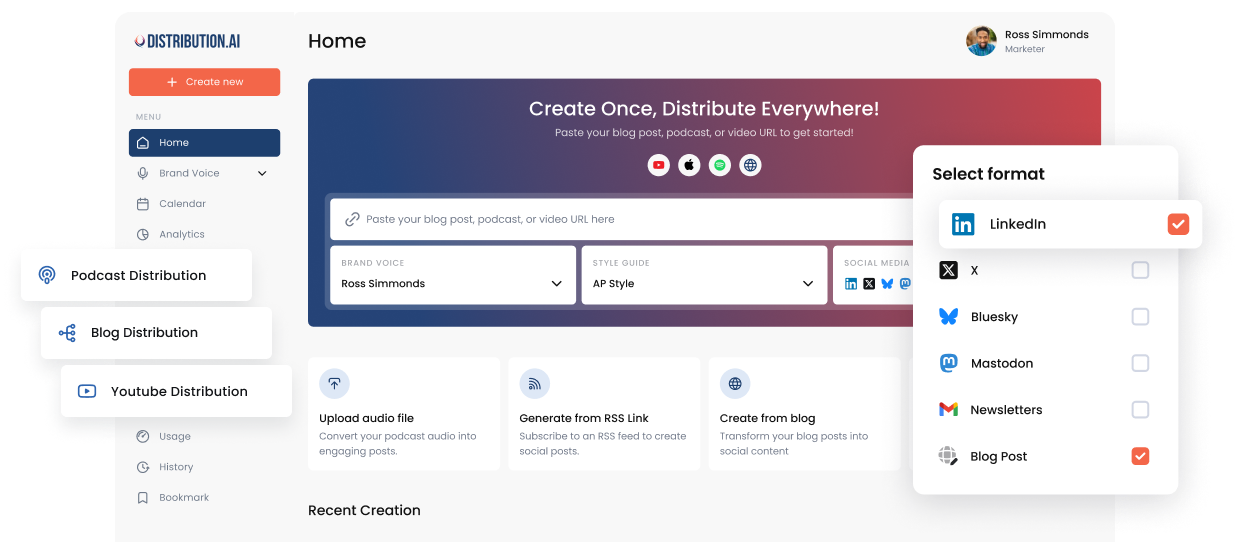
Distribution.ai is an all-in-one AI-powered content distribution engine built specifically for repurposing.
You can feed its content distribution agents any long-form asset, such as blog posts, articles, whitepapers, podcasts, webinars and YouTube videos, to get multiple short-form content pieces in under a minute.
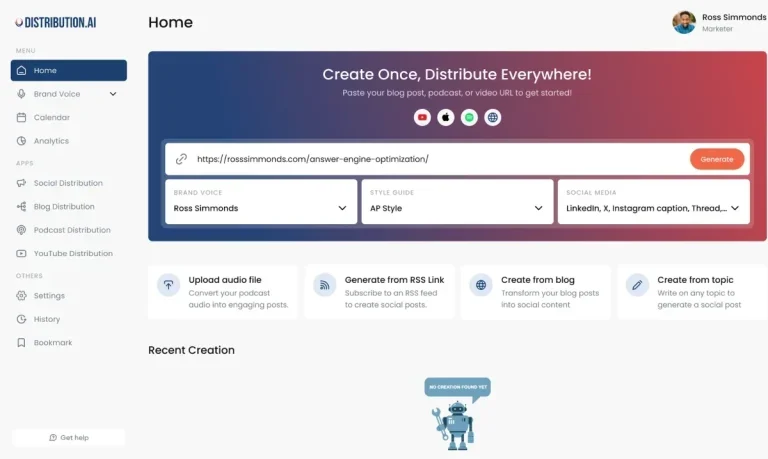
To make sure the drafts meet your standards, you can customize the tone and style to align the AI’s output with what your audience likes.
You can then immediately refine it and schedule it for publishing using the tool’s built-in scheduler.
The platform also comes with analytics features that make it easier for you to track how well your content pieces are performing across social platforms.
The intuitive interface enables you to repurpose your first long-form asset and produce a week’s worth of social media content within minutes.
B. Multimedia Repurposing Tool
You need a platform that extracts viral-worthy clips from large multimedia assets like long-form video and audio files, such as podcast episodes and webinars.
Some common options include Opus Clip, Descript and Repurpose.io. You can simply upload the source content and use these tools to find and extract viral-worthy moments for your audience.
Such tools complement your text-based repurposing workflow by handling the multimedia side of things.
The AI Content Repurposing Workflow in 2026
Now that you have all the components lined up, you can follow these four steps to repurpose your content with AI for an entire month within a day.
Step 1: Audit Your Source Content
Start by reviewing what you’ve already published by digging into your analytics dashboards, such as GA4 for website content, YouTube Analytics for video, your email platform’s reporting for newsletters and native analytics on podcasting channels.
An effective rule of thumb is to go for the content that’s outperforming the rest in terms of impressions, clicks, dwell time and conversion.
Then, make a list of your top performers and categorize them by format (blog post, video, podcast episode, etc.) and by topic. Customer interviews can also be valuable here, as they often reveal recurring pain points and insights that can be repurposed into relevant content. This gives you a clear picture of which assets have the most repurposing potential.
Step 2: Generate the First Draft with AI
To execute this step effectively, you need a customizable AI platform. If you simply pick a general-purpose AI chatbot to “do content” for you, it will only produce generic output that your audience will perceive as noise.
A better alternative is to leverage a purpose-built AI content repurposing tool, such as Distribution.ai, that lets you define your tone and style preferences upfront.
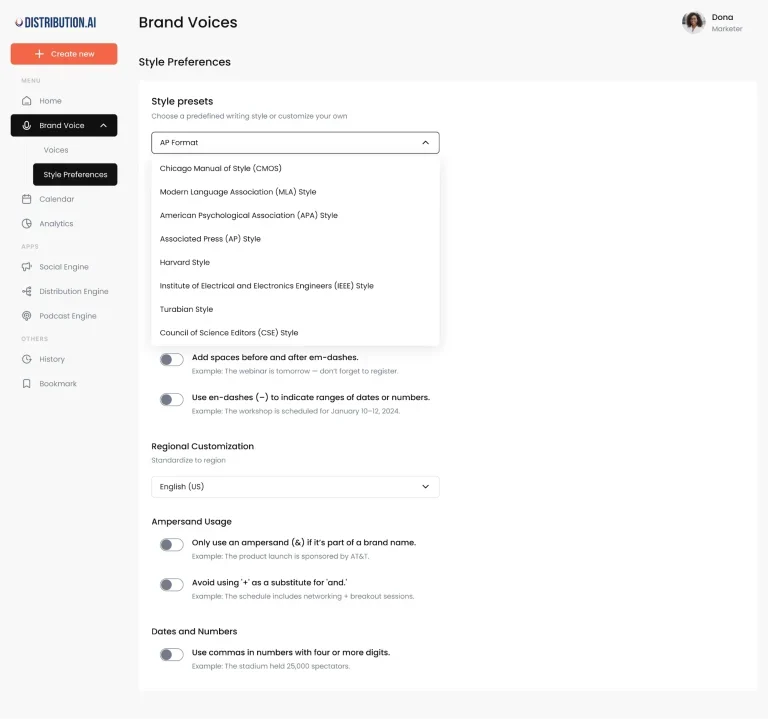
When AI has clear content writing guardrails, like your voice, formatting preferences, writing style and the distribution channel’s nuances, the first drafts come out dramatically better. Whether you’re repurposing a thought leadership article, product guide or Kling AI prompts, tailoring content to each platform improves engagement.
Basically, this adapts your content for each channel rather than producing the same canned output and blasting it everywhere.
Step 3: Refine the Posts and Schedule
Every AI-generated draft needs your editorial skills to add the things LLMs struggle with: genuine emotionality in a conversational tone that adds a personality to your brand.
Apart from that, you must check every piece for factual accuracy because AI can hallucinate details, especially around statistics and quotes.
Finally, weave your calls-to-action in organically rather than tacking them on at the end like an aggressive sales pitch.
And when you’re scheduling, be thoughtful about frequency and timing.
It is better to space out your posts evenly through the week so your content doesn’t fatigue your audience. Similarly, for timing, publish your posts at the times of day when your potential buyers are most active.
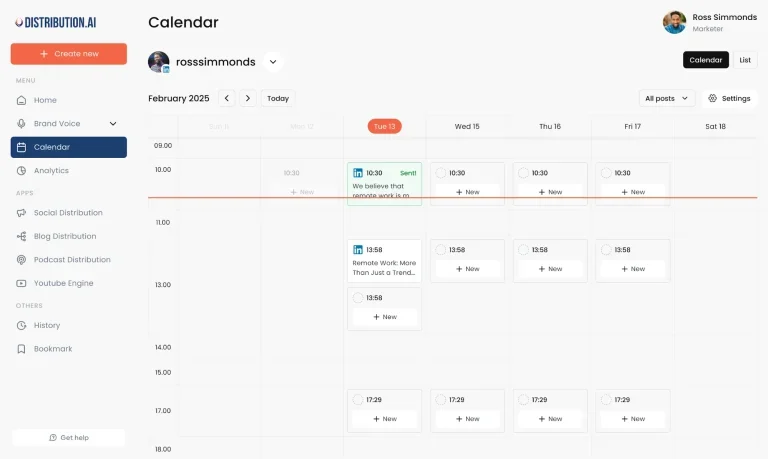
You can do both in Distribution.ai.
After you generate short-form content for social media channels, you can edit it directly on the platform.
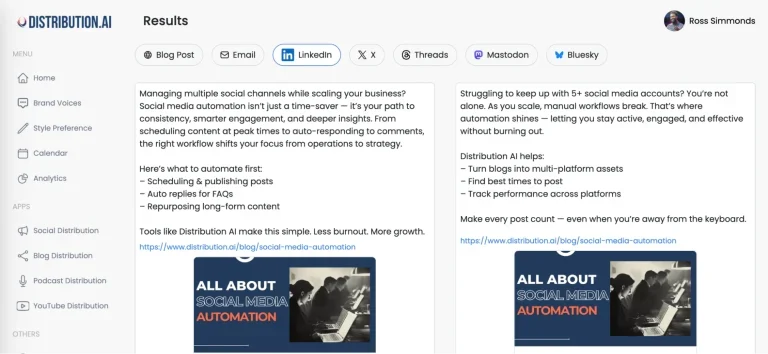
Then, when the final touches are added, you can schedule them directly to your accounts through the built-in scheduler.
Step 5: Measure Performance and Iterate
As mentioned earlier, you need to track two types of metrics to learn where you stand and continually improve your AI content repurposing workflow.
Since you already know the metrics, let’s look at how you can improve them both:
A. Improving Content Performance
The first step here is to track how your repurposed content is performing across channels. An effective way to do this is by using Distribution.ai’s unified analytics dashboard:
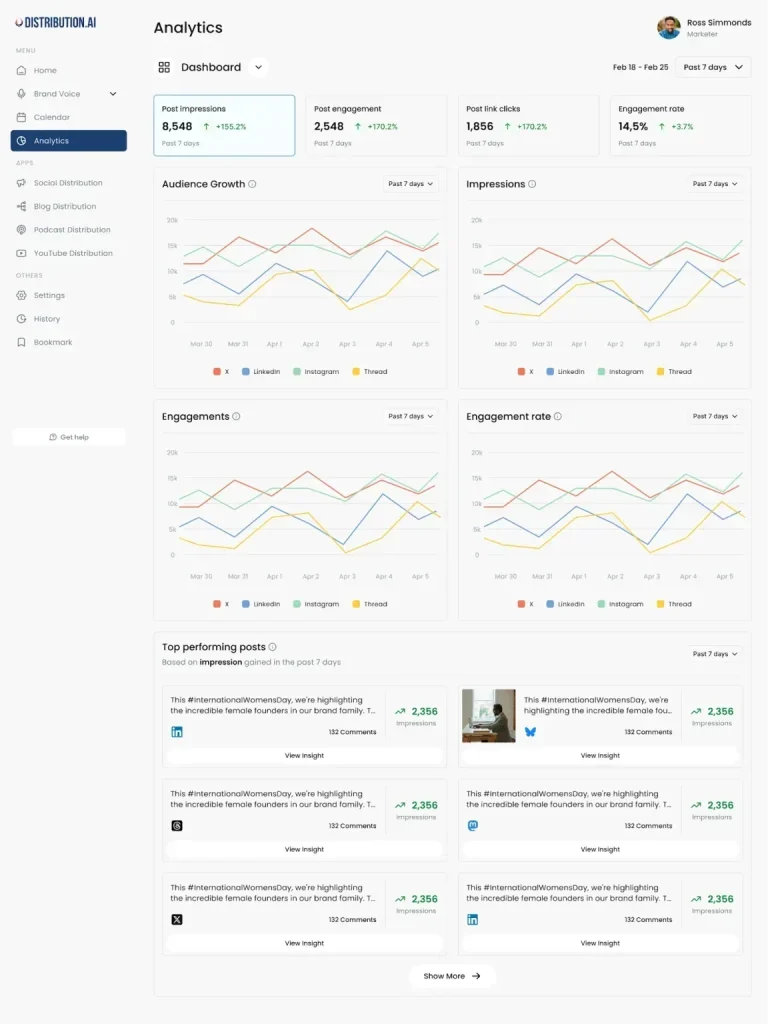
To improve the content performance metrics, you simply need to pick better long-form assets that serve as the source material for the repurposed content.
You can also experiment with different tones and styles for various social media platforms to identify what works better.
Finally, try scheduling your content at different time slots to find a better window for your audience.
B. Improving Process Efficiency
You can streamline your overall process by finding small wins. For instance, check if you can cross-post a snackable asset across platforms. You can also develop a standardized process of choosing the source content piece and using AI to produce drafts.
Common AI Content Repurposing Mistakes to Avoid
Even a solid workflow can go sideways if you fall into these common traps. Here are the oversights that most often undermine content repurposing efforts, and how to sidestep them.
1. Publishing AI Output Without Humanizing
It’s tempting to hit publish as soon as AI spits out a draft, especially when you’re under deadline pressure. But unedited AI content tends to sound flat and impersonal.
Your audience can tell, and engagement (and the rest of the KPIs) drops as a result.
Always add a human editing layer from your brand’s perspective: inject your personality and make sure the piece sounds like something your brand would actually say.
2. Repurposing Every Content Piece for Any Platform
A dense whitepaper breakdown might crush it on LinkedIn as a carousel but flop on Instagram.
When you try to force content into formats that don’t fit, the result feels awkward and forced. A better approach is to match each asset to the platforms where its format and message will naturally resonate with the audience there. It may take a bit of trial and error to know what works best where properly.
3. Ignoring Audience Intent and Platform Behavior
Each social media platform has its own culture and its own unwritten rules. What works on X (concise and opinionated) is completely different from what works on LinkedIn (professional and story-driven).
If you’re creating the same content and pasting it across every account, you’re ignoring how people actually use each platform. You need to have different formats and tone and style guidelines for each platform to maximize the ROI of your repurposing efforts.
4. Focusing on Only a Few Metrics
Metrics like impressions can have a huge numerical value, which can affect how you evaluate your own content. While impressions are important, you also need to look at other KPIs like engagement and clicks to get the full picture.
Streamline AI Content Repurposing with Distribution.ai
If your team has limited resources and tight deadlines (and frankly, who doesn’t?), you need an AI-powered workflow that helps you repurpose content at scale effortlessly.
That’s exactly what Distribution.ai is built for.
It brings together the entire workflow in one place with these capabilities:
- AI agents that repurpose long-form text and multimedia content into ready-to-publish pieces across multiple formats.
- Tone and style customization so every draft reflects your brand voice consistently, no matter the platform.
- Built-in scheduling and analytics to publish across eight channels and track performance, without switching between separate tools.
- End-to-end automation that lets you run the entire workflow on autopilot, from content ingestion to publishing.
Ready to turn your best content into a week’s social media content in 10 minutes?
Frequently Asked Questions
1. What Is AI Content Repurposing?
AI content repurposing is the process of using artificial intelligence tools to transform existing content, like blog posts, videos, or podcasts, into new formats for different platforms. AI helps you adapt content quickly without manual effort while maintaining your core message and brand voice.
2. How Is AI Content Repurposing Different from Content Automation?
Content automation typically refers to scheduling and distributing content you’ve already created. AI content repurposing goes a step further by generating new short-form variations of your content tailored for different channels and audiences.
3. Does AI Content Repurposing Hurt SEO?
Not when done right. The key is to avoid publishing duplicate content across your owned properties. Repurposed content should be meaningfully adapted for each platform rather than copied verbatim. When you create genuinely distinct pieces from the same source, you’re actually expanding your footprint and helping search engines associate your brand with relevant topics.
4. What Types of Content Are Best for Repurposing with AI?
Long-form, high-performing assets tend to work best, including detailed blog posts, webinars, podcast episodes, research reports and YouTube videos. These contain enough depth and variety of ideas to generate multiple repurposed pieces. Evergreen content is especially valuable because it stays relevant for your audience over a longer period.
5. Can AI Repurpose Blog Posts into Social Media Content?
Absolutely. A single blog post can be broken into LinkedIn posts, X threads, Instagram carousels, email newsletter segments and more. AI tools are particularly good at identifying key insights within a post and reformatting them for social channels, though you’ll still want a human eye on the final output.
6. Can AI Turn Webinars, Videos, or Podcasts into Written Content?
Yes. AI can transcribe podcast audio and video content, then restructure the transcript into blog posts, articles, social media snippets and newsletter content. The output usually needs editing for flow and readability, but the heavy lifting of extracting and organizing ideas is handled automatically.
7. How Do You Keep Repurposed Content from Sounding Generic?
Two things make the biggest difference: customizing your AI tool’s tone and style settings to match your brand identity and always running a human editing pass before publishing. Generic-sounding content happens when teams skip both of those steps. Invest a few minutes per piece in personalization and you’ll see a significant improvement.
8. How Many Pieces of Content Can You Create from One Source Asset?
It depends on the depth of the source, but a substantial long-form article or webinar can easily yield five to fifteen repurposed pieces, spanning social posts, newsletter blurbs, video scripts, infographics and more. The more key moments or pointers packed into the original, the more you can extract with just a few clicks.
9. What Is the Best AI Content Repurposing Workflow for Lean Teams?
Start with an audit of your top-performing content, identify the most repurposable talking points, generate drafts using a dedicated AI tool, refine and schedule them and then track results to improve over time. The key for lean teams is consolidating as much of that workflow as possible into a single platform to minimize context-switching and manual effort.
10. Which Metrics Should You Track for AI-Repurposed Content?
Track both content performance metrics (impressions, engagement, click-through rates, signups, lead quality) and process efficiency metrics (output per asset, publishing volume, cadence consistency, content quality over time). Together, these give you a complete picture of whether your repurposing workflow is working and where to improve.
11. When Should a Team Use a Dedicated Platform Instead of Separate Tools?
If your team is spending more time switching between tools than actually creating and distributing content, it’s time for a dedicated platform. Tool sprawl creates friction, which leads to inconsistency and wasted hours. A unified platform brings content creation, personalization, scheduling and analytics into one place, which is especially valuable when you’re managing content across multiple social media platforms.
12. Is Distribution.ai Useful for Content Repurposing?
It’s built specifically for it. Distribution.ai combines AI-powered repurposing, tone and style customization, multi-channel scheduling and performance analytics in a single platform. It’s designed for teams that want to turn long-form assets into a steady stream of repurposed content without dealing with multiple disconnected tools. You can try it free for 15 days to see how it fits your workflow.
Promote, repurpose & distribute your content with AI
Write 10x faster, engage your audience, & never struggle with the blank page again.
Start 15-Day Free Trial
Frequently Asked Questions
Author

Promote, repurpose & distribute your content with AI
Start 15-Day Free Trial