How Does the Bluesky Algorithm Work [With Growth Tactics from Real Users]
Discover how Bluesky algorithm works, how it is different from other social media channels, and the growth tactics you need to win over the platform.

Most social platforms decide what you see using one central algorithm. It predicts what might keep you scrolling and shapes what voices get amplified.
But Bluesky does the opposite. Instead of relying on a single platform to control distribution, it allows you to choose—or even build—the feeds that comprise your timeline. Your experience is shaped by your interests, your communities, and the conversations you participate in, not by perceived algorithmic manipulation.
That means, when it’s about Bluesky, the question isn’t “How do you beat the algorithm?” but “Which feeds are the best for the kind of content you want to create and the people you want to connect with?”
In this guide, we’ll break down how the Bluesky algorithm works, how the Discover feed ranks posts, why custom feeds matter, and how to grow on the platform by showing up in the right places.
How is the Bluesky Algorithm Different From Other Social Media Platforms?
Bluesky feels similar to Twitter (now X). But the core difference is in how it structures the feed. Instead of one structured feed that everyone sees, Bluesky lets users choose and build the algorithms that shape their timelines. This single design decision changes control, moderation, and distribution across the platform.
Here’s how it differs from other social media platforms:
Bluesky does not use one master algorithm
Twitter/X, LinkedIn, Facebook, and Instagram rely on a central algorithm that ranks posts based on engagement signals, prediction models, and ad goals, where users have almost no control.
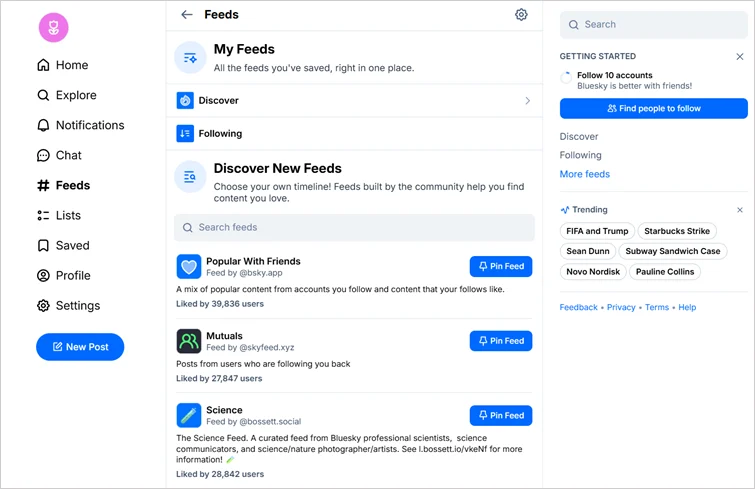
However, Bluesky eliminates the concept of a single default feed entirely. Instead, you select the feed algorithms you want to see. These are called custom feeds (or feed generators), and you can add or remove them based on needs. In short, Bluesky empowers users to use the platform the way they want.
The home timeline is made of multiple feeds
On most social media platforms, your timeline typically displays one main view, or possibly two. On Bluesky, your home feed can include:
- Following (a pure chronological feed)
- Discover (a recommendation feed)
- Custom algorithmic feeds you choose to follow
You can pin, reorder, and switch between feeds instantly. Your timeline becomes modular, and you decide what you see on the platform.
Ranking and moderation are separate systems
Most platforms have integrated ranking and moderation inside the same centralized algorithm. So, when a post suddenly gets less reach, it’s hard to tell whether it’s because the platform doesn’t consider it as relevant content or because it was flagged or filtered.
But Bluesky separates moderation from ranking. One layer of the algorithm decides what reaches the top of a feed, and you can actually choose to see content by selecting custom feeds. Another layer handles moderation—labeling, filtering, and safety controls, which you can adjust according to your requirements.
This means if your post isn’t performing well, it’s usually not because it’s being “shadowed.”
It’s more likely that the feed you’re appearing in doesn’t prioritize the style or topic you’re using. So, you can pick feeds that fit the kind of content you create.
Identity and data are portable via the AT Protocol
Bluesky is built on the AT Protocol, which includes a personal data server. This means your handle, posts, and followers are not tied to a single app. If you switch clients or use third-party services, your identity and social graph move with you. This means if a better Bluesky app comes along, you can move there and your posts, username, and followers will move automatically.
Communities and developers can shape the experience
On Bluesky, anyone can build feed topics, create clean viewing feeds, and design niche feeds for specific interests or subcultures. Instead of the platform controlling what surfaces on your feed, the network can invent the experience.
How the Bluesky Algorithm Works?
Bluesky doesn’t rely on one algorithm. People’s timelines are made up of multiple feeds, and they choose which ones to use. That means the logic behind content ranking isn’t fixed. It’s something you select.
Let’s walk through how each part works in real terms.
The Following Feed
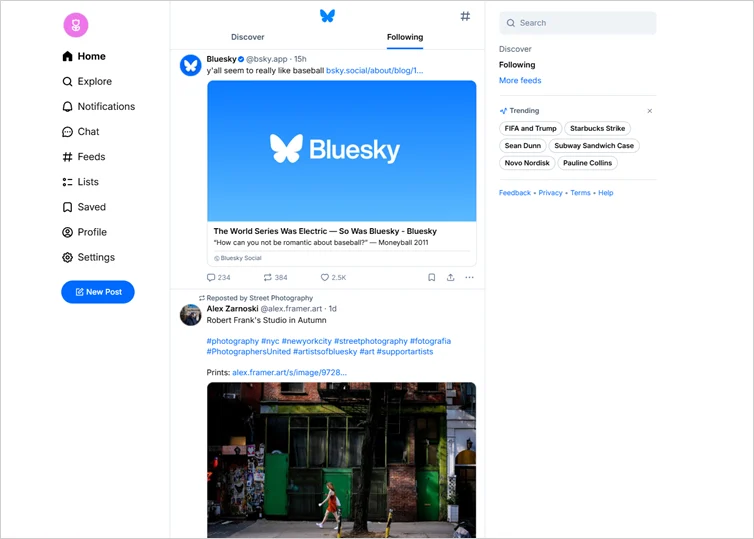
The Following feed is a simple, chronological stream of posts from the accounts you follow. There’s no ranking system deciding what deserves to be seen first. Posts show up in the order they were published. This makes timing and consistency matter more than any other factor here. If your audience is active when you post, they’ll see your content. If they aren’t, it scrolls past in time. So, it’s predictable.
The Discover Feed
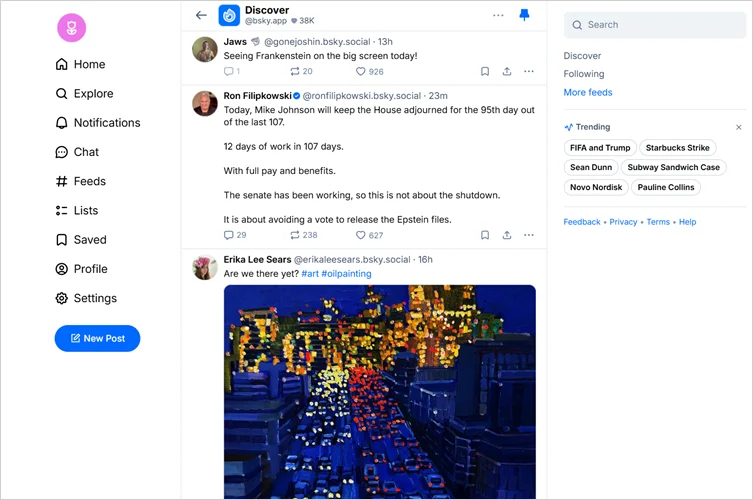
The Discover feed is where Bluesky shows posts that are gaining traction across the network. But unlike platforms like Instagram or X, it doesn’t try to predict what you personally want. It looks at conversation activity and ranks posts based on a few simple signals:
- Recent replies: Posts that spark back-and-forth discussion rise faster than posts that get passive likes.
- Quote-posts: When people respond publicly to a post, it signals that the post is worth engaging with.
- Network proximity: If people you follow (or people they follow) are interacting with a post, Discover treats that post as relevant to your social space.
- Recency: Newer posts are favored. The Discover feed constantly refreshes.
In short, Discover shows you what your network is talking about right now. For instance, if several people in your network respond to a post about AI’s role in social media, that post will likely appear in your Discover feed because there’s an active discussion happening in your social circle.
The best part is that you can change the feed if you’re interested in what Bluesky shows you based on active discussions. You can replace the feed or pin custom feeds, controlling your entire timeline.
Custom Feeds
In Bluesky, users, developers, and communities can create custom feeds that order posts based on rules they choose. These are called feed generators.
You can build a custom feed to:
- Show only standalone posts, like just text posts shown in a Twitter-like feed
- Surface posts gaining momentum in real time (trend feeds)
- Center conversation around a niche (books, design, politics, film essays, art criticism, accessibility, etc.)
- Create a more meaningful timeline by filtering out certain post types
You simply follow a feed like you follow an account. Once you pin a feed, it becomes a core part of your home timeline. So, you can tailor your own timeline.
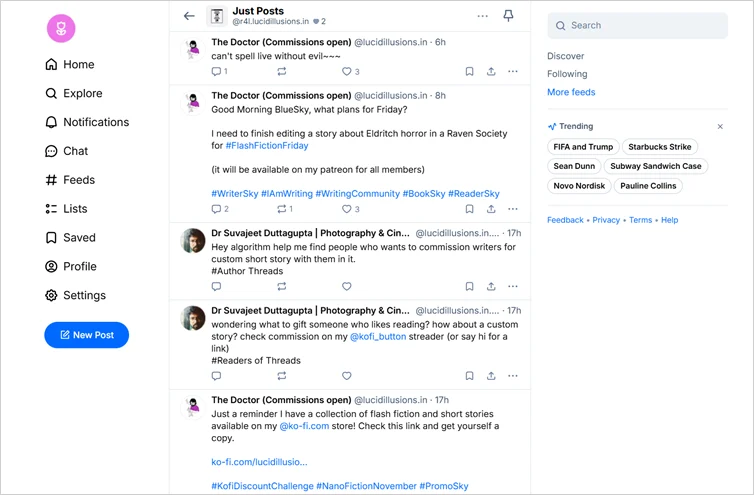
For example, if you’re interested in clean, reflective posts, you can pin popular feeds like Just Post. If you’re in movie circles, you can pin feeds related to film criticism or discussions. And if you want to stay updated on real-time cultural changes, you can pin trending feeds.
How to Grow on Bluesky Faster?
Since Bluesky doesn’t have one algorithm deciding who gets seen, your reach comes from where you participate, not just what you post. Growth here is about getting into the right social spaces and being recognized there.
Here are a few growth tactics to help you:
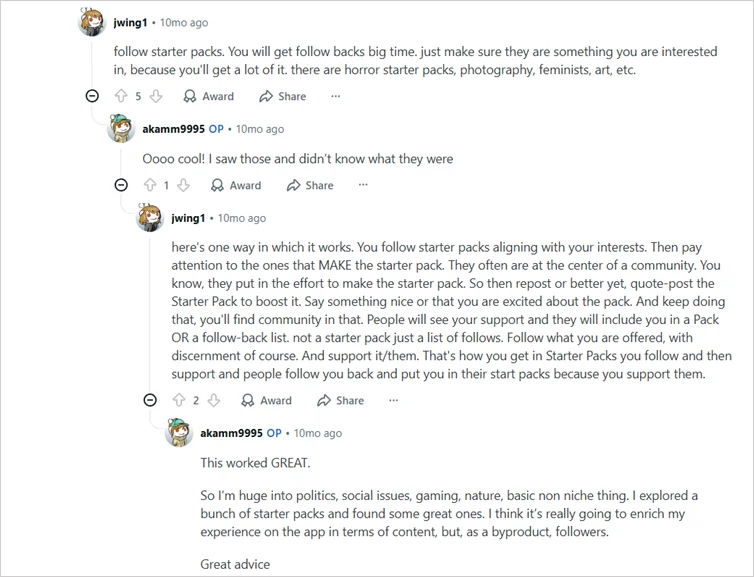
Join and participate in starter packs
Starter packs are curated account lists that help you enter an existing community cluster. They work because Bluesky’s social architecture favors network proximity over algorithmic prediction, that is, the platform surfaces posts through ongoing conversations, not opaque ranking models common in other social media platforms.
By joining a starter pack in your niche (e.g., Tech, HR, marketing), you enter a circle where people already talk to each other. When you reply thoughtfully within that circle, your name becomes familiar, which leads to follows and continued interaction.
Here’s how you can apply this growth tip:
- Search Bluesky for starter packs in your niche
- Follow people in those packs
- Reply where you actually have something to say
- Stay in that cluster consistently
Post into the feeds that match your content style
The biggest advantage of Bluesky is that it gives users more control, that is, you can choose which feeds shape your timeline. Different feed generators highlight different types of posts. For example,
- If you prefer posting clear, standalone thoughts, Just Posts custom feed is the best fit as it shows only original posts.
- For timely commentary, you can access trending or hot feeds, as these surface discussions that gain momentum.
- For deep niche interests, you can post in the topic-specific feeds, as they are best suited for detailed and in-depth content.
Participate in conversations instead of broadcast posting
Unlike algorithm-driven platforms, where consistent posting is the main strategy, Bluesky’s Discover feed and topic feeds surface replies heavily. Replies act as distribution. When you reply:
- You appear in the original poster’s feeds
- Their followers see you
- Topic feeds index your response
This is how you become visible and recognized on Bluesky. It does not happen through follower counts, but through consistent presence in discussions.
Use hashtags to join topic-based feeds
Hashtags on Bluesky not only boost your reach but also serve as a routing tool. They help your post appear inside topic-specific custom feeds where people browse by interest. So, use hashtags when:
- You’re contributing to an ongoing conversation inside a topic feed
- You want people already interested in that subject to find your post
For example, if you’re sharing a sketch or lettering practice, using #typography or #illustration makes sense if you’re in a feed for artists or designers. But tagging a general commentary post with 10 trending hashtags won’t boost your post reach, and it won’t be surfaced into the feeds where your audience actually is.
Post when your network is active
The Following feed on Bluesky is chronological, and posts appear in the order they’re published. There’s no ranking model deciding what deserves more visibility. So, timing is the key.
You can monitor your notifications cluster to see when replies, mentions, and follows tend to happen. These show when your audience is the most active. Plus, you can consider our guide on the Best Times to Post on Bluesky to find out about the platform’s active windows.
For starters, experiment with time slots. If you notice that conversations in your niche feed spike around 9–11 PM, post in this window, and you’ll show up on people’s home timeline while they’re actively scrolling. If it doesn’t work, try a different time slot.
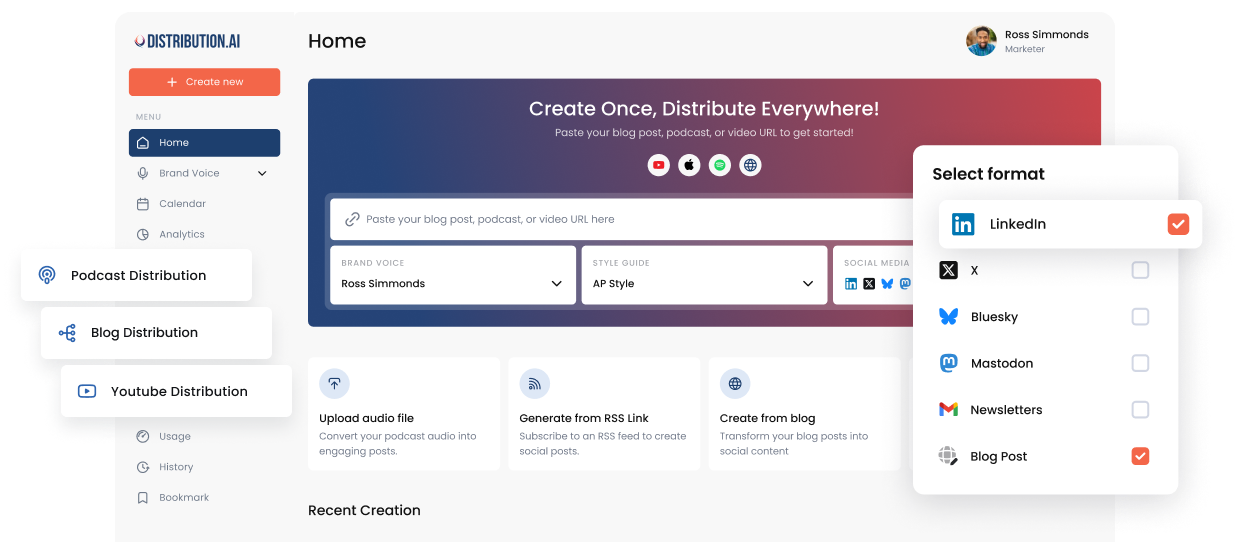
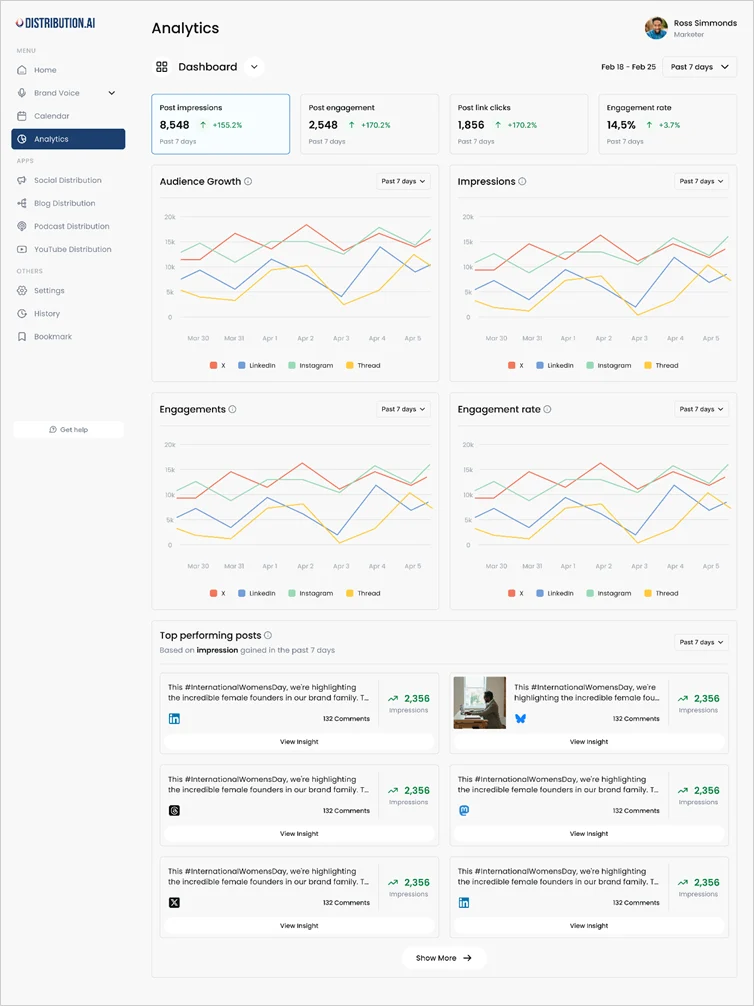
Distribution AI lets you track Bluesky metrics on a single dashboard. You can track engagement rates, clickthrough, top-performing posts, and more to identify your peak activity windows and change your post timings accordingly.
Follow people and feeds that match your interests

Most Bluesky users follow people and feeds and align with their interests because your home feed is shaped by the feeds and accounts you follow. And that affects what you see, how you participate, and what conversations you naturally join.
Since replies are the primary visibility mechanism on this platform, what you see influences what you respond to, and what you respond to shapes how others learn to recognize you.
If you follow too broadly, your feed fills with unrelated conversations. This results in making your platform presence feel inconsistent and harder for others to remember. Growth slows because your interests and identity are unclear.
So, make sure you:
- Follow people who speak in the tone you want to share
- Follow custom feeds that match your interests and posting style
- Unfollow accounts or feeds that pull you into conversations you don’t care about
How Distribution AI Can Help You Grow on Bluesky?
No matter how many growth tactics you implement, if your content isn’t strong, building a presence on Bluesky can be challenging.
This is where you need Distribution AI to help you generate posts that perfectly align with your voice and the platform format.

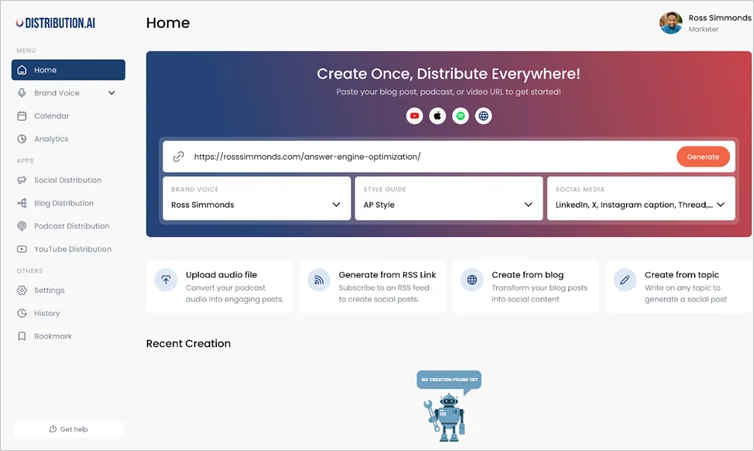
You can use Distribution AI to repurpose your content assets—blogs, podcasts, videos—to create multiple Bluesky posts. You can create infographics, text posts with captions and hooks, A/B test different versions to identify the one that performs the best. You can also schedule and auto-publish these posts at optimal times.
Here’s how Distribution AI can help:
- Content repurposing: Convert blogs, podcasts, or videos into various platform-ready posts automatically.
- Scheduling & distribution: Auto-publish your content across major social media channels, including Bluesky, at optimal times.
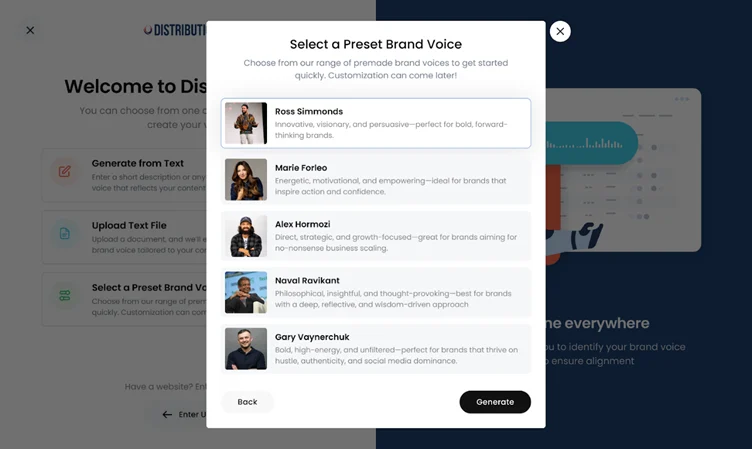
- Brand voice alignment: Set your voice and tone so the tool can generate publish-ready posts.
- A/B testing: Test multiple post variations to identify the highest-performing formats.
- Analytics: Track social media analytics such as engagement rates, clickthrough rate, top-performing posts, and more to refine your content strategy.
Ready To Post on Bluesky?
Bluesky has a different social media architecture. It’s built around user empowerment, open standards, and community-driven discovery instead of one company controlling your timeline. When you understand how customizable feeds work, growth becomes less about chasing viral trends and more about joining the right conversations.
In Bluesky, you don’t need to beat the algorithm. You need to choose the feeds that fit your voice, show up consistently, and participate where your audience is already active. And if you want to scale your presence without burning time, Distribution AI helps you repurpose, schedule, publish, and analyze Bluesky posts — all in one place.
So, plan your Bluesky strategy now and let Distribution AI handle the execution.
Frequently Asked Questions
Does Bluesky use algorithms?
Yes — but not a single, central one. Unlike major platforms, Bluesky doesn’t decide what you should see based on engagement predictions. Instead, it offers a marketplace of algorithms (called custom feeds or feed generators) that you can choose from. This eliminates the feeling of perceived algorithmic manipulation, because you decide which algorithm shapes your timeline.
How does the Bluesky algorithm work?
Bluesky offers algorithmic choice. It allows users to choose their feeds. The platform, unlike other social apps, uses separate systems for ranking and moderation. Your timeline is composed of custom feeds, the Discover feed, and your Following feed. Each one uses different logic, and you choose which ones shape what you see.
How to get posts noticed on Bluesky?
To get your post notices on Bluesky, post in feeds where your content style fits, reply to conversations (replies act as distribution), and post when your network is active. Bluesky promotes engagement through conversation, not performance metrics.
Can anyone build or modify an algorithm on Bluesky?
Yes. Because Bluesky is built on the AT Protocol, developers and communities can create algorithmic feeds using open APIs. You can create custom algorithms or choose feeds built by others from the multiple feed options.
Are there privacy or data controls?
Yes. Your handle, posts, and relationships live on your personal data server, not inside a single company system. You can move your identity between third-party apps without losing your account.
How does Bluesky separate moderation from ranking?
Moderation happens at a different layer than feed ranking. You can use built-in moderation tools or add third-party moderation services. This separation reduces perceived algorithmic manipulation.
How to “train” the Bluesky algorithm?
Selecting feeds on Bluesky is the training. When you choose the feeds, the platform gets trained. The platform doesn’t optimize based on hidden behavior tracking like major platforms.
Is there a more personalized algorithm I can use?
Yes, you can choose customizable feeds that match your interests — e.g., news-first feeds, art-only feeds, cat photos feeds, serious discussion feeds, etc. Bluesky lets users shape their own experience.
Is Bluesky easy to grow on?
In Bluesky, growth is slower than other social apps but more meaningful. People follow accounts based on recognizable voices, instead of viral spikes. Early adopters or new users say growth feels more relational and less performative.
Does AI scrape Bluesky?
Bluesky content is publicly accessible unless accounts are private. Some third-party tools scrape public posts for trending topics or analytics, the same way they do on other platforms.
Promote, repurpose & distribute your content with AI
Write 10x faster, engage your audience, & never struggle with the blank page again.
Start 15-Day Free Trial
Frequently Asked Questions
Author

Promote, repurpose & distribute your content with AI
Start 15-Day Free Trial