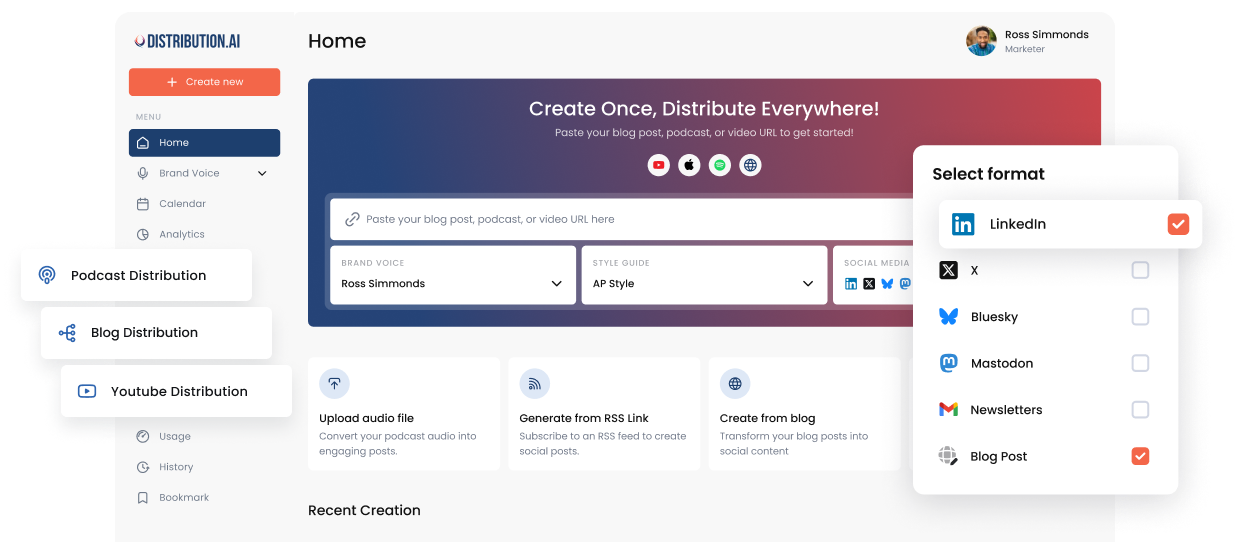
How to build a video repurposing business with AI in 2026
A practical guide to starting a video repurposing business with AI, covering your niche, workflow, pricing, and the tools that make it profitable.
One person with the right AI tools can now do what used to need a small production team.
That has opened up a real way to make money. Taking the long videos companies already record and turning them into the short clips and posts every platform runs on.
You do not need a studio or an editing background to help them, and you do not need to build any AI yourself. What it takes is knowing the tools well enough to run a dependable process around them, and finding the people who will pay for the result.
Here is how to build that business, the clients worth going after, the workflow that keeps it profitable, and the honest limits of what AI can and cannot do.
Why AI made video repurposing a business worth starting?
A company spends real money producing a webinar or a podcast, publishes it once, and watches it collect a few hundred views before it disappears into a folder.
Inside that one recording are a dozen short clips that could have run across their feeds for a month. They never get made, because nobody has the hours to cut them.
For years that was nobody’s business to fix, because turning one video into twenty platform-ready pieces meant an editor and a full afternoon.
Now it takes one person and a few tools. That single change turned a chore into a service you can sell.
Now, the demand is already there so you are walking into a market that already exists, rather than building one from scratch.
- 91% of businesses now use video as a marketing tool, near an all-time high
- Marketers rank short-form clips as the highest-ROI content format they use
- Every platform wants its own format, so one idea becomes a Reel, a Short, a TikTok, and a LinkedIn clip
The old bottleneck was labour. Finding the good moments, cutting them, captioning, resizing each clip for its platform, that was hours of skilled work per video.
AI handles that now, so you do not need an editing background, a studio, or a team to produce clean output. One person can handle the volume that recently took several.
That is what makes the unglamorous nature of the work an advantage. Businesses will gladly hand off slicing a webinar into clips and captioning them, because it eats time they would rather spend elsewhere.
Do it reliably and at volume, and you have something worth charging for.
The types of clients who need video repurposing
The people who need this fall into a few clear groups, and they do not all want the same thing or pay the same rates.
The ones worth chasing early are already producing long-form video on a schedule, so they have raw material piling up and a real reason to want more from it.
1. Podcasters

They record hours of audio and video every week and need clips to promote each episode.
The work is high in volume and steady, which makes them reliable recurring clients once you prove you can keep up.
2. Coaches and creators
They sit on courses, webinars, and talks, and lean on short video to pull in new audiences.
Speed and consistency matter more to them than polish, and they tend to count every dollar, so price accordingly.
3. B2B marketing teams
Their webinars and product talks are ideal material for LinkedIn, but the in-house team rarely has time to cut them.
Budgets are bigger here and they value a dependable turnaround over the lowest rate, though the sale takes longer to close.
4. Event and conference organisers

Every event leaves them with hours of footage and a narrow window to use it while the topic is still warm.
The work is bursty rather than steady, but a single event can be a sizable one-off project.
Choosing a video repurposing niche you can own
A niche is what lets you charge a real rate, because you stop being a pair of hands and become the person who solves one specific problem well. There are two ways to narrow, and the strongest operators use both.
1. Narrow by who you serve
Committing to one client type shapes everything, your pricing, your pitch, the way you package the work. Podcast clipping alone has become a defined category with its own going rates.
Retainers for podcast repurposing commonly run between $1,500 and $5,000 a month for a steady stream of clips and social assets, with full-service programs climbing past $7,500 for higher volume.
A service built specifically for podcasters, one that understands their release schedule and packages itself around episodes, sells far more easily than a generalist pitching everyone.
2. Narrow by what you deliver
You can also niche on the output. Some operators only produce vertical clips for Reels, Shorts, and TikTok. Others own LinkedIn video for B2B, or highlight reels for event organisers.
A tight deliverable is easier to price and faster to get good at, because you run the same play repeatedly instead of rebuilding it per client. It also sets your pricing model.
The market has settled into three: a monthly retainer for a fixed clip volume, a per-clip rate with no floor, and a one-time campaign price tied to a view target. Each suits a different client, and picking the wrong one is a common early mistake.
3. Match the model to the client
A B2B show shipping an episode a week wants a retainer, so the backlog never builds. A founder testing a new show for six weeks wants per-clip, so the spend tracks actual output.
A brand launching a product wants a campaign, so a burst of views lands inside a three-week window.
The niche worth committing to is where steady demand, real budget, and the way you like to work all line up. Once you find that overlap, the rest of the business gets easier to build.
Building a repurposing workflow that runs without a team
The business only works if the process does. A client hands you an hour of raw video, and you need finished, platform-ready clips out the other side without it swallowing your week.
A few things about how this runs are worth knowing before you price a single job.
1. Know your yield before you quote
One hour of source video does not become one hour of clips.
A 50-minute conversation realistically holds around 15 to 16 clips worth posting, and a chunk of any recording is throat-clearing, tangents, and dead air you will cut.
This ratio is the single most useful number in the business, because it tells you what a client’s footage is actually worth and stops you from over-promising forty clips from material that holds fifteen.
Learn your own yield for a given format, and quoting becomes easier.
2. Let the tool find the moments, then overrule it
Modern tools do more than cut, they score clips, ranking which moments are likely to perform and drafting titles and captions for each.
Scoring saves a good amount of time, and it is also where your judgment earns its keep, because the algorithm regularly rates a clip highly that a human can see, lacks context, or skips a quieter moment that would land with the client’s audience.
The tool gets you a first pass. You are the editor who decides what ships.
3. Post the clips before the full episode
Here is a move clients rarely think of. Releasing a few clips ahead of the full episode seeds interest and pulls viewers in before the main piece drops, rather than treating clips as an afterthought once the episode is already old.
Building that sequencing into what you deliver is strategy, not just editing, and it is the kind of thing that makes a client keep you.
4. The tooling that makes solo volume possible
Running this for several clients at once is where the right software decides whether you can scale.
Distribution.ai fits a video-repurposing operation in a few specific ways. Point it at a client’s YouTube video and it cuts the strongest moments into Shorts and publishes them to their channel.
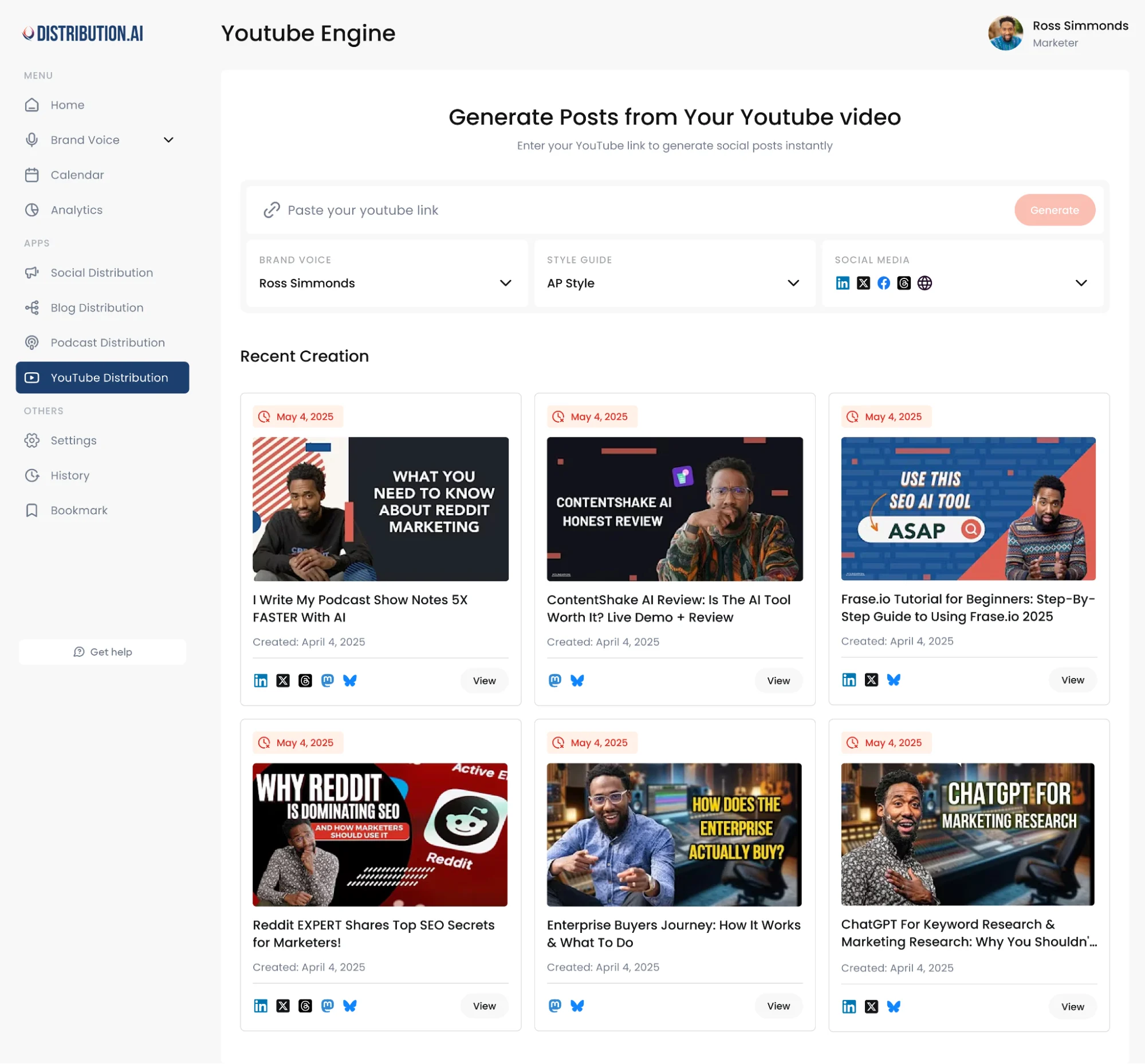
Feed it a video, podcast, or blog and it generates channel-ready posts in the client’s brand voice, with native video attached where it helps.
Its Autopilot can draft new posts automatically whenever a client publishes, and scheduling, approval, and analytics live in the same place. For one person, that consolidation is what turns a fourth or fifth client from impossible into manageable.
How to price your video repurposing services
Pricing is where new operators lose the most, usually by charging for their hours instead of the result.
To a client, the value is simple. Their webinar has become twenty pieces of content pulling in an audience, and that is what the money buys. Price the outcome, and the speed AI gives you turns into your margin.
The three models, and who each suits
The market has settled into three ways to charge, and the right one depends on the client.
- Retainer. A fixed monthly fee for a set volume of clips. It suits clients producing on a schedule, a weekly podcast or a regular webinar, who want the backlog handled for them. This is the model that builds steady income.
- Per-clip. A flat rate for each deliverable, billed as you go. It suits clients testing the waters or running irregularly, where the spend should track actual output.
- Campaign. A one-time price tied to a launch or an event, often against a view or reach target. It suits a product push or a conference, where a burst of content lands in a tight window.
Match the model to the client, and the relationship runs smoothly.
A weekly show fits a retainer, a one-off event fits a campaign, and pairing them right from the start saves a lot of awkward renegotiation later.
What the market actually pays
Real rates give you a floor to price against. Podcast repurposing retainers commonly run between $1,500 and $5,000 a month for a steady stream of clips and social assets, and full-service programs that add strategy and distribution climb past $7,500.
Clip-only packages sit lower; premium branded work sits higher. Where you land comes down to volume, turnaround, and how much judgment you bring beyond the raw output.
Charge more by owning more of the outcome
The operators charging at the top of these ranges tend to own more of what the client actually wants.
They choose the strongest moments, write the captions that perform, sequence the release, and report on what worked.
Each layer of judgment you add carries you from a commodity clipper competing on price toward a partner the client wants to keep.
That gap is what separates a $500 package from a $5,000 one built on similar raw work.
How to find your first video repurposing clients
The way through is to stop hunting for people who want a repurposing service and go straight to people already sitting on unused video.
They have the problem whether they have named it or not. A handful of tactics that actually work early on:
1. Lead with free sample clips
Pick a business already publishing long-form video, cut two or three clips from something they posted, and send them over unprompted. Showing the result beats describing it, and it makes a month of your work easy to picture.
2. Time the pitch to their publish day
Reach out right after they drop an episode, when promotion is already on their mind. A clip cut from that exact episode, in their inbox the same day, is hard to ignore.
3. Mine the backlog for proof
A weekly podcaster has a year of episodes nobody clipped. Pull a great moment from an old one and show them the reach they walked past. Old content is a free demo pool.
4. Turn the first client into three
Ask your first happy client for a testimonial, permission to use the clips as samples, and two names of people who also make video. Referral moves faster than cold outreach in a niche.
5. Post before-and-afters publicly
One raw source beside the clips you pulled from it shows the transformation no pitch can. Do it where your niche gathers and the proof compounds.
6. Target the tools, not just the people
Search for who is using Riverside, StreamYard, or a podcast host, since those users are already producing video and feeling the backlog. The tool they use tells you they have the raw material.
7. Offer a paid trial clip pack
For a hesitant lead, a small one-off pack at a low rate beats a free-versus-full-retainer leap. It gets money on the table and proves the workflow before they commit monthly.
Handling content rights and AI disclosure
This part is dull and it protects your business, so nail it with your first client. You are working with video you do not own, and a few habits keep you safe.
- Get permission in writing. The client owns the source video, so put a short usage-rights line in your agreement covering your right to cut, edit, and publish from it. It earns its keep the day a clip blows up and ownership suddenly matters.
- Check what is buried in the footage. A client owns their webinar, but the background music, a stock clip in a slide, or a guest on the episode can carry separate rights. Flag it and agree who clears it.
- Be upfront about AI. Disclosure opinions split hard and there is no settled rule yet, so keep it simple and tell the client how the work gets made. One who knows your process is never blindsided.
- Check the output before it ships. AI will occasionally put words in a client’s mouth they would never use. Treat brand accuracy as your job and review anything the tool wrote before it goes out under their name.
Start your video repurposing business this week
Reading about this business is easy. The people who build one are the ones who take a first small step while the idea is fresh, so here is where to start.
Pick one niche from the client types earlier and commit to it for now. Then find a single business in that niche already publishing long-form video, take one of their recent pieces, and cut two or three clips from it. That sample is your first pitch, your first portfolio piece, and your proof the workflow runs, all at once.
To make that first sample fast, you need a tool that does the heavy cutting for you.
Distribution.ai takes a client’s video and turns it into short clips and channel-ready posts, so you can produce a sample in an afternoon rather than a weekend, and run several clients once the work starts coming in.
Promote, repurpose & distribute your content with AI
Write 10x faster, engage your audience, & never struggle with the blank page again.
Start 15-Day Free Trial
Frequently Asked Questions
Author

Promote, repurpose & distribute your content with AI
Start 15-Day Free Trial