X Knows When You Paste Your Replies [Breaking News]
Most people draft their best X replies somewhere other than X. A notes app. A Google Doc. A chat window with an AI model. Then they copy, paste and hit reply. X can see that. The platform’s open-source recommendation code tracks whether a reply was pasted or typed in the app. That signal gets fed […]
 By

Most people draft their best X replies somewhere other than X.
A notes app. A Google Doc. A chat window with an AI model. Then they copy, paste and hit reply.
X can see that.
The platform’s open-source recommendation code tracks whether a reply was pasted or typed in the app. That signal gets fed to the AI models that score replies under larger accounts. And once a reply gets scored down, it stays down.
I’ve spent more than a decade telling anyone who’ll listen that distribution rules everything around me.
Replies are one of the most underrated distribution channels on X.
So when X starts grading how a reply was written, I pay attention… and you should too.

What The Code Actually Shows Us
X publishes big chunks of its ranking and filtering systems on GitHub at github.com/xai-org/x-algorithm. Inside the reply-handling flows, mostly under grox/flows/reply_spam, the client tracks a flag called is_pasted.
That flag goes to the AI scorers (Grok and Gemma variants, depending on account size) as one of a set of extra signals. Independent breakdowns of the code show the model sees lines like these:
- Reply was pasted: true or false
- Replies sent in the last 24 hours
- Blocks received recently
- Follower count
- Account risk labels
The scorers give each reply a score from 0 to 3. This mostly happens under accounts with large followings, with thresholds commonly cited somewhere between 125K and 250K followers. A score of exactly 0 can trigger a label called RiskyHighVizReply. That label is tied to reduced visibility, most clearly in notifications to non-followers and possibly in thread ranking.
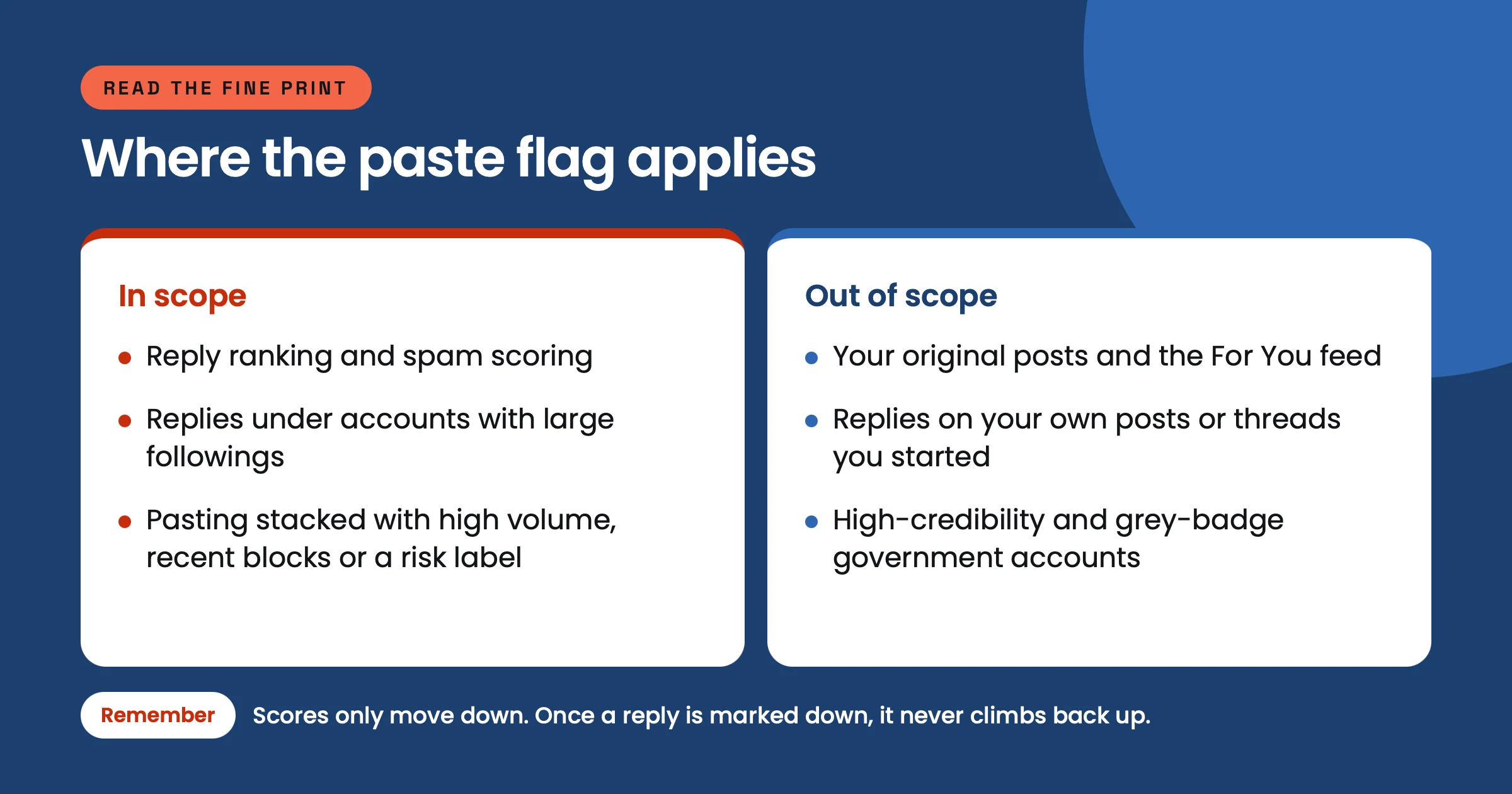
A score only gets written when it’s lower than the one before it. Once a reply is marked down, it never climbs back up…
Limitations Of The Pasting Function
Before you swear off drafting forever, read the fine print.
This applies to reply ranking and spam scoring. Your original posts and the main For You feed, which runs on the Phoenix transformer, sit outside its scope.
Pasting is one signal among several. Heavy reply volume, recent blocks or an existing risk label can matter more. The exact weights live in private prompts that X left out of the release to make the system harder to game.
Some accounts look exempt from the lowest score, including high-credibility accounts and grey-badge government accounts. Replies on your own posts or inside threads you started are usually skipped by these scorers entirely. So the paste flag is a heuristic for possible bot or AI-generated spam. One thoughtful pasted reply won’t sink you on its own.
Reply spam under big accounts has been a mess for years.
Anyone with an API key can generate a thousand AI replies before lunch. Policing that with engagement signals alone is hard.
Paste detection is cheap. Text that lands in one block, with no keystrokes behind it, correlates with automation. Pair it with volume, blocks and account signals and you raise the cost of low-effort spam without punishing normal people for one careful reply.
I get it. I’d probably build the same thing…
But there’s a real trade-off here, and I feel it personally. We build Distribution.ai to help people get more mileage out of what they create. Serious operators draft outside the app and sharpen ideas before they ship. That process now carries a small tax on X… and the tax lands hardest on the people who take replies seriously.
Native behavior wins. That’s been true on every platform I’ve studied since I started treating Reddit as a B2B channel in 2018. Platforms reward people who act like users, and they get better every year at spotting everyone else.
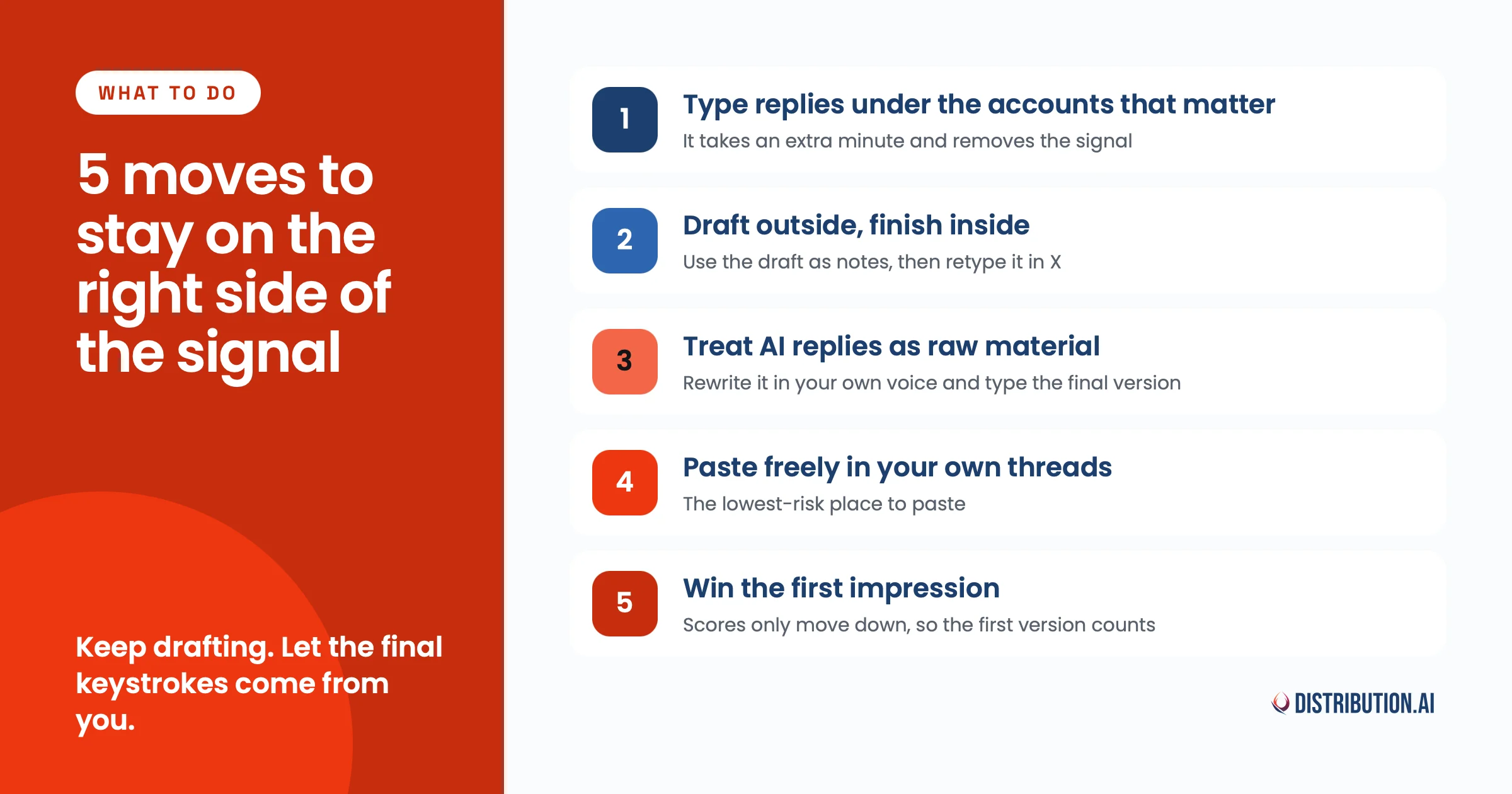
Here’s exactly where I’d put my energy if replies are part of how you grow on X, five moves keep you on the right side of this signal.
1. Type replies under the accounts that matter
If you’re replying under a big account because you want its audience to find you, type it in the app. It takes an extra minute and removes the signal completely. That minute is cheap insurance on a reply that can’t recover from a bad score.
2. Draft outside, finish inside
Thinking in a doc is still smart, especially for longer replies. Use the draft as notes, then retype the final version in X. The risk climbs when a paste stacks on top of other spam signals like high volume or a brand-new account.
3. Treat AI replies as raw material
Pasting an AI-written reply wholesale under a big account is the exact pattern this system was built to catch. Rewrite it in your own voice and type the final version. You’ll end up with a sharper reply anyway.
4. Paste freely in your own threads
The scorers generally skip replies on posts you wrote or threads you started. That makes your own threads the lowest-risk place to paste, and a great place to extend a post with extra context or a follow-up.
5. Win the first impression
Scores only move down. A reply that starts weak stays weak, so the first version you post is the one that counts. Post when you can stick around to engage, and make the first line earn the read.
Own The Last Mile For Pasting Replies
X is grading how replies get written, along with what they say. That’s a line in the code anyone can read today.
Keep drafting. Keep thinking in docs. Just let the final keystrokes come from you, inside the app.
Create once, distribute forever. Make sure the distribution still looks human.
The full code is public at github.com/xai-org/x-algorithm.
The reply-scoring code sits in a folder called grox, which is where to look if you want to check it yourself.
X updates the release regularly, so production weights and thresholds can shift from what’s there today.
Author

Promote, repurpose & distribute your content with AI
Start 15-Day Free Trial