How to Generate Leads Without Creating More Content
Discover why your content isn’t generating leads and how a smarter distribution framework helps marketers get more from what they’ve already published

Your team is exhausted. The content calendar keeps growing. You’re shipping blogs, case studies, whitepapers, webinars. And you’re measuring success by volume: posts published, pieces shipped, assets created.
Then you look at your lead numbers and realize something’s broken.
You’re not short on content. You’re short on reach.
The Dirty Secret Nobody Talks About
Here’s what most marketing teams miss: You don’t need more content. You need to work harder on the content you already have.
The Barbie marketing team spent more on promotion than on production. That’s not a movie studio exception—that’s how winning marketing actually works. But in B2B, we’ve inverted it. We treat distribution like it’s a bonus task. We create content first, then hope it finds an audience.
And it doesn’t.
Only 42% of B2B marketers think their content distribution efforts are actually effective. That’s not a content problem. That’s a distribution problem.
The Math That Should Scare You
Let’s say you published a solid 2,000-word blog post six months ago. It ranks for three keywords. It gets 300 organic visits a month. You gated an offer on it. Maybe 5-8 of those monthly visitors become leads.
That post is delivering about 60 leads a year. And you’ve moved on to creating the next one.
But what if you’d taken that post and:
- Carved out 5 LinkedIn posts from it
- Pulled the research into an infographic
- Turned it into an email series
- Built a Twitter/X thread from the core insight
- Syndicated it to 3-4 industry platforms
- Referenced it in client follow-ups
- Made it part of your outreach sequences
You don’t need new content. You need to distribute what you already created.
The Framework That Changes Everything: D.R.E.A.M.
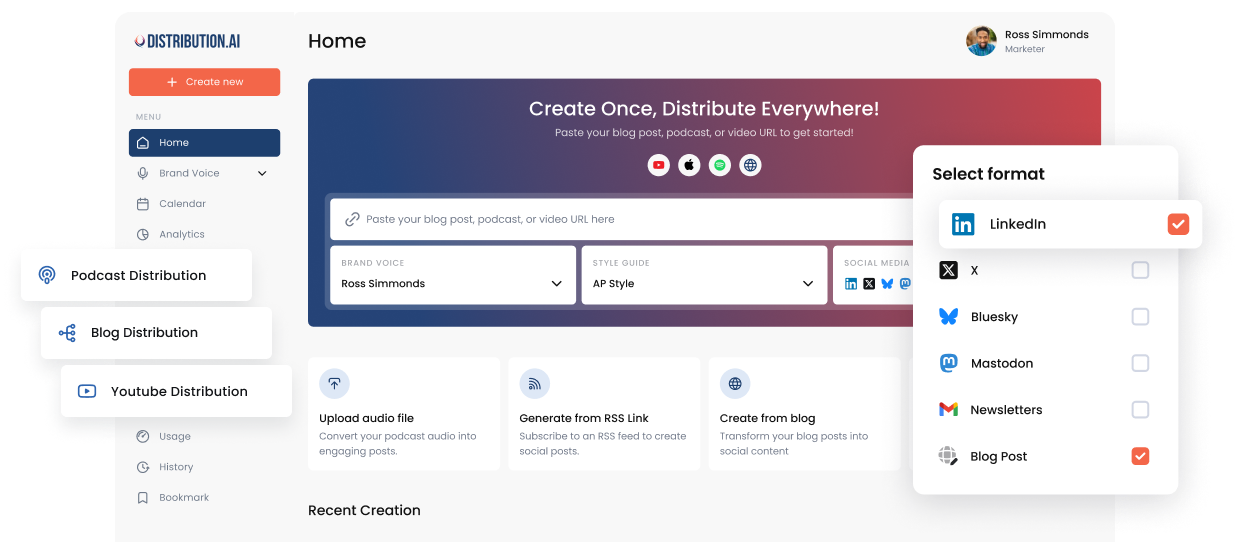
We built Foundation’s distribution philosophy around one idea: Distribution Rules Everything Around Me.
Here’s how it works:
- Discover Know what content actually exists in your archive. Most teams have 80% of the assets they need already published and forgotten. Audit everything from the last 18 months. Find the winners—the pieces that rank, convert, or resonate.
- Restructure Take one pillar piece of content and break it into formats. A case study becomes:
- A LinkedIn carousel
- An email sequence (5 parts)
- A 60-second video script
- Three tweet threads
- A sales battlecard
Same insight. Six different distribution vehicles. Six different audiences.
- Engage Put these repurposed assets in front of your audience where they already hang out. Not through owned channels only—through communities, forums, industry platforms, and direct conversations. The goal is earned attention, not shouted reach.
- Attribute Track which distribution channels actually drive leads. Not just traffic—leads. Which channels move people closer to a purchase decision? Double down on those.
- Measure Calculate the ROI on distribution. If you spent 3 hours repurposing one piece of content into 6 formats and that drove 15 new leads, you’ve just created a repeatable engine. That’s 5 leads per hour invested. Your last blog post probably took 10-15 hours and drove what… a handful of leads?
Why This Actually Works
Three reasons:
First, repetition without saturation. Your audience sees your idea multiple times, in different formats, from different angles. That’s how you build memory. LinkedIn users won’t see your Twitter threads. Twitter users aren’t reading your blogs. Email subscribers aren’t digging through archives. By distributing across channels, you reach different portions of the same audience.
Second, format preference is real. Some people consume Twitter. Some won’t touch it. Some consume video. Some hate it. Some read case studies religiously. Some skip directly to testimonials. 75% of decision-makers trust a brand more when it’s associated with industry experts or influencers. By serving the same insight in multiple formats, you’re honoring how different people actually consume information.
Third, you short-circuit the creation bottleneck. Your SMEs are busy. Your writers are drowning. Your designers have a six-week backlog. But repurposing doesn’t require all those layers. One content strategist can take a high-value blog post and spawn six distribution assets in 2-3 hours. You’re not asking experts to create new IP—you’re asking operators to package existing IP.
The Specific Moves
Here’s what actually works:
For every high-performing blog post:
- Pull the headline, deck, and three key stats into a LinkedIn post (with a link)
- Build a 5-email nurture sequence that delivers the post gradually, one section per email
- Turn the research into a customer case study or data point (if applicable)
- Create a 60-second YouTube Short or LinkedIn video reading the key insight
- Thread it into your sales process (include it in response sequences, email signatures, decks)
For every webinar:
- Clip the 5-10 most quotable moments into short video assets
- Transcribe and turn into 3-4 blog posts
- Pull speaker quotes into LinkedIn carousels
- Send the full replay to your entire email list (and segment by company/industry if possible)
- Host it on your site with a gating strategy (free for optin, plus a second gate for premium transcripts)
For every customer win or case study:
- Video testimonial snippet
- Written case study
- LinkedIn recommendation/logo placement
- Email to other prospects in that vertical
- Sales deck asset
- Customer quote library (for outreach and assets)
- Reddit/Quora response if relevant
You see the pattern. One piece of IP, six-to-ten distribution channels, dozens of lead opportunities.
What You Stop Doing
Here’s the flip side: You probably need to ship less new content.
Most teams are publishing too frequently with too little impact. They’d be better off:
- Publishing one insanely valuable asset per week (instead of three okay ones)
- Spending 50% of effort on creation, 50% on distribution (instead of 80/20)
- Measuring by lead generation and MQL-to-SQL conversion (instead of page views)
- Retiring content that doesn’t perform (instead of hoarding old posts)
If your current content calendar feels overwhelming, that’s a signal. It means you’re on a hamster wheel of creation instead of building a machine of distribution.
The Math Compounded
Let’s revisit that blog post scenario.
Old approach: 10 hours to create → 60 leads/year
New approach: 10 hours to create + 3 hours to distribute across 6 formats → 180+ leads/year
You added 3 hours of work and tripled the output.
Now multiply that across your entire archive. If you have 100 published posts, and you methodically redistribute the top 25 over the next quarter, you’re not creating more work—you’re harvesting the content you already paid for.
And your team gets to breathe.
The Timing Is Right
Here’s why this matters now:
One: AI is making repurposing fast. You can take a blog post and have Claude, ChatGPT, or a custom workflow generate 80% of your email sequence, video script, or thread. That 3-hour repurposing task is now 30 minutes.
Two: Algorithm changes have made niche distribution platforms valuable again. Reddit traffic is flowing into LLMs. Niche communities are growing. The old “post to blog and hope for Google” game doesn’t work anymore. You need to be where your audience is.
Three: Attention is fragmented. Your prospect is seeing you on LinkedIn Tuesday, Twitter Thursday, a case study on their CRO’s recommendation Saturday. The more surfaces you occupy, the more memorable you become.
Start Here
Pick your three best-performing pieces of content from the last year. (Check your analytics. Look for pieces that rank well, get traffic, or convert visitors.)
For each one, ask:
- Can this become a video? (30 seconds to 2 minutes)
- Can this become 5 LinkedIn posts? (Each one a key takeaway)
- Can this become an email sequence? (5-7 emails, one idea per)
- Can this be syndicated to industry platforms?
- Can this be a Twitter/X thread? (14-20 tweets, one thread)
Don’t overthink it. Just start repurposing.
You’ll be shocked at how many leads pour in from content you thought was already dead.
The era of “create and pray” is over. The winners in B2B aren’t the companies with the most content. They’re the companies with the smartest distribution.
You don’t need to write more. You need to spread farther.
And that changes everything.
Promote, repurpose & distribute your content with AI
Write 10x faster, engage your audience, & never struggle with the blank page again.
Start 15-Day Free Trial
Frequently Asked Questions
Author

Promote, repurpose & distribute your content with AI
Start 15-Day Free Trial